Garmin Forerunner 970
Garmin Instinct 3 Solar 50mm

Garmin Forerunner 970 Garmin Instinct 3 Solar 50mm

Overview

Welcome to our in-depth comparison of the Garmin Forerunner 970 and the Garmin Instinct 3 Solar 50mm. Both watches share a strong athletic DNA — offering GPS, heart rate monitoring, sleep tracking, and multi-sport modes — but they take very different paths when it comes to display quality, battery strategy, and smart features. Read on to see which watch best matches your training style and lifestyle priorities.

Common Features

  • Both watches feature an OLED/AMOLED display type.
  • Both watches are waterproof.
  • Neither watch has branded damage-resistant glass as a shared standard feature.
  • The watch band is replaceable on both watches.
  • Both watches support an Always-On Display.
  • Both watches have GPS built in.
  • Both watches include a heart rate monitor.
  • Both watches monitor blood oxygenation levels.
  • Both watches include a barometer.
  • Both watches have an accelerometer.
  • Both watches have a compass.
  • Both watches include a temperature sensor.
  • Both watches have a gyroscope.
  • Both watches have a route tracker.
  • Both watches track distance and measure pace.
  • Both watches support trackback mode.
  • Both watches track sleep.
  • Both watches support multi-sport mode and detect activities automatically.
  • Both watches track elevation.
  • Both watches are compatible with iOS and Android.
  • Neither watch has a cellular module.
  • Both watches support ANT+ and NFC.
  • Neither watch supports wireless charging.
  • Both watches have a rechargeable, non-removable battery.
  • Both watches include HRV tracking.
  • Both watches measure VO2 max and resting heart rate.
  • Both watches provide fast/slow heart rate notifications.
  • Both watches show a readiness level.
  • Both watches have a stopwatch, silent alarm, and phone-locating feature.
  • Both watches provide activity reports and inactivity alerts.
  • Both watches count calories burned, support goal setting, achievements, exercise diary, weight tracking, and BMI tracking.
  • Both watches have a battery level indicator and are compatible with Windows and Mac OS X.
  • Neither watch has an external memory slot or a 3.5 mm audio jack socket.

Main Differences

  • Screen size is 1.4″ on Garmin Forerunner 970 and 1.1″ on Garmin Instinct 3 Solar 50mm.
  • ATM rating is 5 ATM on Garmin Forerunner 970 and 10 ATM on Garmin Instinct 3 Solar 50mm.
  • Resolution is 454 x 454 px on Garmin Forerunner 970 and 176 x 176 px on Garmin Instinct 3 Solar 50mm.
  • Touchscreen support is present on Garmin Forerunner 970 but not available on Garmin Instinct 3 Solar 50mm.
  • Weight is 56 g on Garmin Forerunner 970 and 58 g on Garmin Instinct 3 Solar 50mm.
  • Sapphire glass display is present on Garmin Forerunner 970 but not available on Garmin Instinct 3 Solar 50mm.
  • Thickness is 12.9 mm on Garmin Forerunner 970 and 14.4 mm on Garmin Instinct 3 Solar 50mm.
  • Height is 47 mm on Garmin Forerunner 970 and 50 mm on Garmin Instinct 3 Solar 50mm.
  • Pixel density is 458.6 ppi on Garmin Forerunner 970 and 226 ppi on Garmin Instinct 3 Solar 50mm.
  • Width is 47 mm on Garmin Forerunner 970 and 50 mm on Garmin Instinct 3 Solar 50mm.
  • Band width is 22 mm on Garmin Forerunner 970 and 26 mm on Garmin Instinct 3 Solar 50mm.
  • Volume is 28.4961 cm³ on Garmin Forerunner 970 and 36 cm³ on Garmin Instinct 3 Solar 50mm.
  • A cadence sensor is present on Garmin Instinct 3 Solar 50mm but not available on Garmin Forerunner 970.
  • Wi-Fi support is present on Garmin Forerunner 970 but not available on Garmin Instinct 3 Solar 50mm.
  • Battery life is 15 days on Garmin Forerunner 970 and effectively unlimited on Garmin Instinct 3 Solar 50mm thanks to solar charging.
  • Battery life with GPS on is 26 hours on Garmin Forerunner 970 and 260 hours on Garmin Instinct 3 Solar 50mm.
  • Battery life in training mode is 14 hours on Garmin Forerunner 970 and 60 hours on Garmin Instinct 3 Solar 50mm.
  • Solar power battery charging is present on Garmin Instinct 3 Solar 50mm but not available on Garmin Forerunner 970.
  • Map uploading is supported on Garmin Forerunner 970 but not available on Garmin Instinct 3 Solar 50mm.
  • Vibrating alerts are present on Garmin Forerunner 970 but not available on Garmin Instinct 3 Solar 50mm.
  • Call control is supported on Garmin Forerunner 970 but not available on Garmin Instinct 3 Solar 50mm.
  • Internal storage is 32 GB on Garmin Forerunner 970 and 0.128 GB on Garmin Instinct 3 Solar 50mm.
  • The ability to answer calls is present on Garmin Forerunner 970 but not available on Garmin Instinct 3 Solar 50mm.
  • Voice commands are supported on Garmin Forerunner 970 but not available on Garmin Instinct 3 Solar 50mm.
Specs Comparison
Garmin Forerunner 970

Garmin Forerunner 970

Garmin Instinct 3 Solar 50mm

Garmin Instinct 3 Solar 50mm

Design:
screen size 1.4" 1.1"
Display type OLED/AMOLED OLED/AMOLED
water resistance Waterproof Waterproof
has branded damage-resistant glass
ATM rating 5 ATM 10 ATM
resolution 454 x 454 px 176 x 176 px
Watch band is replaceable
has a touch screen
weight 56 g 58 g
Has sapphire glass display
thickness 12.9 mm 14.4 mm
Always-On Display
height 47 mm 50 mm
pixel density 458.6 ppi 226 ppi
Has a display
width 47 mm 50 mm
width of band 22 mm 26 mm
volume 28.4961 cm³ 36 cm³

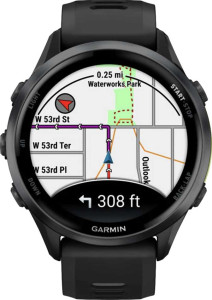
The most striking design difference between the Forerunner 970 and the Instinct 3 Solar 50mm lies in their displays. The Forerunner 970 sports a larger 1.4″ screen at a remarkable 458.6 ppi resolution (454 × 454 px), compared to the Instinct 3's 1.1″ panel at only 226 ppi (176 × 176 px). In practice, this means the Forerunner 970 renders maps, metrics, and text with significantly sharper clarity — a real advantage for data-dense training screens. The Forerunner 970 also adds a touchscreen and sapphire glass, making it both more interactive and more scratch-resistant in daily use, neither of which the Instinct 3 offers.

On physical form factor, the results are more nuanced. Despite its larger screen, the Forerunner 970 is actually slimmer (12.9 mm vs 14.4 mm) and slightly lighter (56 g vs 58 g), with a smaller footprint (47 × 47 mm vs 50 × 50 mm) and lower overall volume (28.5 cm³ vs 36 cm³). This makes the Forerunner 970 the more wrist-friendly option despite its display advantage. The Instinct 3 uses a wider 26 mm band versus the Forerunner 970's 22 mm, which contributes to its bulkier profile. Both watches share replaceable bands and Always-On Display support.

The one area where the Instinct 3 holds a clear edge is water resistance: its 10 ATM rating doubles the Forerunner 970's 5 ATM, making it more suitable for serious water activities like swimming in open water or diving. Overall though, the Forerunner 970 has a decisive design advantage for users who prioritize display quality, compactness, and premium glass protection — the Instinct 3 trades those qualities for a ruggedized, higher water-resistance profile.

Sensors:
has GPS
Has a heart rate monitor
Monitors blood oxygenation levels
Has a barometer
has an accelerometer
has a compass
Has a temperature sensor
Has a cadence sensor
has a gyroscope
Has a wind speed sensor
Monitors perspiration

Both the Forerunner 970 and the Instinct 3 Solar 50mm share a remarkably similar sensor foundation: GPS, heart rate monitoring, blood oxygen tracking, barometer, accelerometer, compass, temperature sensor, and gyroscope are all present on both devices. For the vast majority of athletes — runners, cyclists, hikers, and swimmers — this shared suite covers essentially every core biometric and environmental measurement they would need during training or outdoor navigation.

The single differentiator in this category is the cadence sensor, which is present on the Instinct 3 but absent on the Forerunner 970. A built-in cadence sensor is particularly valuable for cyclists and runners, as it measures pedal or stride rate directly from the wrist without requiring an external accessory. For users who prioritize cadence data as a core training metric, this gives the Instinct 3 a tangible practical advantage.

That said, the edge here is narrow and use-case dependent. Runners and cyclists who rely heavily on cadence metrics will appreciate the Instinct 3's inclusion, but for most other disciplines the two watches are effectively tied on sensors. Neither watch monitors perspiration or wind speed, so both have the same gaps at the edges of the sensor spectrum.

Activity tracking:
Has a route tracker
Tracks distance
Measures pace
Has trackback mode
Tracks your sleep
Has multi-sport mode
Detects activities automatically
Tracks elevation
Tracks steps taken
Provides sleep reports
Has exercise tagging
Has a stroke counter for swimming
Tracks calorie intake
Designed for diving
Designed for golf

Activity tracking is one area where the Forerunner 970 and the Instinct 3 Solar 50mm are in complete lockstep. Every single feature in this category — from route tracking and multi-sport mode to sleep reporting, automatic activity detection, and even niche capabilities like a stroke counter for swimming and golf support — is identical across both devices.

The breadth of shared tracking features is genuinely impressive on both watches. Automatic activity detection removes the friction of manually logging workouts, multi-sport mode is essential for triathletes, and the combination of calorie intake tracking with sleep reports supports a more holistic approach to recovery and performance. The fact that both watches include trackback mode is also worth noting for outdoor adventurers — it allows retracing a route back to the starting point without pre-loaded maps.

With no differentiators whatsoever in this group, activity tracking is a complete tie. Buyers choosing between these two watches can set this category aside entirely — whichever device wins on other criteria will serve them equally well as an activity tracker.

Connectivity:
Is compatible with iOS
Is compatible with Android
supports Wi-Fi
has a cellular module
supports ANT+
has NFC

Connectivity between the Forerunner 970 and the Instinct 3 Solar 50mm is largely aligned: both support iOS and Android, ANT+ for connecting external sensors like heart rate straps and power meters, and NFC for contactless payments. Neither watch includes a cellular module, so both rely on a paired smartphone for notifications and data sync when away from home.

The one meaningful distinction is Wi-Fi, which the Forerunner 970 supports and the Instinct 3 does not. In practice, Wi-Fi connectivity allows the Forerunner 970 to sync workouts, download maps, and update firmware directly over a home network — without needing a phone nearby. For users who regularly work with large data transfers like detailed course maps or software updates, this is a genuine convenience advantage.

Overall, the Forerunner 970 holds a modest but practical edge in connectivity thanks solely to its Wi-Fi support. For users who keep their phone close at hand, the gap narrows considerably — but for those who prefer a more autonomous sync experience, the Instinct 3's omission is a real limitation.

Battery:
battery life 15 days Infinity days
battery life with GPS on 26 hours 260 hours
battery life in training mode 14 hours 60 hours
has wireless charging
Has a solar power battery
has a rechargeable battery
has a removable battery

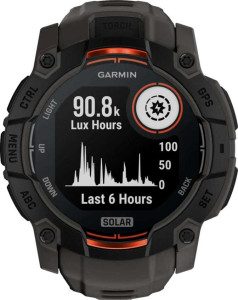
Battery life is where the gap between these two watches becomes impossible to ignore. The Forerunner 970 delivers a respectable 15 days of smartwatch use and 26 hours with GPS active — solid numbers for a feature-rich training watch. The Instinct 3 Solar 50mm, however, operates in an entirely different tier: 260 hours of GPS runtime and a listed smartwatch endurance of infinity days, courtesy of its solar charging capability. In training mode, the contrast is equally stark — 60 hours versus 14 hours.

The solar panel is the defining factor here. Under sufficient sunlight exposure, the Instinct 3 can theoretically replenish energy as fast as it consumes it, making extended expeditions, ultra-distance events, or multi-week trips viable without ever touching a charger. For the Forerunner 970, a two-week backcountry adventure or a multi-day ultramarathon would require careful power management or access to charging — constraints the Instinct 3 is designed to eliminate.

The Instinct 3 Solar 50mm wins this category decisively and by a wide margin. Neither watch supports wireless charging, but that shared limitation is largely irrelevant given the Instinct 3's solar advantage. For any user where battery anxiety is a real concern — whether on long training blocks, remote expeditions, or simply preferring less frequent charging — the Instinct 3 is in a class of its own here.

Features:
release date June 2025 January 2025
has HRV tracking
measures VO2 max
measures resting heart rate
has fast/slow heart rate notifications
shows readiness level
Can upload maps
Has vibrating alerts
Has a stopwatch
Locates your phone
Has silent alarm
has irregular heart rate warnings
has fall detection
Has notifications
Acquires GPS faster
Has call control
Provides the sunrise/sunset time
internal storage 32GB 0.128GB
Can be used to answer calls
supports Galileo
Has smart alarm
Informs about the risk of thunderstorms
has voice commands
Has a built-in camera remote control function

A strong shared feature base exists between the Forerunner 970 and the Instinct 3 Solar 50mm — both offer HRV tracking, VO2 max estimation, readiness scores, fall detection, fast GPS acquisition, and thunderstorm risk alerts. For health-conscious athletes and outdoor users, these overlapping capabilities mean neither watch leaves you fundamentally underserved on core smartwatch and wellness features.

Where the Forerunner 970 pulls significantly ahead is in its smartwatch and communication capabilities. It supports map uploads, call answering, call control, and voice commands — none of which are available on the Instinct 3. It also includes vibrating alerts, which the Instinct 3 lacks entirely, meaning the Instinct 3 relies solely on visual or audible cues for notifications. Perhaps most strikingly, the Forerunner 970 packs 32 GB of internal storage versus the Instinct 3's 0.128 GB — a difference of roughly 250x. That cavernous storage on the Forerunner 970 enables detailed map libraries, music, and extensive activity logs to live on-device, whereas the Instinct 3's storage is essentially symbolic in comparison.

The Forerunner 970 wins this category clearly and comprehensively. Users who want their watch to function as a capable smart companion — taking calls, issuing voice commands, storing maps and media — will find the Instinct 3 a significant step down. The Instinct 3 covers the athletic essentials well, but the Forerunner 970 operates at a meaningfully higher level of everyday functionality.
App & Software:
Provides activity reports
Has inactivity alerts
Counts how many calories you've burned
Has goal setting
Has achievements
Has exercise diary
Has weight tracking
Tracks BMI
Tracks water intake
Has coaching
Has temperature tracking
Has period notifications
Supports routes
Displays fertile window notifications
Includes maps
Predicts start date
Predicts ovulation
Has barcode scanner on app

App and software support is another category where the Forerunner 970 and the Instinct 3 Solar 50mm are in perfect alignment. Both deliver an unusually comprehensive suite covering not just athletic performance — activity reports, coaching, exercise diary, route support, and maps — but also broader wellness dimensions including weight and BMI tracking, water intake logging, and a full reproductive health toolkit with period notifications, fertile window alerts, and ovulation prediction.

The depth of the shared feature set here is worth emphasizing. The inclusion of reproductive health tracking alongside athletic coaching and body composition tools positions both watches as genuinely holistic wellness platforms, not just sports devices. Neither app supports a barcode scanner, which would otherwise be useful for calorie tracking via food logging — but that is the only shared gap in an otherwise expansive software offering.

With every single feature identical across both products, this category is an unambiguous tie. Software experience will not be a deciding factor between these two watches — users can expect the same app capabilities regardless of which device they choose.

Miscellaneous:
has a battery level indicator
Is compatible with Windows
Is compatible with Mac OS X
has an external memory slot
has a socket for a 3.5 mm audio jack

The miscellaneous specs for the Forerunner 970 and the Instinct 3 Solar 50mm are identical across every data point. Both are compatible with Windows and Mac OS X, both display a battery level indicator, and neither offers an external memory slot or a 3.5 mm audio jack.

The absence of a 3.5 mm jack is unsurprising for modern smartwatches of this class — wired audio has largely been replaced by Bluetooth connectivity in this category. The lack of external memory expansion is similarly typical, though it does mean users are locked into whatever internal storage each device ships with — a distinction that carries more weight given the dramatic storage difference already noted in the Features category.

There are no differentiators here whatsoever, making this category a straightforward tie. Neither watch gains or loses any ground on miscellaneous compatibility or hardware provisions.

Comparison Summary & Verdict

After examining every specification, it is clear that these two Garmin watches serve meaningfully different athletes. The Garmin Forerunner 970 stands out with its sharper 454 x 454 px AMOLED display, sapphire glass protection, touchscreen, Wi-Fi, voice commands, call control, map uploading, and a generous 32 GB of internal storage — making it the stronger choice for tech-forward athletes who want a premium, feature-rich experience. The Garmin Instinct 3 Solar 50mm, on the other hand, wins decisively on battery endurance, offering up to 260 hours of GPS runtime and virtually unlimited everyday battery life thanks to solar charging, along with a rugged 10 ATM water resistance rating and a built-in cadence sensor. If longevity in the field and durability matter most, the Instinct 3 Solar is the clear pick; if cutting-edge smart features and display quality are your priority, the Forerunner 970 delivers.

Garmin Forerunner 970
Buy Garmin Forerunner 970 if...

Buy the Garmin Forerunner 970 if you want a high-resolution touchscreen with sapphire glass, advanced smart features like voice commands and call control, Wi-Fi connectivity, and 32 GB of onboard storage for maps and music.

Garmin Instinct 3 Solar 50mm
Buy Garmin Instinct 3 Solar 50mm if...

Buy the Garmin Instinct 3 Solar 50mm if you prioritize near-unlimited battery life through solar charging, exceptional GPS endurance of up to 260 hours, a rugged 10 ATM water resistance rating, and a built-in cadence sensor for cycling.