Garmin Instinct 3 AMOLED 45mm
Garmin Instinct E 45mm

Garmin Instinct 3 AMOLED 45mm Garmin Instinct E 45mm

Overview

Welcome to our in-depth comparison of the Garmin Instinct 3 AMOLED 45mm and the Garmin Instinct E 45mm — two rugged GPS smartwatches from Garmin that share a familiar silhouette but take notably different approaches to display technology, feature depth, and battery performance. Whether you are drawn to a richer screen experience or a leaner, more essential design, this comparison breaks down exactly where these two watches align and where they diverge.

Common Features

  • Both watches are waterproof with a 10 ATM water resistance rating.
  • Neither watch features branded damage-resistant glass or sapphire glass on the display.
  • The watch band is replaceable on both models.
  • Neither model has a touchscreen.
  • Both watches have a case height of 45 mm.
  • Both models include GPS, a heart rate monitor, a barometer, an accelerometer, a compass, a gyroscope, and a temperature sensor.
  • Blood oxygenation level monitoring is available on both watches.
  • Both watches offer route tracking, distance tracking, pace measurement, step counting, elevation tracking, sleep tracking, sleep reports, and automatic activity detection.
  • Both models are compatible with iOS and Android, and support ANT+.
  • Neither watch supports Wi-Fi or has a cellular module.
  • Neither watch supports wireless charging or has a solar power battery, though both have a rechargeable, non-removable battery.
  • HRV tracking, VO2 max measurement, resting heart rate measurement, and fast/slow heart rate notifications are available on both watches.
  • Neither watch supports map uploading or vibrating alerts, but both include a stopwatch and phone-locating feature.
  • Both watches provide activity reports, inactivity alerts, calorie burn tracking, goal setting, achievements, an exercise diary, a free app, and an ad-free experience.
  • Both watches have a battery level indicator, auto pause, compatibility with external heart rate monitors, smart scales, and are compatible with Windows, Mac OS X, and PC.
  • Neither watch has an external memory slot.

Main Differences

  • Screen size is 1.2″ on the Garmin Instinct 3 AMOLED 45mm and 0.9″ on the Garmin Instinct E 45mm.
  • The display type is OLED/AMOLED on the Garmin Instinct 3 AMOLED 45mm and LCD on the Garmin Instinct E 45mm.
  • Resolution is 390 x 390 px on the Garmin Instinct 3 AMOLED 45mm and 176 x 176 px on the Garmin Instinct E 45mm.
  • Pixel density is 459 ppi on the Garmin Instinct 3 AMOLED 45mm and 276 ppi on the Garmin Instinct E 45mm.
  • Always-On Display is available on the Garmin Instinct 3 AMOLED 45mm but not on the Garmin Instinct E 45mm.
  • Weight is 53 g on the Garmin Instinct 3 AMOLED 45mm and 48 g on the Garmin Instinct E 45mm.
  • Thickness is 14.9 mm on the Garmin Instinct 3 AMOLED 45mm and 14.2 mm on the Garmin Instinct E 45mm.
  • Volume is 30.1725 cm³ on the Garmin Instinct 3 AMOLED 45mm and 28.755 cm³ on the Garmin Instinct E 45mm.
  • A cadence sensor is present on the Garmin Instinct 3 AMOLED 45mm but not on the Garmin Instinct E 45mm.
  • Trackback mode is available on the Garmin Instinct 3 AMOLED 45mm but not on the Garmin Instinct E 45mm.
  • Multi-sport mode is supported on the Garmin Instinct 3 AMOLED 45mm but not on the Garmin Instinct E 45mm.
  • Golf features are included on the Garmin Instinct 3 AMOLED 45mm but not on the Garmin Instinct E 45mm.
  • NFC is available on the Garmin Instinct 3 AMOLED 45mm but not on the Garmin Instinct E 45mm.
  • Battery life is 18 days on the Garmin Instinct 3 AMOLED 45mm and 16 days on the Garmin Instinct E 45mm.
  • Battery life with GPS on is 32 hours on the Garmin Instinct 3 AMOLED 45mm and 24 hours on the Garmin Instinct E 45mm.
  • Battery life in training mode is 23 hours on the Garmin Instinct 3 AMOLED 45mm and 16 hours on the Garmin Instinct E 45mm.
  • Internal storage is 4 GB on the Garmin Instinct 3 AMOLED 45mm and 0.128 GB on the Garmin Instinct E 45mm.
  • Readiness level tracking and fall detection are available on the Garmin Instinct 3 AMOLED 45mm but not on the Garmin Instinct E 45mm.
  • Coaching, period notifications, fertile window notifications, start date prediction, and ovulation prediction are present on the Garmin Instinct 3 AMOLED 45mm but not on the Garmin Instinct E 45mm.
Specs Comparison
Garmin Instinct 3 AMOLED 45mm

Garmin Instinct 3 AMOLED 45mm

Garmin Instinct E 45mm

Garmin Instinct E 45mm

Design:
screen size 1.2" 0.9"
Display type OLED/AMOLED LCD
water resistance Waterproof Waterproof
has branded damage-resistant glass
ATM rating 10 ATM 10 ATM
resolution 390 x 390 px 176 x 176 px
Watch band is replaceable
has a touch screen
weight 53 g 48 g
Has sapphire glass display
thickness 14.9 mm 14.2 mm
Always-On Display
height 45 mm 45 mm
pixel density 459 ppi 276 ppi
Has a display
width 45 mm 45 mm
width of band 22 mm 22 mm
volume 30.1725 cm³ 28.755 cm³

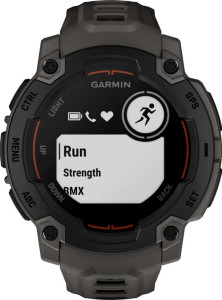
Both watches share the same 45mm height and width, a 22mm replaceable band, and identical 10 ATM water resistance, so the physical footprint on the wrist is comparable. Where they diverge significantly is in display technology and visual quality. The Instinct 3 AMOLED uses an OLED/AMOLED panel with a 1.2″ screen at 390 x 390 px and 459 ppi, while the Instinct E relies on a LCD panel measuring just 0.9″ at 176 x 176 px and 276 ppi. In practice, this means the Instinct 3 AMOLED renders sharper text, richer colors, and deeper contrast — qualities that matter for map readability, data glances during activity, and general day-to-day legibility.

A particularly meaningful differentiator is the Always-On Display feature, present on the Instinct 3 AMOLED but absent on the Instinct E. On an AMOLED panel, always-on mode is power-efficient because only lit pixels consume energy, allowing the watch face to remain visible at a glance without a wrist raise. The Instinct E, with its LCD, requires the display to be fully activated to show content, which is a functional step down for users who want constant time visibility. The Instinct 3 AMOLED is also slightly heavier at 53g versus 48g, and marginally thicker at 14.9mm versus 14.2mm — differences that are real but unlikely to be felt in daily wear.

The Instinct 3 AMOLED has a clear design edge in display quality and usability. The jump from 276 ppi to 459 ppi and from a 0.9″ LCD to a 1.2″ AMOLED with always-on capability represents a meaningful upgrade in how information is presented and consumed. The Instinct E trades visual richness for a marginally slimmer, lighter build, which may appeal to users prioritizing discretion over display performance, but on display-centric design criteria, the Instinct 3 AMOLED leads decisively.

Sensors:
has GPS
Has a heart rate monitor
Monitors blood oxygenation levels
Has a barometer
has an accelerometer
has a compass
Has a temperature sensor
Has a cadence sensor
has a gyroscope
Has a wind speed sensor
Monitors perspiration

The sensor suites of these two watches are nearly identical across the board. Both carry GPS, a heart rate monitor, blood oxygenation (SpO2) monitoring, a barometer, an accelerometer, a compass, a temperature sensor, and a gyroscope — a comprehensive set that covers navigation, environmental awareness, and core biometric tracking for the vast majority of outdoor and fitness use cases.

The only differentiator in this group is the cadence sensor, which is present on the Instinct 3 AMOLED but absent on the Instinct E. A cadence sensor measures step or pedal cycles per minute, making it directly relevant for runners tracking stride rate and cyclists monitoring pedaling efficiency. For users who treat cadence as a core training metric — particularly those following structured run or cycling programs — its absence on the Instinct E is a tangible gap.

Overall, the sensor category is nearly a wash, but the Instinct 3 AMOLED holds a narrow edge thanks solely to its cadence sensor. For casual athletes or users who do not actively train with cadence data, both watches offer functionally equivalent sensing capabilities. The gap only becomes meaningful for performance-focused runners or cyclists for whom cadence is a regular coaching input.

Activity tracking:
Has a route tracker
Tracks distance
Measures pace
Has trackback mode
Tracks your sleep
Has multi-sport mode
Detects activities automatically
Tracks elevation
Tracks steps taken
Provides sleep reports
Has exercise tagging
Has a stroke counter for swimming
Tracks calorie intake
Designed for diving
Designed for golf

For everyday activity tracking, both watches cover the same ground: route tracking, distance, pace, elevation, steps, sleep with reports, automatic activity detection, exercise tagging, swim stroke counting, and calorie intake tracking. This shared foundation is substantial and means either watch serves well as a general-purpose fitness companion across a wide range of daily and recreational activities.

The meaningful gaps emerge around versatility for more demanding use cases. The Instinct 3 AMOLED includes trackback mode and multi-sport mode, neither of which the Instinct E offers. Trackback is particularly valuable for outdoor navigation — it allows the wearer to retrace a route back to the starting point, a critical safety feature on trails or in backcountry conditions. Multi-sport mode, on the other hand, enables seamless transitions between disciplines in a single session, which is essential for triathletes or anyone combining activities like swimming, cycling, and running without stopping to manually switch profiles. The Instinct 3 AMOLED is also designed for golf, adding course-awareness functionality that the Instinct E entirely lacks.

The Instinct 3 AMOLED has a clear advantage in this category. While the Instinct E handles routine fitness tracking capably, it is missing features that elevate a sports watch from passive logger to active training and navigation tool. Users who venture off marked paths, compete in multi-discipline events, or play golf will find the Instinct E's omissions limiting, whereas the Instinct 3 AMOLED accommodates all of those scenarios.

Connectivity:
Is compatible with iOS
Is compatible with Android
supports Wi-Fi
has a cellular module
supports ANT+
has NFC

Connectivity parity is largely the rule here. Both watches support iOS and Android and include ANT+, the wireless protocol widely used to sync with third-party fitness accessories like heart rate chest straps, speed sensors, and power meters. Neither watch offers Wi-Fi or a cellular module, so both rely on a paired smartphone for data syncing and notifications rather than operating independently of a phone.

The single differentiator in this category is NFC, which is present on the Instinct 3 AMOLED and absent on the Instinct E. NFC enables contactless payments directly from the wrist — a convenience feature that removes the need to carry a phone or card during runs, gym sessions, or quick errands. For users who regularly make on-the-go purchases, this is a genuinely useful addition; for those who rarely pay from their wrist, it carries little weight.

The Instinct 3 AMOLED holds a modest edge in connectivity purely due to its NFC support. The gap is not dramatic — both watches are equally capable in terms of device compatibility and accessory pairing — but NFC adds a layer of daily convenience that the Instinct E simply cannot replicate.

Battery:
battery life 18 days 16 days
battery life with GPS on 32 hours 24 hours
battery life in training mode 23 hours 16 hours
has wireless charging
Has a solar power battery
has a rechargeable battery
has a removable battery

Battery life tells an interesting story here, particularly given that the Instinct 3 AMOLED runs a power-hungry OLED display. Despite that, it edges out the Instinct E across every metric: 18 days versus 16 days in smartwatch mode, 32 hours versus 24 hours with GPS active, and 23 hours versus 16 hours in training mode. The GPS and training mode gaps are especially telling — a 33% advantage in GPS endurance means the Instinct 3 AMOLED can sustain significantly longer outdoor sessions or multi-day expeditions before needing a charge.

In practical terms, the training mode difference is where most active users will feel it most. A 16-hour training mode ceiling on the Instinct E is adequate for most single-day ultras or long cycling events, but the Instinct 3 AMOLED's 23 hours provides a more comfortable buffer for back-to-back days of tracked activity. Both watches share the same charging infrastructure — rechargeable, non-removable batteries, no wireless charging, and no solar assist — so neither has a recharging convenience advantage.

The Instinct 3 AMOLED wins the battery category outright, and the result is counterintuitive: the watch with the more demanding display still lasts longer across all three measured scenarios. For endurance athletes or travelers who want to minimize charge frequency, this advantage compounds meaningfully over time.

Features:
release date January 2025 January 2025
has HRV tracking
measures VO2 max
measures resting heart rate
has fast/slow heart rate notifications
shows readiness level
Can upload maps
Has vibrating alerts
Has a stopwatch
Locates your phone
Has silent alarm
has irregular heart rate warnings
has fall detection
Has notifications
Acquires GPS faster
Has call control
Provides the sunrise/sunset time
internal storage 4GB 0.128GB
Can be used to answer calls
supports Galileo
Has smart alarm
Informs about the risk of thunderstorms
warranty period 1 years 1 years
has voice commands
Has a built-in camera remote control function

Across the broader features list, these two watches share a solid common core — HRV tracking, VO2 max, resting heart rate, fast/slow heart rate notifications, stopwatch, phone finder, silent alarm, notifications, faster GPS acquisition, Galileo support, sunrise/sunset times, and thunderstorm risk alerts all appear on both. The shared warranty period of 1 year and identical absence of voice commands, call control, and map uploads round out a picture of two watches that are philosophically aligned in scope.

Three differentiators stand out. The Instinct 3 AMOLED includes a readiness level feature, which synthesizes recovery and strain data to indicate how prepared the body is for exertion — a meaningful tool for athletes managing training load day to day. It also adds fall detection, a safety-oriented feature that can be critical for solo outdoor adventurers or older users. Perhaps the most consequential gap, however, is internal storage: 4GB on the Instinct 3 AMOLED versus just 0.128GB on the Instinct E. That 30-fold difference translates directly into the ability to store music, detailed maps, or larger activity logs locally on the watch — functionality the Instinct E is practically unable to support at its storage ceiling.

The Instinct 3 AMOLED has a decisive advantage in this category. The storage gap alone is disqualifying for users who want on-device music or data-rich features, and the additions of readiness level and fall detection further widen the gap in both athletic utility and personal safety. The Instinct E covers the essentials competently, but the Instinct 3 AMOLED is the substantially more capable device here.

App & Software:
Provides activity reports
Has inactivity alerts
Counts how many calories you've burned
Has goal setting
Has achievements
Free app
Has exercise diary
Ad-free
Has weight tracking
Tracks BMI
Tracks water intake
Has live tracking
Has coaching
Has temperature tracking
Has period notifications
Supports routes
Syncs with existing calendars
Has voice feedback
Has music playback
Displays fertile window notifications
Includes maps
Doesn’t require account
Predicts start date
Predicts ovulation
Has video tutorials
Supports widgets
Can be personalised
Has barcode scanner on app

The app and software ecosystem is remarkably consistent between these two watches. Both benefit from the same free, ad-free companion app with an extensive shared feature set — activity reports, calorie tracking, goal setting, exercise diary, live tracking, route support, calendar sync, voice feedback, music playback, maps, widgets, and full personalization. For most users, this overlap means the day-to-day app experience will feel essentially the same regardless of which watch they choose.

Where the Instinct 3 AMOLED pulls ahead is in two distinct areas: coaching and reproductive health tracking. Coaching support adds a layer of guided training intelligence to the app, helping users structure workouts rather than simply logging them after the fact. On the reproductive health side, the Instinct 3 AMOLED supports period notifications, fertile window notifications, ovulation prediction, and cycle start date prediction — none of which are available on the Instinct E. For users who rely on their watch as a holistic health platform, this is a meaningful omission on the Instinct E's part.

The Instinct 3 AMOLED has a clear software advantage, particularly for users who want guided coaching or comprehensive menstrual cycle tracking. The Instinct E's app foundation is solid and identical in most respects, but the absent features are not minor cosmetic gaps — they represent whole categories of health and training functionality that some users will specifically seek out.

Miscellaneous:
has a battery level indicator
Is compatible with Windows
Has auto pause
Compatible with external heart rate monitors
Available on PC
Compatible with smart scales
Is compatible with Mac OS X
has an external memory slot
has a socket for a 3.5 mm audio jack

The miscellaneous category presents a clean sweep of shared features: both watches offer a battery level indicator, auto pause, compatibility with external heart rate monitors and smart scales, and full desktop platform support across Windows and Mac OS X. Neither watch includes an external memory slot or a 3.5mm audio jack, so both share the same hardware limitations on that front as well.

There is not a single differentiating data point in this group. Every spec listed returns the same value for both products, meaning no advantage can be attributed to either watch based on this data alone. The practical takeaway is that users of either device will enjoy the same ecosystem integration — the same desktop sync options, the same accessory compatibility, and the same workout automation via auto pause.

This category is an unambiguous tie. Buyers should look to other specification groups — display, battery, features, or activity tracking — to inform their decision, as miscellaneous compatibility adds no differentiating weight to either side of the comparison.

Comparison Summary & Verdict

After examining every specification, it is clear that both watches serve distinct audiences. The Garmin Instinct 3 AMOLED 45mm is the more feature-rich option, boasting a vibrant AMOLED display with Always-On support, a larger 1.2″ screen at 459 ppi, NFC, a cadence sensor, multi-sport and golf modes, trackback navigation, fall detection, readiness level tracking, and a generous 4 GB of internal storage — all backed by longer battery life across every tested mode. The Garmin Instinct E 45mm, on the other hand, strips things back to the essentials: it is lighter at 48 g, slightly slimmer, and still delivers core GPS fitness tracking, heart rate monitoring, SpO2, and solid battery life at a more accessible level. Choose the Instinct 3 AMOLED if you want a premium, fully loaded smartwatch for serious training and daily wear. Choose the Instinct E if you need a capable, no-frills fitness tracker that covers the fundamentals without unnecessary complexity.

Garmin Instinct 3 AMOLED 45mm
Buy Garmin Instinct 3 AMOLED 45mm if...

Buy the Garmin Instinct 3 AMOLED 45mm if you want a premium smartwatch with a vivid AMOLED Always-On display, advanced training features like multi-sport mode, cadence tracking, and trackback navigation, plus NFC payments and significantly more internal storage.

Garmin Instinct E 45mm
Buy Garmin Instinct E 45mm if...

Buy the Garmin Instinct E 45mm if you want a lighter, slimmer GPS fitness watch that covers all the essential health and activity tracking features at a more straightforward level without the added complexity of advanced sport modes or premium display technology.