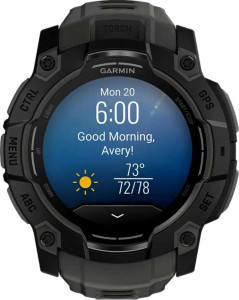
Garmin Instinct 3 AMOLED 50mm
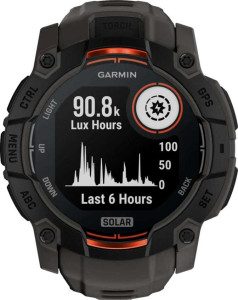
Garmin Instinct 3 Solar 50mm

Garmin Instinct 3 AMOLED 50mm Garmin Instinct 3 Solar 50mm

Overview

Welcome to our in-depth spec comparison between the Garmin Instinct 3 AMOLED 50mm and the Garmin Instinct 3 Solar 50mm. Both rugged GPS watches share the same sensor suite and activity-tracking foundations, yet they take strikingly different approaches to display quality and battery strategy. Whether you prioritize a vivid, high-resolution screen or near-limitless endurance in the field, this breakdown will help you find the right fit.

Common Features

  • Both watches feature an OLED/AMOLED display type.
  • Both watches are waterproof with a 10 ATM rating.
  • Neither watch has branded damage-resistant glass.
  • Neither watch has a sapphire glass display.
  • Both watches have a thickness of 14.4 mm.
  • The watch band is replaceable on both models.
  • Neither watch has a touchscreen.
  • Both watches have GPS.
  • Both watches include a heart rate monitor.
  • Both watches monitor blood oxygenation levels.
  • Both watches have a barometer, accelerometer, compass, temperature sensor, and cadence sensor.
  • Both watches offer route tracking, distance tracking, pace measurement, and trackback mode.
  • Both watches track sleep, support multi-sport mode, detect activities automatically, and track elevation.
  • Both watches are compatible with iOS and Android.
  • Neither watch supports Wi-Fi or has a cellular module.
  • Both watches support ANT+ and have NFC.
  • Neither watch supports wireless charging, and the battery is rechargeable but not removable.
  • Both watches support HRV tracking, VO2 max measurement, resting heart rate measurement, and fast/slow heart rate notifications.
  • Both watches show a readiness level, cannot upload maps, and have a stopwatch.
  • Both watches provide activity reports, inactivity alerts, calorie tracking, goal setting, achievements, an exercise diary, a free ad-free app, and compatibility with Windows, Mac OS X, smart scales, and external heart rate monitors.
  • Both watches have a battery level indicator, auto pause, and no external memory slot.

Main Differences

  • Screen size is 1.3″ on Garmin Instinct 3 AMOLED 50mm and 1.1″ on Garmin Instinct 3 Solar 50mm.
  • Resolution is 416 x 416 px on Garmin Instinct 3 AMOLED 50mm and 176 x 176 px on Garmin Instinct 3 Solar 50mm.
  • Pixel density is 452 ppi on Garmin Instinct 3 AMOLED 50mm and 226 ppi on Garmin Instinct 3 Solar 50mm.
  • Weight is 59 g on Garmin Instinct 3 AMOLED 50mm and 58 g on Garmin Instinct 3 Solar 50mm.
  • Battery life is 24 days on Garmin Instinct 3 AMOLED 50mm and unlimited (Infinity) days on Garmin Instinct 3 Solar 50mm.
  • Battery life with GPS on is 40 hours on Garmin Instinct 3 AMOLED 50mm and 260 hours on Garmin Instinct 3 Solar 50mm.
  • Battery life in training mode is 30 hours on Garmin Instinct 3 AMOLED 50mm and 60 hours on Garmin Instinct 3 Solar 50mm.
  • Solar battery charging is present on Garmin Instinct 3 Solar 50mm but not available on Garmin Instinct 3 AMOLED 50mm.
  • Internal storage is 4 GB on Garmin Instinct 3 AMOLED 50mm and 0.128 GB on Garmin Instinct 3 Solar 50mm.
Specs Comparison
Garmin Instinct 3 AMOLED 50mm

Garmin Instinct 3 AMOLED 50mm

Garmin Instinct 3 Solar 50mm

Garmin Instinct 3 Solar 50mm

Design:
screen size 1.3" 1.1"
Display type OLED/AMOLED OLED/AMOLED
water resistance Waterproof Waterproof
has branded damage-resistant glass
ATM rating 10 ATM 10 ATM
resolution 416 x 416 px 176 x 176 px
Watch band is replaceable
has a touch screen
weight 59 g 58 g
Has sapphire glass display
thickness 14.4 mm 14.4 mm
Always-On Display
height 50 mm 50 mm
pixel density 452 ppi 226 ppi
Has a display
width 50 mm 50 mm
width of band 26 mm 26 mm
volume 36 cm³ 36 cm³

The most significant design differentiator between these two watches lies entirely in the display. The Instinct 3 AMOLED 50mm packs a 1.3″ screen at 416 × 416 px, delivering a pixel density of 452 ppi, while the Instinct 3 Solar 50mm uses a much smaller 1.1″ panel at just 176 × 176 px, yielding 226 ppi. In practical terms, this is a night-and-day difference in sharpness: text, maps, and metrics on the AMOLED variant will appear crisp and detailed, whereas the Solar model's lower-resolution screen will look noticeably coarser up close — a trade-off that is inherent to MIP/transflective-style displays optimized for solar charging rather than visual fidelity.

Where the two watches are essentially identical is in their physical footprint. Both share the same 50 × 50 mm case dimensions, 14.4 mm thickness, 36 cm³ volume, and 26 mm band width, with the AMOLED version weighing just 1 g more (59 g vs. 58 g) — a difference that is imperceptible on the wrist. Both also feature an Always-On Display, replaceable bands, no touchscreen, and equal water resistance at 10 ATM. Neither uses sapphire or branded damage-resistant glass.

For the Design category, the Instinct 3 AMOLED 50mm holds a clear visual advantage: its substantially larger, far sharper screen makes it the better choice for users who prioritize display quality and readability. The Solar model's display concessions are a direct consequence of its solar-charging architecture, not a design flaw per se, but anyone placing weight on screen clarity should lean toward the AMOLED variant.

Sensors:
has GPS
Has a heart rate monitor
Monitors blood oxygenation levels
Has a barometer
has an accelerometer
has a compass
Has a temperature sensor
Has a cadence sensor
has a gyroscope
Has a wind speed sensor
Monitors perspiration

Across the entire sensor suite, the Instinct 3 AMOLED 50mm and Instinct 3 Solar 50mm are a perfect match. Both carry the same core set of health and navigation sensors: GPS, heart rate monitor, SpO2 (blood oxygenation), barometer, accelerometer, compass, temperature sensor, cadence sensor, and gyroscope. This is a well-rounded, capable package for outdoor athletes and adventurers alike.

The combination of barometer, compass, and GPS makes both watches competent navigation tools for hiking and trail running, while the gyroscope and accelerometer together enable accurate activity tracking and fall detection-style motion analysis. The SpO2 sensor adds meaningful value for altitude monitoring and sleep quality assessment. Notably, neither watch includes a wind speed sensor or perspiration monitor, but those remain rare features even on high-end sport watches and are unlikely to factor into most buyers' decisions.

This group is a complete tie. There is no sensor-based reason to choose one model over the other — both deliver an identical hardware sensing platform, meaning the choice between them must rest entirely on other categories such as display quality or battery strategy.

Activity tracking:
Has a route tracker
Tracks distance
Measures pace
Has trackback mode
Tracks your sleep
Has multi-sport mode
Detects activities automatically
Tracks elevation
Tracks steps taken
Provides sleep reports
Has exercise tagging
Has a stroke counter for swimming
Tracks calorie intake
Designed for diving
Designed for golf

Activity tracking is another category where the Instinct 3 AMOLED 50mm and Instinct 3 Solar 50mm are completely identical. Both cover the full spectrum of movement and wellness tracking: route tracking, distance, pace, elevation, steps, and automatic activity detection — meaning the watch recognizes when you start running or swimming without requiring manual input. Sleep tracking with dedicated sleep reports rounds out the 24/7 wellness picture.

For multi-discipline athletes, both watches offer multi-sport mode, a stroke counter for swimming, and trackback mode — a useful navigation safety net that guides you back along your recorded route. The inclusion of golf mode on both models adds versatility beyond typical outdoor sport watches, while the explicit absence of a diving mode sets a clear boundary at the high end of water activities. Calorie intake tracking and exercise tagging further support users who want a more complete picture of their training load and recovery.

There is no differentiator to call out here — this is a full tie. Every activity tracking capability present on one watch is equally present on the other, so this category has no bearing on the buying decision between the two models.

Connectivity:
Is compatible with iOS
Is compatible with Android
supports Wi-Fi
has a cellular module
supports ANT+
has NFC

Connectivity is straightforward and identical on both models. The Instinct 3 AMOLED 50mm and Instinct 3 Solar 50mm support ANT+ and NFC, pair with both iOS and Android smartphones, and share the same notable absences: no Wi-Fi and no cellular module. The lack of Wi-Fi means firmware updates and syncs must go through a paired phone rather than a home network directly — a minor inconvenience for most users but worth noting for those who prefer phone-free operation.

ANT+ is a meaningful inclusion for athletes, enabling wireless connectivity with third-party fitness accessories like chest-strap heart rate monitors, cycling power meters, and foot pods — extending the ecosystem well beyond what the watch's onboard sensors alone can capture. NFC adds contactless payment capability, a practical convenience for users who want to leave their wallet behind on a run or ride.

With no differences whatsoever across every connectivity spec, this category is a complete tie. Neither watch offers a connectivity advantage over the other, and this group should not influence the choice between the two models.

Battery:
battery life 24 days Infinity days
battery life with GPS on 40 hours 260 hours
battery life in training mode 30 hours 60 hours
has wireless charging
Has a solar power battery
has a rechargeable battery
has a removable battery

Battery life is where these two watches diverge most dramatically, and it is the defining trade-off of the entire comparison. The Instinct 3 Solar 50mm lists its general battery life as ∞ (infinity) days thanks to its solar charging panel, and backs that up with a GPS-on endurance of 260 hours versus just 40 hours for the AMOLED model. In training mode the gap is equally stark: 60 hours versus 30 hours. For multi-day expeditions, ultra-endurance events, or users who simply dislike charging routines, the Solar model's figures are in a different league.

The Instinct 3 AMOLED 50mm, by contrast, offers a respectable 24 days of general use — competitive for a watch with a power-hungry AMOLED screen running in always-on mode — but it is fundamentally dependent on regular charging. Neither model supports wireless charging, so both require a physical cable connection when they do need power, and neither has a removable battery.

The Instinct 3 Solar 50mm holds an overwhelming advantage in this category. Unless a buyer specifically prioritizes display quality over everything else, the Solar model's battery credentials make it the more capable tool for anyone spending extended time away from a power source. The AMOLED variant's 24-day rating is not poor in absolute terms, but next to solar-assisted near-unlimited runtime, it cannot compete.

Features:
release date January 2025 January 2025
has HRV tracking
measures VO2 max
measures resting heart rate
has fast/slow heart rate notifications
shows readiness level
Can upload maps
Has vibrating alerts
Has a stopwatch
Locates your phone
Has silent alarm
has irregular heart rate warnings
has fall detection
Has notifications
Acquires GPS faster
Has call control
Provides the sunrise/sunset time
internal storage 4GB 0.128GB
Can be used to answer calls
supports Galileo
Has smart alarm
Informs about the risk of thunderstorms
warranty period 1 years 1 years
has voice commands
Has a built-in camera remote control function

Across nearly the entire feature set, these two watches are indistinguishable. Both offer HRV tracking, VO2 max estimation, readiness scores, fall detection, faster GPS acquisition, Galileo satellite support, thunderstorm risk alerts, and sunrise/sunset times — a well-stocked toolkit that covers health monitoring, safety, and outdoor navigation in equal measure. Shared absences are also notable: neither watch supports vibrating alerts, call control, smart alarms, voice commands, or map uploads, which sets a clear ceiling on their smartwatch functionality compared to more lifestyle-oriented wearables.

The single concrete differentiator in this group is internal storage: the Instinct 3 AMOLED 50mm provides 4 GB, while the Instinct 3 Solar 50mm offers just 0.128 GB. That is a difference of more than 30× in raw capacity. In practice, 4 GB is enough to store music for offline playback or a substantial library of downloaded content, whereas 0.128 GB is essentially limited to activity logs and basic data — leaving the Solar model dependent on a paired phone for any media needs.

The Instinct 3 AMOLED 50mm takes a clear edge here, solely on the strength of its vastly larger onboard storage. For users who want to use their watch as a standalone media device during workouts or remote activities, this gap is significant. Feature-for-feature otherwise, both watches are on completely equal footing.

App & Software:
Provides activity reports
Has inactivity alerts
Counts how many calories you've burned
Has goal setting
Has achievements
Free app
Has exercise diary
Ad-free
Has weight tracking
Tracks BMI
Tracks water intake
Has live tracking
Has coaching
Has temperature tracking
Has period notifications
Supports routes
Syncs with existing calendars
Has voice feedback
Has music playback
Displays fertile window notifications
Includes maps
Doesn’t require account
Predicts start date
Predicts ovulation
Has video tutorials
Supports widgets
Can be personalised
Has barcode scanner on app

The Garmin Instinct 3 AMOLED 50mm and Garmin Instinct 3 Solar 50mm offer identical app and software features, providing a comprehensive set of tools for fitness tracking and personal management. Both models include activity reports, inactivity alerts, calorie tracking, goal setting, achievements, and a free app. They both feature an exercise diary, are ad-free, and allow for weight tracking, BMI tracking, and water intake tracking. Both also offer live tracking, coaching, temperature tracking, period notifications, route support, calendar syncing, voice feedback, music playback, fertile window notifications, and maps.

Both models have the same software features, such as predicting start dates and ovulation, displaying video tutorials, supporting widgets, personalization options, and having a barcode scanner on the app. Neither product offers a barcode scanner feature, however, so this is not a differentiator.

There are no differences between the two models in terms of app and software features. Both the AMOLED and Solar versions offer the same range of functionality to enhance the user experience.

Miscellaneous:
has a battery level indicator
Is compatible with Windows
Has auto pause
Compatible with external heart rate monitors
Available on PC
Compatible with smart scales
Is compatible with Mac OS X
has an external memory slot
has a socket for a 3.5 mm audio jack

The Garmin Instinct 3 AMOLED 50mm and Garmin Instinct 3 Solar 50mm have identical specifications in the Miscellaneous category. Both models include a battery level indicator, are compatible with Windows and Mac OS X, and support external heart rate monitors. They also feature auto pause functionality, are available on PC, and can sync with smart scales.

Neither model offers an external memory slot or a socket for a 3.5mm audio jack, as both devices lack these features.

Overall, there are no differences between the two models in this category, as both offer the same set of miscellaneous features and compatibility options.

Comparison Summary & Verdict

After examining every specification, it is clear that these two watches serve distinct types of adventurers. The Garmin Instinct 3 AMOLED 50mm shines for users who want a sharper, larger display — with its 1.3″ screen, 452 ppi pixel density, and 4 GB of internal storage — making it ideal for those who value visual clarity and media capacity in a rugged watch. The Garmin Instinct 3 Solar 50mm, on the other hand, is purpose-built for endurance, offering an extraordinary 260 hours of GPS battery life, up to 60 hours in training mode, and theoretically unlimited daily battery life thanks to its solar charging capability. Both watches are equally matched across sensors, connectivity, health tracking, and software. Your choice ultimately comes down to one core trade-off: screen quality versus battery longevity.

Garmin Instinct 3 AMOLED 50mm
Buy Garmin Instinct 3 AMOLED 50mm if...

Buy the Garmin Instinct 3 AMOLED 50mm if you want a sharper, larger display with higher pixel density and significantly more internal storage for your adventures.

Garmin Instinct 3 Solar 50mm
Buy Garmin Instinct 3 Solar 50mm if...

Buy the Garmin Instinct 3 Solar 50mm if you need exceptional battery endurance, with up to 260 hours of GPS life and solar-powered charging for extended expeditions.