Garmin Tactix 8
Garmin Tactix 8 Solar 51mm

Garmin Tactix 8 Garmin Tactix 8 Solar 51mm

Overview

When choosing between the Garmin Tactix 8 and the Garmin Tactix 8 Solar 51mm, two premium tactical smartwatches share a striking amount of common ground — yet diverge in ways that matter deeply to serious users. Both sport a 1.4″ sapphire glass display, a full sensor suite, and robust activity tracking, but the key battlegrounds lie in display technology and visual clarity versus battery endurance and solar autonomy. Which trade-off aligns with your priorities?

Common Features

  • Both watches feature a 1.4″ screen size.
  • Both watches are waterproof.
  • Neither watch has branded damage-resistant glass.
  • The watch band is replaceable on both models.
  • Both watches have a touch screen.
  • Both watches feature a sapphire glass display.
  • Both watches have an Always-On Display.
  • Both watches measure 51 mm in height.
  • Both watches have GPS.
  • Both watches include a heart rate monitor.
  • Both watches monitor blood oxygenation levels.
  • Both watches have a barometer.
  • Both watches have an accelerometer.
  • Both watches have a compass.
  • Both watches have a temperature sensor.
  • Neither watch has a cadence sensor.
  • Both watches have a route tracker.
  • Both watches track distance and measure pace.
  • Both watches track sleep and support multi-sport mode.
  • Both watches detect activities automatically and track elevation.
  • Both watches are compatible with iOS and Android.
  • Both watches support Wi-Fi and ANT+.
  • Both watches have NFC.
  • Neither watch has a cellular module.
  • Neither watch supports wireless charging.
  • Both watches have a rechargeable, non-removable battery.
  • Both watches support HRV tracking and VO2 max measurement.
  • Both watches measure resting heart rate and show readiness level.
  • Both watches can upload maps and have vibrating alerts.
  • Both watches provide activity reports and have inactivity alerts.
  • Both watches count calories burned and support goal setting.
  • Both watches offer a free, ad-free app with an exercise diary.
  • Both watches have a battery level indicator and auto pause.
  • Both watches are compatible with Windows, Mac OS X, and PC.
  • Both watches are compatible with external heart rate monitors and smart scales.
  • Neither watch has an external memory slot.

Main Differences

  • The display type is OLED/AMOLED on the Garmin Tactix 8 and LCD on the Garmin Tactix 8 Solar 51mm.
  • The resolution is 454 x 454 px on the Garmin Tactix 8 and 280 x 280 px on the Garmin Tactix 8 Solar 51mm.
  • The pixel density is 462 ppi on the Garmin Tactix 8 and 282 ppi on the Garmin Tactix 8 Solar 51mm.
  • The weight is 92 g on the Garmin Tactix 8 and 95 g on the Garmin Tactix 8 Solar 51mm.
  • The thickness is 14.7 mm on the Garmin Tactix 8 and 15.4 mm on the Garmin Tactix 8 Solar 51mm.
  • The volume is 38.2347 cm³ on the Garmin Tactix 8 and 40.0554 cm³ on the Garmin Tactix 8 Solar 51mm.
  • The battery life is 29 days on the Garmin Tactix 8 and 48 days on the Garmin Tactix 8 Solar 51mm.
  • The battery life with GPS on is 84 hours on the Garmin Tactix 8 and 149 hours on the Garmin Tactix 8 Solar 51mm.
  • The battery life in power save mode is 984 hours on the Garmin Tactix 8 and 2568 hours on the Garmin Tactix 8 Solar 51mm.
  • Solar power battery charging is available on the Garmin Tactix 8 Solar 51mm but not on the Garmin Tactix 8.
Specs Comparison
Garmin Tactix 8

Garmin Tactix 8

Garmin Tactix 8 Solar 51mm

Garmin Tactix 8 Solar 51mm

Design:
screen size 1.4" 1.4"
Display type OLED/AMOLED LCD
water resistance Waterproof Waterproof
has branded damage-resistant glass
resolution 454 x 454 px 280 x 280 px
Watch band is replaceable
has a touch screen
weight 92 g 95 g
Has sapphire glass display
thickness 14.7 mm 15.4 mm
Always-On Display
height 51 mm 51 mm
pixel density 462 ppi 282 ppi
Has a display
width 51 mm 51 mm
width of band 26 mm 26 mm
volume 38.2347 cm³ 40.0554 cm³

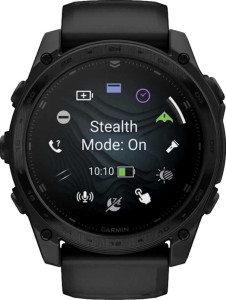
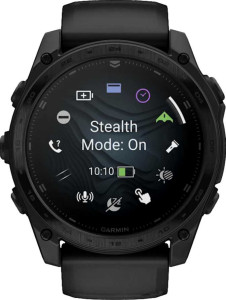
Both watches share the same 51 mm footprint, a 1.4″ screen, sapphire glass, a replaceable 26 mm band, touchscreen input, and an Always-On Display — so on paper they occupy the same physical space on your wrist. The differences, however, run deeper than the chassis. The standard Tactix 8 uses an OLED/AMOLED panel at 454 × 454 px and 462 ppi, while the Solar 51mm relies on an LCD panel at just 280 × 280 px and 282 ppi. That is not a marginal gap — it is nearly a 2.6× difference in total pixel count, which translates directly to sharper map rendering, crisper text, and more vivid color contrast in everyday use.

The LCD technology in the Solar model is what enables its solar charging capability, as OLED panels are not suited for ambient light harvesting. But that trade-off has a visible cost: LCD displays tend to look washed out compared to AMOLED, especially in dark environments where OLED's per-pixel lighting produces true blacks and stronger contrast. For a tactically oriented watch where map legibility and readability under stress matter, this distinction is meaningful. The Solar is also slightly heavier at 95 g versus 92 g, and marginally thicker at 15.4 mm versus 14.7 mm, with a larger volume — differences that are minor but consistent with its bulkier internal construction.

From a pure display and design standpoint, the standard Garmin Tactix 8 has a clear edge: its AMOLED panel delivers a significantly sharper and more visually refined experience, and it is the lighter, slimmer option. The Tactix 8 Solar 51mm accepts those design compromises in exchange for solar energy harvesting — a trade worth considering based on your priority between display quality and off-grid endurance.

Sensors:
has GPS
Has a heart rate monitor
Monitors blood oxygenation levels
Has a barometer
has an accelerometer
has a compass
Has a temperature sensor
Has a cadence sensor
has a gyroscope
Has a wind speed sensor
Monitors perspiration

Across every sensor in this category, the Garmin Tactix 8 and the Tactix 8 Solar 51mm are perfectly identical. Both carry a comprehensive suite that includes GPS, a heart rate monitor, blood oxygenation (SpO2) tracking, a barometer, an accelerometer, a compass, a gyroscope, a temperature sensor, and notably, a wind speed sensor — a relatively rare inclusion that adds genuine utility for activities like sailing, mountaineering, or any mission-critical outdoor operation where environmental awareness matters.

Neither watch includes a cadence sensor or perspiration monitor, but those omissions are consistent across both models and are unlikely to be dealbreakers for the tactical and outdoor-focused audience these watches target. The presence of a barometer alongside GPS is worth highlighting: barometric altitude readings are faster and more power-efficient than GPS-derived elevation, making that pairing particularly valuable for navigation in dynamic terrain. The gyroscope working in tandem with the accelerometer also enables more accurate motion tracking and gesture recognition beyond what either sensor delivers alone.

This category is a complete tie. Sensor hardware is not a differentiating factor between these two models — whichever you choose, you get the same environmental and biometric awareness capabilities. The decision between them should rest entirely on the trade-offs identified in other specification groups.

Activity tracking:
Has a route tracker
Tracks distance
Measures pace
Has trackback mode
Tracks your sleep
Has multi-sport mode
Detects activities automatically
Tracks elevation
Tracks steps taken
Provides sleep reports
Has exercise tagging
Has a stroke counter for swimming
Tracks calorie intake
Designed for diving
Designed for golf

Activity tracking is another domain where the Garmin Tactix 8 and the Tactix 8 Solar 51mm are functionally indistinguishable — every feature present on one is present on the other. What stands out is the sheer breadth of the shared capability. Beyond the expected fitness staples like step counting, pace measurement, and sleep tracking with full sleep reports, both watches extend into more specialized territory: diving support, golf mode, a stroke counter for swimming, and calorie intake tracking alongside expenditure — a combination that positions these as genuine multi-discipline tools rather than simple fitness trackers.

The inclusion of trackback mode and a route tracker alongside automatic activity detection reinforces the tactical and expedition-grade positioning of both models. Trackback is particularly valuable in backcountry or operational environments where retracing a path without pre-loaded maps can be critical. Automatic activity detection reduces the cognitive overhead of manually logging workouts — a small but meaningful convenience during back-to-back training sessions or unpredictable field use. The multi-sport mode ties it all together, allowing seamless transitions between activity types without stopping to reconfigure the watch.

As with the sensor category, this is a complete tie with no differentiating factors between the two models. Activity tracking capability should play no role in choosing between them — both offer the same extensive, mission-ready feature set.

Connectivity:
Is compatible with iOS
Is compatible with Android
supports Wi-Fi
has a cellular module
supports ANT+
has NFC

Connectivity is yet another category where both watches land on identical ground. The Garmin Tactix 8 and the Tactix 8 Solar 51mm both support Wi-Fi, ANT+, and NFC, and are compatible with both iOS and Android — covering the full spectrum of mainstream smartphone ecosystems without compromise. Neither model includes a cellular module, meaning both rely on a paired phone for notifications, data sync, and streaming when away from Wi-Fi.

The combination of ANT+ and NFC is worth contextualizing. ANT+ enables low-power communication with a wide ecosystem of third-party fitness accessories — heart rate chest straps, cycling power meters, and similar peripherals — without draining the battery the way Bluetooth can over extended sessions. NFC, on the other hand, enables contactless payments, a convenience that is genuinely useful for athletes who prefer to leave their phone behind during training or travel. Together, these two protocols meaningfully extend the practical utility of both watches beyond the wrist.

No advantage exists for either model here — connectivity is a complete tie. Both offer a well-rounded, capable wireless feature set with the same notable absence of cellular. For users who prioritize fully standalone connectivity without a paired device, that gap applies equally to both watches.

Battery:
battery life 29 days 48 days
battery life with GPS on 84 hours 149 hours
has wireless charging
Has a solar power battery
battery life in power save mode 984 hours 2568 hours
has a rechargeable battery
has a removable battery

Battery life is where these two watches diverge most dramatically, and the gap is not subtle. The Garmin Tactix 8 delivers 29 days of standard battery life and 84 hours with GPS active — respectable numbers for a feature-rich tactical watch. The Tactix 8 Solar 51mm, however, more than doubles those figures: 48 days of standard use and 149 hours with GPS on, courtesy of its solar power battery. In power-save mode, the difference becomes almost surreal — 984 hours for the standard Tactix 8 versus 2568 hours for the Solar, which translates to roughly 41 days versus 107 days of emergency reserve endurance.

These numbers carry real operational weight. For extended expeditions, multi-day ultramarathons, or deployments where access to charging infrastructure is uncertain or impossible, the Solar's endurance advantage is not just a convenience — it can be mission-critical. The 149-hour GPS runtime in particular means the Solar can sustain continuous navigation tracking for over six days without recharging, assuming sufficient sunlight to supplement battery draw. Neither model supports wireless charging, so both require a physical connection when they do need to top up.

The battery category delivers the clearest win of any group so far: the Tactix 8 Solar 51mm has a decisive and substantial advantage across every metric. The trade-off, as established in the Design comparison, is a lower-resolution LCD display. For users whose primary concern is staying powered in the field for as long as possible, the Solar's endurance makes a compelling case that is difficult to argue against on specs alone.

Features:
release date February 2025 February 2025
has HRV tracking
measures VO2 max
measures resting heart rate
has fast/slow heart rate notifications
shows readiness level
Can upload maps
Has vibrating alerts
Has a stopwatch
Locates your phone
Has silent alarm
has irregular heart rate warnings
has fall detection
Has notifications
Acquires GPS faster
Has call control
Provides the sunrise/sunset time
internal storage 32GB 32GB
Can be used to answer calls
supports Galileo
Has smart alarm
Informs about the risk of thunderstorms
number of microphones 1 1
has voice commands
Has a built-in camera remote control function

Feature parity continues into this category without a single point of divergence. Both the Garmin Tactix 8 and the Tactix 8 Solar 51mm carry an identical, extensive feature set — and the depth of that shared capability deserves attention. On the health intelligence side, both offer HRV tracking, VO2 max measurement, readiness scoring, and irregular heart rate warnings, forming a genuinely comprehensive cardiovascular monitoring stack that goes well beyond what most sport watches provide. Fall detection adds a meaningful safety layer for solo outdoor use.

The navigation and situational awareness features are equally notable. Both models support uploadable maps, faster GPS acquisition, Galileo satellite support, and thunderstorm risk alerts — a combination that speaks directly to the expedition and tactical use cases these watches are built for. 32GB of internal storage provides ample space for detailed offline maps, music, or other data without relying on a connected phone. Voice commands and call answering capability round out a feature set that blurs the line between a smartwatch and a dedicated field device.

The only shared absences worth noting are the lack of a smart alarm and no camera remote control — neither of which represents a meaningful gap for the target audience. Ultimately, this category is a complete tie: feature selection plays no role in differentiating these two models. The choice between them remains anchored in the trade-offs already identified — display quality and weight versus battery endurance.

App & Software:
Provides activity reports
Has inactivity alerts
Counts how many calories you've burned
Has goal setting
Has achievements
Free app
Has exercise diary
Ad-free
Has weight tracking
Tracks BMI
Tracks water intake
Has live tracking
Has coaching
Has temperature tracking
Has period notifications
Supports routes
Syncs with existing calendars
Has voice feedback
Has music playback
Displays fertile window notifications
Includes maps
Doesn’t require account
Predicts start date
Predicts ovulation
Has video tutorials
Supports widgets
Can be personalised
Has barcode scanner on app

The software and app experience is shared in full between the Garmin Tactix 8 and the Tactix 8 Solar 51mm — every feature, every absence, mirrored exactly. What stands out here is not differentiation but the sheer scope of the platform both watches plug into. The companion app is free and ad-free, covers everything from live tracking and route support to coaching, music playback, and calendar sync, and extends into detailed wellness territory including water intake tracking, BMI, and temperature trends.

The reproductive health features — period notifications, fertile window display, ovulation and start date prediction — indicate that the software platform is designed to serve a broad user base, not just the tactical or performance-focused audience the hardware aesthetic might suggest. On the training side, the combination of an exercise diary, voice feedback, video tutorials, and goal setting with achievements creates a structured progression environment that supports long-term habit building rather than just passive data logging. The requirement for an account is the one friction point, but it applies equally to both models.

Predictably, this is a complete tie. The app and software ecosystem is identical for both watches, and it is a strong one — comprehensive, polished, and well-rounded across fitness, wellness, and navigation use cases. Software should not factor into the decision between these two models at all.
Miscellaneous:
has a battery level indicator
Is compatible with Windows
Has auto pause
Compatible with external heart rate monitors
Available on PC
Compatible with smart scales
Is compatible with Mac OS X
has an external memory slot
has a socket for a 3.5 mm audio jack

Rounding out the comparison, the Miscellaneous category offers no surprises: the Garmin Tactix 8 and the Tactix 8 Solar 51mm are once again identical across every data point. Both are compatible with Windows and Mac OS X, support smart scales and external heart rate monitors, and include auto pause — a practical feature that stops activity recording automatically during unplanned breaks, keeping workout data clean without requiring manual intervention.

Two shared absences are worth acknowledging. Neither watch includes an external memory slot, meaning users are bound to the 32GB of internal storage established in the Features category — sufficient for most use cases, but fixed. There is also no 3.5mm audio jack, so wired audio is not an option; music playback relies entirely on Bluetooth headphones. These are consistent limitations that apply equally to both models and reflect broader industry trends in wearable design rather than meaningful trade-offs between the two.

This category is a complete tie, consistent with the pattern seen across connectivity, sensors, activity tracking, features, and software. The Miscellaneous specs confirm that these two watches are built on the same functional platform — the only meaningful differences between them, across this entire comparison, remain the display technology and resolution established in Design, and the substantial battery endurance gap in favor of the Tactix 8 Solar 51mm.

Comparison Summary & Verdict

After examining the full specification set, both watches are remarkably well-matched in sensors, connectivity, activity tracking, and software features. The defining fork in the road is a classic trade-off: the Garmin Tactix 8 delivers a sharper, more vibrant OLED/AMOLED display at 462 ppi and 454 x 454 px resolution, making it the better choice for users who value crisp visuals and a slightly lighter, slimmer profile at 92 g and 14.7 mm. The Garmin Tactix 8 Solar 51mm, by contrast, prioritises endurance above all else — its solar-assisted battery pushes smartwatch mode to 48 days, GPS runtime to 149 hours, and power-save mode to an extraordinary 2568 hours. For off-grid expeditions and extended field operations, that autonomy is invaluable. Choose the Tactix 8 for display quality; choose the Solar 51mm for maximum battery independence.

Garmin Tactix 8
Buy Garmin Tactix 8 if...

Buy the Garmin Tactix 8 if you prioritise a sharper, more vibrant OLED/AMOLED display with higher resolution and pixel density, and prefer a marginally lighter and slimmer build.

Garmin Tactix 8 Solar 51mm
Buy Garmin Tactix 8 Solar 51mm if...

Buy the Garmin Tactix 8 Solar 51mm if maximising battery life is your top priority, especially for extended expeditions where solar charging can push endurance to 48 days or 149 hours of GPS use.