Garmin Venu 4
Garmin Vivoactive 6

Garmin Venu 4 Garmin Vivoactive 6

Overview

When choosing between the Garmin Venu 4 and the Garmin Vivoactive 6, you are looking at two capable smartwatches from the same brand that take notably different approaches to sensor depth, health features, and form factor. Both share a polished OLED display, solid waterproofing, and comprehensive fitness tracking, yet they diverge in meaningful ways across areas like advanced health monitoring, battery behavior, and overall size — making the right choice very much dependent on what you value most in a daily wearable.

Common Features

  • Both the Garmin Venu 4 and Garmin Vivoactive 6 feature an OLED/AMOLED display type.
  • Both watches are waterproof with a 5 ATM rating and a waterproof depth of 50 m.
  • An always-on display is available on both the Garmin Venu 4 and Garmin Vivoactive 6.
  • The watch band is replaceable on both the Garmin Venu 4 and Garmin Vivoactive 6.
  • Both watches feature branded damage-resistant glass, specifically Gorilla Glass 3.
  • Blood oxygenation level monitoring is available on both the Garmin Venu 4 and Garmin Vivoactive 6.
  • A heart rate monitor is present on both the Garmin Venu 4 and Garmin Vivoactive 6.
  • GPS is built into both the Garmin Venu 4 and Garmin Vivoactive 6.
  • Both watches include an accelerometer, a compass, and a gyroscope.
  • A cadence sensor is not available on either the Garmin Venu 4 or Garmin Vivoactive 6.
  • Perspiration monitoring is not available on either the Garmin Venu 4 or Garmin Vivoactive 6.
  • Both the Garmin Venu 4 and Garmin Vivoactive 6 track sleep, distance, steps, and pace, and provide sleep reports.
  • Automatic activity detection and exercise tagging are available on both the Garmin Venu 4 and Garmin Vivoactive 6.
  • A stroke counter for swimming is present on both the Garmin Venu 4 and Garmin Vivoactive 6.
  • Neither the Garmin Venu 4 nor the Garmin Vivoactive 6 has a cellular module.
  • Both watches are compatible with iOS and Android, and support Wi-Fi, ANT+, NFC, and Galileo.
  • Wireless charging is not available on either the Garmin Venu 4 or Garmin Vivoactive 6.
  • Both the Garmin Venu 4 and Garmin Vivoactive 6 have a rechargeable, non-removable battery with no solar power option.
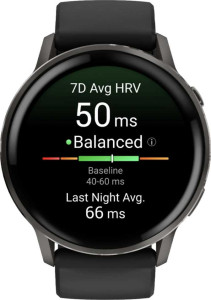
  • HRV tracking, VO2 max measurement, resting heart rate measurement, and fast/slow heart rate notifications are present on both watches.
  • Both watches offer phone locating, call control, notifications, and a silent alarm.
  • Activity reports, inactivity alerts, calorie tracking, goal setting, achievements, an exercise diary, and an ad-free free app are available on both the Garmin Venu 4 and Garmin Vivoactive 6.
  • Both watches have a battery level indicator, auto pause, compatibility with smart scales and external heart rate monitors, Windows compatibility, and no external memory slot.
  • Neither the Garmin Venu 4 nor the Garmin Vivoactive 6 supports aptX.

Main Differences

  • Screen size is 1.4″ on the Garmin Venu 4 and 1.2″ on the Garmin Vivoactive 6.
  • Pixel density is 458 ppi on the Garmin Venu 4 and 459 ppi on the Garmin Vivoactive 6.
  • Resolution is 454 x 454 px on the Garmin Venu 4 and 390 x 390 px on the Garmin Vivoactive 6.
  • Thickness is 12 mm on the Garmin Venu 4 and 10.9 mm on the Garmin Vivoactive 6.
  • Weight is 38 g on the Garmin Venu 4 and 36 g on the Garmin Vivoactive 6.
  • Height and width are 45 mm on the Garmin Venu 4 and 42.2 mm on the Garmin Vivoactive 6.
  • Maximum operating temperature is 55 °C on the Garmin Venu 4 and 60 °C on the Garmin Vivoactive 6.
  • Volume is 24.3 cm³ on the Garmin Venu 4 and 19.411156 cm³ on the Garmin Vivoactive 6.
  • Band width is 22 mm on the Garmin Venu 4 and 20 mm on the Garmin Vivoactive 6.
  • A temperature sensor is present on the Garmin Venu 4 but not available on the Garmin Vivoactive 6.
  • A barometer is present on the Garmin Venu 4 but not available on the Garmin Vivoactive 6.
  • Route tracking is available on the Garmin Venu 4 but not on the Garmin Vivoactive 6.
  • Elevation tracking is available on the Garmin Venu 4 but not on the Garmin Vivoactive 6.
  • Multi-sport mode is supported on the Garmin Venu 4 but not on the Garmin Vivoactive 6.
  • Battery life is 12 days on the Garmin Venu 4 and 11 days on the Garmin Vivoactive 6.
  • Charge time is 1 hour on the Garmin Venu 4 and 1.5 hours on the Garmin Vivoactive 6.
  • Battery life with GPS on is 19 hours on the Garmin Venu 4 and 21 hours on the Garmin Vivoactive 6.
  • Readiness level tracking is available on the Garmin Venu 4 but not on the Garmin Vivoactive 6.
  • The ability to answer calls directly on the watch is present on the Garmin Venu 4 but not on the Garmin Vivoactive 6.
  • Irregular heart rate warnings are available on the Garmin Venu 4 but not on the Garmin Vivoactive 6.
  • ECG technology is present on the Garmin Venu 4 but not on the Garmin Vivoactive 6.
  • A smart alarm is available on the Garmin Vivoactive 6 but not on the Garmin Venu 4.
  • Voice commands are supported on the Garmin Venu 4 but not on the Garmin Vivoactive 6.
  • Faster GPS acquisition is available on the Garmin Venu 4 but not on the Garmin Vivoactive 6.
  • Temperature tracking in the app is available on the Garmin Venu 4 but not on the Garmin Vivoactive 6.
  • Weight tracking in the app is available on the Garmin Venu 4 but not on the Garmin Vivoactive 6.
Specs Comparison
Garmin Venu 4

Garmin Venu 4

Garmin Vivoactive 6

Garmin Vivoactive 6

Design:
screen size 1.4" 1.2"
Display type OLED/AMOLED OLED/AMOLED
water resistance Waterproof Waterproof
ATM rating 5 ATM 5 ATM
waterproof depth rating 50 m 50 m
Always-On Display
pixel density 458 ppi 459 ppi
resolution 454 x 454 px 390 x 390 px
Watch band is replaceable
has branded damage-resistant glass
Gorilla Glass version Gorilla Glass 3 Gorilla Glass 3
thickness 12 mm 10.9 mm
weight 38 g 36 g
height 45 mm 42.2 mm
width 45 mm 42.2 mm
maximum operating temperature 55 °C 60 °C
lowest potential operating temperature -20 °C -20 °C
Has a display
has a touch screen
Has sapphire glass display
volume 24.3 cm³ 19.411156 cm³
is designed for kids
width of band 22 mm 20 mm

Both watches share a strong design foundation: OLED/AMOLED displays with always-on support, 5 ATM / 50 m water resistance, Gorilla Glass 3 protection, and replaceable bands. In day-to-day use, these shared traits mean neither watch compromises on visibility, swim-proofing, or long-term wearability. The pixel density is virtually identical — 458 ppi on the Venu 4 versus 459 ppi on the Vivoactive 6 — so sharpness is a non-issue on either device.

The real divergence is in physical size and presence. The Venu 4 sports a larger 1.4″ screen at 454 × 454 px in a 45 × 45 mm case, while the Vivoactive 6 uses a 1.2″ panel at 390 × 390 px in a more compact 42.2 × 42.2 mm body. The Venu 4's bigger canvas makes maps, metrics, and text easier to read at a glance, but it comes with a noticeably larger footprint and greater volume (24.3 cm³ vs 19.4 cm³). The Vivoactive 6 is also slightly thinner (10.9 mm vs 12 mm) and lighter (36 g vs 38 g), which matters over long runs or all-day wear. Its narrower 20 mm band also suits smaller wrists better than the Venu 4's 22 mm band.

The choice here comes down to wrist size and use priority. The Venu 4 has the edge for readability thanks to its larger screen real estate, while the Vivoactive 6 has the edge for comfort and discretion with its slimmer, lighter, and more compact profile. Neither is objectively superior — they serve different wrist sizes and aesthetic preferences.

Sensors:
Monitors blood oxygenation levels
Has a heart rate monitor
has GPS
has an accelerometer
Has a temperature sensor
has a compass
Has a barometer
has a gyroscope
Has a cadence sensor
Monitors perspiration

At their core, both watches share a solid sensor suite: heart rate monitor, SpO2 tracking, GPS, accelerometer, gyroscope, and compass. For the vast majority of fitness use cases — running, cycling, swimming, sleep tracking — this shared foundation means either watch will serve users equally well without meaningful compromise.

Where the Venu 4 pulls ahead is in its two additional sensors: a temperature sensor and a barometer. The temperature sensor enables body and ambient temperature tracking, which is useful for understanding recovery and environmental conditions during workouts. The barometer is arguably the more impactful addition — it enables accurate elevation tracking and floor-climbing detection without relying solely on GPS altitude data, which is notoriously less precise. Hikers, trail runners, and stair climbers will notice the difference in data quality. The Vivoactive 6 lacks both of these sensors, meaning it must either skip those metrics entirely or approximate them through GPS.

The Venu 4 has a clear edge in this category. The absence of a barometer and temperature sensor on the Vivoactive 6 is not a dealbreaker for casual users, but for anyone focused on outdoor activities or detailed environmental health data, the Venu 4 delivers a meaningfully richer sensing package.

Activity tracking:
Tracks your sleep
Tracks distance
Tracks steps taken
Measures pace
Provides sleep reports
Detects activities automatically
Has a route tracker
Tracks elevation
Has multi-sport mode
Has exercise tagging
Has a stroke counter for swimming
Tracks calorie intake
Designed for diving
Designed for golf

For everyday fitness habits, both watches cover the same ground: sleep tracking with reports, step counting, distance, pace, automatic activity detection, exercise tagging, swim stroke counting, calorie intake tracking, and golf support. Users who primarily walk, swim, or play golf will find little to separate the two devices in day-to-day use.

The gaps emerge for more structured or outdoors-oriented athletes. The Venu 4 adds route tracking, elevation tracking, and multi-sport mode — three features absent on the Vivoactive 6. Route tracking lets users record and retrace paths, which is invaluable for trail runners and hikers. Elevation tracking adds vertical gain and loss to workouts, a metric that meaningfully changes how effort is measured on hilly terrain. Multi-sport mode is particularly relevant for triathletes or anyone who chains disciplines in a single session — without it, the Vivoactive 6 requires manually switching between activity profiles, which is disruptive mid-race or mid-workout.

The Venu 4 holds a clear advantage in this category. The Vivoactive 6 is a capable tracker for single-sport users with straightforward routines, but the Venu 4's additional capabilities make it the stronger choice for anyone whose activity mix involves varied terrain, outdoor navigation, or multi-discipline training.

Connectivity:
has a cellular module
Is compatible with iOS
Is compatible with Android
supports Wi-Fi
supports ANT+
has NFC
supports Galileo

Connectivity is the one category where these two watches are in complete lockstep. Both support Wi-Fi, ANT+, and NFC, work with iOS and Android, include Galileo satellite support for improved GPS accuracy in dense urban or forested environments, and neither offers a cellular module. There is not a single differentiating data point between them here.

The practical implications are identical for both: NFC enables contactless payments without a phone nearby, ANT+ allows pairing with third-party accessories like heart rate chest straps and cycling sensors, and Wi-Fi facilitates faster firmware updates and data syncing when away from a phone. The shared absence of cellular means both watches require a paired smartphone for call and data connectivity beyond their onboard features.

This category is a dead tie. Connectivity should not factor into a decision between the Venu 4 and Vivoactive 6 — buyers should look to other specification groups to make their choice.

Battery:
battery life 12 days 11 days
charge time 1 hours 1.5 hours
battery life with GPS on 19 hours 21 hours
has wireless charging
has a rechargeable battery
Has a solar power battery
has a removable battery

Battery life tells an interesting and somewhat counterintuitive story here. In smartwatch mode, the Venu 4 edges ahead with 12 days versus 11 days on the Vivoactive 6 — a modest difference that, in practice, means one extra charging cycle every few weeks. Flip to active GPS use, however, and the Vivoactive 6 pulls ahead with 21 hours compared to the Venu 4's 19 hours. That two-hour gap is meaningful for endurance athletes: it could be the difference between finishing a long ultramarathon or multi-day hike with battery to spare versus scrambling to conserve power.

Charging speed also favors the Venu 4, which reaches full charge in 1 hour versus 1.5 hours for the Vivoactive 6. A 30-minute difference may sound minor, but for users who charge opportunistically — during a morning shower or a short desk break — faster charging translates to more reliable readiness. Both watches share the same structural limitations: no wireless charging, no solar option, and a non-removable battery.

Overall, this category is closely contested and the right answer depends on how each watch is used. The Venu 4 has the edge for everyday smartwatch users who prioritize fewer charges and faster top-ups, while the Vivoactive 6 has the edge for GPS-heavy athletes who need maximum endurance during long outdoor activities.

Features:
release date September 2025 April 2025
has HRV tracking
measures VO2 max
measures resting heart rate
has fast/slow heart rate notifications
shows readiness level
Can be used to answer calls
Locates your phone
Has call control
Has notifications
has irregular heart rate warnings
Has ECG technology
Has silent alarm
Has vibrating alerts
has fall detection
Has a stopwatch
Has smart alarm
has voice commands
internal storage 8GB 8GB
Has a built-in camera remote control function
Acquires GPS faster
warranty period 1 years 1 years
has a front camera

Both watches share a respectable common feature set: HRV tracking, VO2 max measurement, resting heart rate monitoring, fast/slow heart rate notifications, fall detection, notifications, call control, phone finder, silent and vibrating alerts, a stopwatch, and 8 GB of internal storage. For most health-conscious users, this shared foundation is already comprehensive. The one exclusive feature the Vivoactive 6 brings to the table is a smart alarm, which wakes users at an optimal point in their sleep cycle — a genuinely useful addition for light sleepers.

The Venu 4, however, accumulates a longer list of exclusive capabilities that carry real weight. ECG technology enables on-demand electrocardiogram readings, offering a meaningful cardiac safety net that the Vivoactive 6 simply cannot match — this alone is a significant differentiator for heart health-conscious users. The Venu 4 also adds irregular heart rate warnings, a readiness score for gauging daily recovery, the ability to answer calls directly from the wrist, voice commands, and faster GPS acquisition. Answering calls from the watch is a quality-of-life feature many users underestimate until they have it, and quicker GPS lock means less standing around waiting before a workout begins.

The Venu 4 wins this category decisively. Aside from the smart alarm on the Vivoactive 6, every meaningful exclusive feature in this group belongs to the Venu 4 — most notably ECG and call-answering capabilities that push it well beyond a fitness tracker and into premium smartwatch territory.

App & Software:
Provides activity reports
Has inactivity alerts
Counts how many calories you've burned
Has goal setting
Has achievements
Free app
Has exercise diary
Ad-free
Has coaching
Has temperature tracking
Has period notifications
Supports routes
Syncs with existing calendars
Has voice feedback
Has music playback
Displays fertile window notifications
Includes maps
Doesn’t require account
Predicts ovulation
Predicts start date
Has video tutorials
Supports widgets
Can be personalised
Has barcode scanner on app
Tracks water intake
Has weight tracking
Has live tracking
Tracks BMI

The software experience between these two watches is remarkably aligned. Both deliver a full-featured, free, ad-free companion app with activity reports, goal setting, coaching, exercise diary, inactivity alerts, calorie tracking, music playback, live tracking, maps, route support, calendar sync, voice feedback, widgets, video tutorials, and a comprehensive women's health suite covering cycle predictions, fertile window notifications, and ovulation forecasting. For the overwhelming majority of users, the app experience will feel functionally identical day to day.

The Venu 4 differentiates itself in two specific areas: temperature tracking within the app and weight tracking with corresponding BMI logging. It is worth noting that both watches list BMI tracking as supported, yet only the Venu 4 includes weight tracking — without manual weight input, BMI calculation has no basis, making weight tracking a prerequisite that the Vivoactive 6 lacks in practice. Temperature tracking in the app extends the utility of the Venu 4's onboard temperature sensor, creating a more complete picture of health trends over time.

The Venu 4 has a narrow but meaningful edge here. The gap is not wide enough to define the software experience as categorically superior, but for users who want holistic body composition monitoring and temperature-correlated health data, the Venu 4's app capabilities are the more complete package.
Miscellaneous:
has a battery level indicator
has aptX
Available on PC
Has auto pause
Compatible with smart scales
Compatible with external heart rate monitors
Is compatible with Windows
has an external memory slot
Is compatible with Mac OS X
has a socket for a 3.5 mm audio jack

Miscellaneous specs occasionally surface hidden differentiators, but not here. Every single data point in this category is identical across the Venu 4 and Vivoactive 6: both offer a battery level indicator, auto pause, smart scale compatibility, external heart rate monitor support, and full PC compatibility across Windows and Mac. Neither has an external memory slot, an aptX audio codec, or a 3.5 mm audio jack.

The shared absence of aptX is worth briefly contextualizing — aptX is a Bluetooth audio codec that delivers higher-quality wireless audio. Its absence on both watches means audio quality when streaming music is subject to standard Bluetooth codec performance, which is the same constraint for each device. Similarly, no 3.5 mm jack means neither watch can connect wired headphones directly, which is typical for smartwatches of this form factor.

This is a complete tie. There is no differentiating factor in this category, and it should carry no weight in a buying decision between the two watches.

Comparison Summary & Verdict

After examining every specification, the Garmin Venu 4 emerges as the more feature-rich option, offering a larger screen, a barometer, temperature sensor, ECG technology, irregular heart rate warnings, route tracking, elevation tracking, multi-sport mode, voice commands, and faster GPS acquisition — all backed by a quicker 1-hour charge time. It is the stronger pick for users who want a comprehensive health and training tool. The Garmin Vivoactive 6, on the other hand, delivers a slimmer, lighter build with a longer GPS battery life of 21 hours and a smart alarm, making it an appealing choice for everyday users who prefer a more compact, understated wearable with solid core tracking and a higher maximum operating temperature tolerance. If advanced sensors and richer health data are your priority, go with the Venu 4; if portability and extended GPS endurance matter more, the Vivoactive 6 is a well-rounded alternative.

Garmin Venu 4
Buy Garmin Venu 4 if...

Buy the Garmin Venu 4 if you want advanced health monitoring with ECG, a barometer, a temperature sensor, route and elevation tracking, multi-sport mode, and the convenience of faster charging and voice commands.

Garmin Vivoactive 6
Buy Garmin Vivoactive 6 if...

Buy the Garmin Vivoactive 6 if you prefer a slimmer, lighter watch with a longer GPS battery life and a more streamlined feature set for everyday fitness tracking.