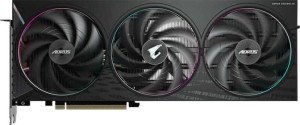
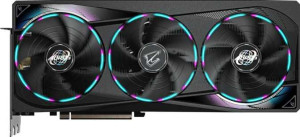
At first glance, the clock speed story appears to favor the Aorus RTX 5060 Ti Elite: its base clock of 2407 MHz beats the Aorus RTX 5070 Master's 2325 MHz, and their boost clocks are essentially identical at 2722 MHz vs 2715 MHz. However, clock speed alone is a poor measure of GPU performance — what matters far more is how many execution units are running at those clocks. The 5070 Master houses 6,144 shading units against the 5060 Ti's 4,608, a 33% advantage in raw shader count that the similar clocks cannot compensate for.
That shader gap propagates directly into every throughput metric. The 5070 Master delivers 33.36 TFLOPS of floating-point performance versus 25.09 TFLOPS on the 5060 Ti — a meaningful ~33% lead that translates to greater headroom in compute-heavy workloads like ray tracing, AI-accelerated rendering, and shader-intensive scenes. The texture rate gap mirrors this at 521.3 GTexels/s vs 392 GTexels/s, meaning the 5070 can push more textured geometry per second, benefiting highly detailed open-world environments. The pixel fill rate gap is even more pronounced — 217.2 GPixel/s vs 130.7 GPixel/s, roughly 66% wider — driven by the 5070's significantly larger ROP count (80 vs 48). More ROPs means the GPU can write more pixels to the framebuffer per clock, which directly supports higher resolutions and frame rates, particularly at 4K.
Both cards share the same 1750 MHz memory speed and both support Double Precision Floating Point, so neither holds an edge on those fronts. The verdict for this group is clear: the Aorus RTX 5070 Master holds a substantial and well-rounded performance advantage across every throughput metric that matters — compute, texturing, and pixel output — making it the stronger performer by a significant margin, despite the 5060 Ti's marginally higher base clock.