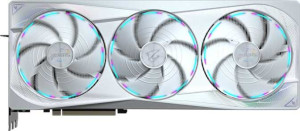
Gigabyte Aorus GeForce RTX 5080 Master Ice
Nvidia RTX Pro 4500 Blackwell

Gigabyte Aorus GeForce RTX 5080 Master Ice Nvidia RTX Pro 4500 Blackwell

Overview

When choosing between the Gigabyte Aorus GeForce RTX 5080 Master Ice and the Nvidia RTX Pro 4500 Blackwell, buyers face a compelling clash of enthusiast gaming firepower versus professional workstation capability. Both cards are rooted in the same Blackwell architecture and 5 nm process, yet they diverge sharply across VRAM capacity, clock speeds, power consumption, and display output configurations. Read on to discover how every key specification compares before making your decision.

Common Features

  • Both products have 112 render output units (ROPs).
  • Double Precision Floating Point (DPFP) is supported on both products.
  • Both products use GDDR7 memory.
  • Both products have a 256-bit memory bus width.
  • ECC memory is supported on both products.
  • Both products support OpenGL version 4.6.
  • Both products support OpenCL version 3.
  • Multi-display technology is supported on both products.
  • Ray tracing is supported on both products.
  • 3D is supported on both products.
  • DLSS is supported on both products.
  • XeSS (XMX) is not available on either product.
  • Both products support Intel Resizable BAR.
  • Neither product has any USB-C ports.
  • Neither product has any DVI outputs.
  • Neither product has any mini DisplayPort outputs.
  • Both products are built on the Blackwell GPU architecture.
  • Both products use PCIe version 5.
  • Both products are manufactured on a 5 nm semiconductor process.
  • Both products feature 45,600 million transistors.
  • Air-water cooling is not available on either product.

Main Differences

  • GPU base clock speed is 2295 MHz on Gigabyte Aorus GeForce RTX 5080 Master Ice and 1590 MHz on Nvidia RTX Pro 4500 Blackwell.
  • GPU turbo clock speed is 2805 MHz on Gigabyte Aorus GeForce RTX 5080 Master Ice and 2617 MHz on Nvidia RTX Pro 4500 Blackwell.
  • Pixel rate is 314.2 GPixel/s on Gigabyte Aorus GeForce RTX 5080 Master Ice and 293.1 GPixel/s on Nvidia RTX Pro 4500 Blackwell.
  • Floating-point performance is 60.32 TFLOPS on Gigabyte Aorus GeForce RTX 5080 Master Ice and 54.94 TFLOPS on Nvidia RTX Pro 4500 Blackwell.
  • Texture rate is 942.5 GTexels/s on Gigabyte Aorus GeForce RTX 5080 Master Ice and 858.4 GTexels/s on Nvidia RTX Pro 4500 Blackwell.
  • GPU memory speed is 1875 MHz on Gigabyte Aorus GeForce RTX 5080 Master Ice and 1750 MHz on Nvidia RTX Pro 4500 Blackwell.
  • Shading units number 10,752 on Gigabyte Aorus GeForce RTX 5080 Master Ice and 10,496 on Nvidia RTX Pro 4500 Blackwell.
  • Texture mapping units (TMUs) total 336 on Gigabyte Aorus GeForce RTX 5080 Master Ice and 328 on Nvidia RTX Pro 4500 Blackwell.
  • Effective memory speed is 30,000 MHz on Gigabyte Aorus GeForce RTX 5080 Master Ice and 28,000 MHz on Nvidia RTX Pro 4500 Blackwell.
  • Maximum memory bandwidth is 960 GB/s on Gigabyte Aorus GeForce RTX 5080 Master Ice and 896 GB/s on Nvidia RTX Pro 4500 Blackwell.
  • VRAM is 16 GB on Gigabyte Aorus GeForce RTX 5080 Master Ice and 32 GB on Nvidia RTX Pro 4500 Blackwell.
  • DirectX 12 Ultimate is supported on Gigabyte Aorus GeForce RTX 5080 Master Ice, while Nvidia RTX Pro 4500 Blackwell supports DirectX 12.
  • RGB lighting is present on Gigabyte Aorus GeForce RTX 5080 Master Ice but not available on Nvidia RTX Pro 4500 Blackwell.
  • An HDMI output is present on Gigabyte Aorus GeForce RTX 5080 Master Ice but not available on Nvidia RTX Pro 4500 Blackwell.
  • DisplayPort outputs number 3 on Gigabyte Aorus GeForce RTX 5080 Master Ice and 4 on Nvidia RTX Pro 4500 Blackwell.
  • Thermal Design Power (TDP) is 360W on Gigabyte Aorus GeForce RTX 5080 Master Ice and 200W on Nvidia RTX Pro 4500 Blackwell.
  • Width is 360 mm on Gigabyte Aorus GeForce RTX 5080 Master Ice and 266.7 mm on Nvidia RTX Pro 4500 Blackwell.
  • Height is 150 mm on Gigabyte Aorus GeForce RTX 5080 Master Ice and 111.8 mm on Nvidia RTX Pro 4500 Blackwell.
Specs Comparison
Gigabyte Aorus GeForce RTX 5080 Master Ice

Gigabyte Aorus GeForce RTX 5080 Master Ice

Nvidia RTX Pro 4500 Blackwell

Nvidia RTX Pro 4500 Blackwell

Performance:
GPU clock speed 2295 MHz 1590 MHz
GPU turbo 2805 MHz 2617 MHz
pixel rate 314.2 GPixel/s 293.1 GPixel/s
floating-point performance 60.32 TFLOPS 54.94 TFLOPS
texture rate 942.5 GTexels/s 858.4 GTexels/s
GPU memory speed 1875 MHz 1750 MHz
shading units 10752 10496
texture mapping units (TMUs) 336 328
render output units (ROPs) 112 112
Has Double Precision Floating Point (DPFP)

Looking at raw clock speeds tells much of the story here: the Aorus RTX 5080 Master Ice runs its base clock at 2295 MHz versus the RTX Pro 4500 Blackwell's 1590 MHz, a gap of over 700 MHz. Under boost, the difference narrows — 2805 MHz versus 2617 MHz — but the Aorus still holds a meaningful lead. In practice, higher sustained clocks translate directly to snappier frame delivery and better performance consistency under load, particularly in demanding real-time workloads.

The architectural throughput metrics reinforce this gap. The Aorus delivers 60.32 TFLOPS of floating-point performance against the Pro 4500's 54.94 TFLOPS, roughly a 10% advantage. Its texture rate of 942.5 GTexels/s and pixel rate of 314.2 GPixel/s similarly outpace the Pro 4500's 858.4 GTexels/s and 293.1 GPixel/s respectively. These figures matter most in rendering-heavy scenarios — higher texture throughput means more detail processed per frame, while a higher pixel rate supports smoother output at elevated resolutions. The shading unit counts are close (10,752 vs. 10,496), so the Aorus advantage is amplified primarily by its clock speed lead rather than a large difference in raw silicon.

One area where both cards are identical is the 112 ROPs and shared support for Double Precision Floating Point, meaning neither has an edge in blended compute-and-graphics workloads that rely heavily on DPFP. The Aorus also edges out the Pro 4500 in memory interface speed (1875 MHz vs. 1750 MHz), which can reduce memory bottlenecks in bandwidth-sensitive tasks. Overall, the Aorus RTX 5080 Master Ice holds a clear performance advantage across nearly every throughput metric in this group, with the Pro 4500 being the closer competitor only on ROP count and DPFP support where they are evenly matched.

Memory:
effective memory speed 30000 MHz 28000 MHz
maximum memory bandwidth 960 GB/s 896 GB/s
VRAM 16GB 32GB
GDDR version GDDR7 GDDR7
memory bus width 256-bit 256-bit
Supports ECC memory

The memory specifications of the Gigabyte Aorus GeForce RTX 5080 Master Ice and Nvidia RTX Pro 4500 Blackwell show distinct differences in key areas. The Aorus 5080 has an effective memory speed of 30000 MHz, which is faster than the Pro 4500's 28000 MHz. Additionally, the maximum memory bandwidth of the Aorus 5080 is 960 GB/s, higher than the Pro 4500's 896 GB/s, indicating a greater capacity for handling high-volume data transfers in the Aorus 5080.

In terms of VRAM, the Aorus 5080 is equipped with 16GB, while the Pro 4500 has a larger 32GB of VRAM. Both cards use GDDR7 memory, with a 256-bit memory bus width on each, ensuring they both have a similar interface for transferring data across the memory. Both products also support ECC (Error-Correcting Code) memory, a feature ensuring memory reliability by detecting and correcting errors.

While the Aorus 5080 has faster memory speed and higher bandwidth, the Pro 4500 offers double the VRAM, which may benefit certain memory-intensive applications.

Features:
DirectX version DirectX 12 Ultimate DirectX 12
OpenGL version 4.6 4.6
OpenCL version 3 3
Supports multi-display technology
supports ray tracing
Supports 3D
supports DLSS
has XeSS (XMX)
AMD SAM / Intel Resizable BAR Intel Resizable BAR Intel Resizable BAR
has LHR
has RGB lighting
supported displays 4 4

The Gigabyte Aorus GeForce RTX 5080 Master Ice and Nvidia RTX Pro 4500 Blackwell both offer strong feature sets, though there are a few differences. Both cards support DirectX 12, but the Aorus 5080 supports DirectX 12 Ultimate, while the Pro 4500 supports only the standard DirectX 12. Both cards support OpenGL 4.6 and OpenCL 3, as well as multi-display technology, ray tracing, and 3D. They also support DLSS and do not include XeSS (XMX) support.

In terms of design features, the Aorus 5080 includes RGB lighting, while the Pro 4500 does not. Both cards support Intel Resizable BAR (AMD SAM), and neither has LHR (Lite Hash Rate), making them both suitable for a wide range of tasks, including gaming and creative work. Both models also support up to four displays, making them great for multi-monitor setups.

Overall, the Aorus 5080 provides a slight edge in terms of DirectX support and aesthetic customization, with its inclusion of RGB lighting, while both cards share many core features such as ray tracing and multi-display support.

Ports:
has an HDMI output
DisplayPort outputs 3 4
USB-C ports 0 0
DVI outputs 0 0
mini DisplayPort outputs 0 0

The port configurations of the Gigabyte Aorus GeForce RTX 5080 Master Ice and Nvidia RTX Pro 4500 Blackwell show some key differences. The Aorus 5080 includes an HDMI output, whereas the Pro 4500 does not. Both cards have no USB-C ports, DVI outputs, or mini DisplayPort outputs. However, the Pro 4500 offers one more DisplayPort output, with a total of four compared to the Aorus 5080's three.

In summary, the Aorus 5080 provides HDMI output but has one fewer DisplayPort output than the Pro 4500, which might be a consideration for users needing more display connectivity.

General info:
GPU architecture Blackwell Blackwell
release date January 2025 March 2025
Thermal Design Power (TDP) 360W 200W
PCI Express (PCIe) version 5 5
semiconductor size 5 nm 5 nm
number of transistors 45600 million 45600 million
Has air-water cooling
width 360 mm 266.7 mm
height 150 mm 111.8 mm

The Gigabyte Aorus GeForce RTX 5080 Master Ice and Nvidia RTX Pro 4500 Blackwell both feature the same GPU architecture, Blackwell, and share a semiconductor size of 5 nm, along with an identical number of transistors at 45600 million. The primary differences between these two products lie in their thermal design power (TDP) and physical dimensions. The Aorus 5080 has a much higher TDP of 360W, compared to the Pro 4500's 200W, suggesting that the Aorus 5080 may require more power for operation.

Both cards use PCI Express (PCIe) version 5, which offers faster data transfer speeds, and neither includes air-water cooling. In terms of size, the Aorus 5080 is larger, measuring 360 mm in width and 150 mm in height, while the Pro 4500 is more compact, with a width of 266.7 mm and a height of 111.8 mm.

Overall, while both cards share the same core architecture and transistor count, the Aorus 5080 has a higher TDP and is physically larger, which could impact system compatibility and power requirements.

Comparison Summary & Verdict

Having examined every specification, these two GPUs clearly serve different audiences. The Gigabyte Aorus GeForce RTX 5080 Master Ice leads in raw throughput, posting higher clock speeds, a superior floating-point performance of 60.32 TFLOPS, and support for DirectX 12 Ultimate, while also offering HDMI output and RGB lighting for gaming-oriented builds. The Nvidia RTX Pro 4500 Blackwell, on the other hand, counters with a massive 32 GB of VRAM, a far more efficient 200W TDP, a smaller and lighter form factor, and four DisplayPort outputs designed for professional multi-monitor workstation environments. Neither card is the outright winner for every buyer; the Master Ice is built for peak gaming performance, while the RTX Pro 4500 Blackwell is engineered for power-efficient professional workloads that demand large memory capacity.

Gigabyte Aorus GeForce RTX 5080 Master Ice
Buy Gigabyte Aorus GeForce RTX 5080 Master Ice if...

Buy the Gigabyte Aorus GeForce RTX 5080 Master Ice if you want maximum gaming performance, DirectX 12 Ultimate support, HDMI output, and RGB aesthetics in your build.

Nvidia RTX Pro 4500 Blackwell
Buy Nvidia RTX Pro 4500 Blackwell if...

Buy the Nvidia RTX Pro 4500 Blackwell if you need a professional workstation GPU with 32 GB of VRAM, a low 200W power draw, and four DisplayPort outputs in a compact form factor.