Gigabyte Aorus GeForce RTX 5090 Master
Nvidia RTX Pro 6000 Blackwell Server Edition

Gigabyte Aorus GeForce RTX 5090 Master Nvidia RTX Pro 6000 Blackwell Server Edition

Overview

Welcome to our in-depth specification comparison between the Gigabyte Aorus GeForce RTX 5090 Master and the Nvidia RTX Pro 6000 Blackwell Server Edition. Both cards share the same Blackwell architecture and 5 nm process, yet they take strikingly different paths when it comes to VRAM capacity, raw compute throughput, and overall form factor. Whether you are evaluating peak gaming performance or professional workstation capability, this side-by-side breakdown covers every key specification to help you make the right choice.

Common Features

  • Both GPUs have a memory speed of 1750 MHz.
  • Both GPUs support Double Precision Floating Point (DPFP).
  • Both GPUs have an effective memory speed of 28000 MHz.
  • Both GPUs use GDDR7 memory.
  • Both GPUs have a 512-bit memory bus width.
  • Both GPUs support ECC memory.
  • Both GPUs are compatible with DirectX 12 Ultimate.
  • Both GPUs support OpenGL version 4.6.
  • Both GPUs support OpenCL version 3.
  • Both GPUs support multi-display technology.
  • Both GPUs support ray tracing.
  • Both GPUs support 3D rendering.
  • Both GPUs support DLSS.
  • XeSS (XMX) support is not available on either GPU.
  • Both GPUs have zero USB-C ports.
  • Both GPUs have zero DVI outputs.
  • Both GPUs have zero mini DisplayPort outputs.
  • Both GPUs are based on the Blackwell GPU architecture.
  • Both GPUs use PCIe version 5.
  • Both GPUs are built on a 5 nm semiconductor process and contain 92200 million transistors.
  • Neither GPU features air-water cooling.

Main Differences

  • GPU base clock speed is 2017 MHz on Gigabyte Aorus GeForce RTX 5090 Master and 1590 MHz on Nvidia RTX Pro 6000 Blackwell Server Edition.
  • GPU turbo clock is 2655 MHz on Gigabyte Aorus GeForce RTX 5090 Master and 2617 MHz on Nvidia RTX Pro 6000 Blackwell Server Edition.
  • Pixel rate is 467.3 GPixel/s on Gigabyte Aorus GeForce RTX 5090 Master and 502.5 GPixel/s on Nvidia RTX Pro 6000 Blackwell Server Edition.
  • Floating-point performance is 115.5 TFLOPS on Gigabyte Aorus GeForce RTX 5090 Master and 126 TFLOPS on Nvidia RTX Pro 6000 Blackwell Server Edition.
  • Texture rate is 1805 GTexels/s on Gigabyte Aorus GeForce RTX 5090 Master and 1968 GTexels/s on Nvidia RTX Pro 6000 Blackwell Server Edition.
  • Shading units number 21760 on Gigabyte Aorus GeForce RTX 5090 Master and 24064 on Nvidia RTX Pro 6000 Blackwell Server Edition.
  • Texture mapping units (TMUs) total 680 on Gigabyte Aorus GeForce RTX 5090 Master and 752 on Nvidia RTX Pro 6000 Blackwell Server Edition.
  • Render output units (ROPs) total 176 on Gigabyte Aorus GeForce RTX 5090 Master and 192 on Nvidia RTX Pro 6000 Blackwell Server Edition.
  • Maximum memory bandwidth is 1790 GB/s on Gigabyte Aorus GeForce RTX 5090 Master and 1600 GB/s on Nvidia RTX Pro 6000 Blackwell Server Edition.
  • VRAM is 32 GB on Gigabyte Aorus GeForce RTX 5090 Master and 96 GB on Nvidia RTX Pro 6000 Blackwell Server Edition.
  • RGB lighting is present on Gigabyte Aorus GeForce RTX 5090 Master but not available on Nvidia RTX Pro 6000 Blackwell Server Edition.
  • An HDMI output is present on Gigabyte Aorus GeForce RTX 5090 Master but not available on Nvidia RTX Pro 6000 Blackwell Server Edition.
  • DisplayPort outputs number 3 on Gigabyte Aorus GeForce RTX 5090 Master and 4 on Nvidia RTX Pro 6000 Blackwell Server Edition.
  • Thermal Design Power (TDP) is 575W on Gigabyte Aorus GeForce RTX 5090 Master and 600W on Nvidia RTX Pro 6000 Blackwell Server Edition.
  • Width is 360 mm on Gigabyte Aorus GeForce RTX 5090 Master and 266.7 mm on Nvidia RTX Pro 6000 Blackwell Server Edition.
  • Height is 150 mm on Gigabyte Aorus GeForce RTX 5090 Master and 111.8 mm on Nvidia RTX Pro 6000 Blackwell Server Edition.
Specs Comparison
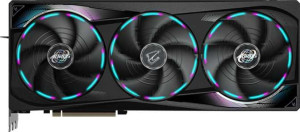
Gigabyte Aorus GeForce RTX 5090 Master

Gigabyte Aorus GeForce RTX 5090 Master

Nvidia RTX Pro 6000 Blackwell Server Edition

Nvidia RTX Pro 6000 Blackwell Server Edition

Performance:
GPU clock speed 2017 MHz 1590 MHz
GPU turbo 2655 MHz 2617 MHz
pixel rate 467.3 GPixel/s 502.5 GPixel/s
floating-point performance 115.5 TFLOPS 126 TFLOPS
texture rate 1805 GTexels/s 1968 GTexels/s
GPU memory speed 1750 MHz 1750 MHz
shading units 21760 24064
texture mapping units (TMUs) 680 752
render output units (ROPs) 176 192
Has Double Precision Floating Point (DPFP)

At first glance, the Gigabyte Aorus GeForce RTX 5090 Master appears faster due to its significantly higher base clock of 2017 MHz versus the Nvidia RTX Pro 6000 Blackwell Server Edition's 1590 MHz. However, clock speed alone is a misleading metric when comparing GPUs with different shader counts. The Pro 6000 fields a substantially larger compute array — 24,064 shading units, 752 TMUs, and 192 ROPs — against the RTX 5090 Master's 21,760, 680, and 176 respectively. More execution units running at a moderately lower clock can — and in this case does — outpace fewer units running faster.

This dynamic plays out clearly in the throughput figures. The Pro 6000 edges ahead in every sustained-workload metric: 126 TFLOPS of floating-point performance versus 115.5 TFLOPS, a texture fill rate of 1,968 GTexels/s versus 1,805 GTexels/s, and a pixel rate of 502.5 GPixel/s versus 467.3 GPixel/s. In practice, these gaps translate to higher throughput in compute-heavy tasks such as 3D rendering, simulation, and AI inference — workloads where raw parallel processing capacity matters more than peak boost frequency. The virtually identical GPU turbo clocks (2,617 vs. 2,655 MHz) and identical memory speeds (1,750 MHz) confirm that the architectural width of the Pro 6000, not a frequency advantage, is the driver of its lead. Both cards also support Double Precision Floating Point, making each viable for scientific and professional compute workloads.

Overall, the RTX Pro 6000 Blackwell Server Edition holds a clear performance edge in this group. Its larger shader array consistently delivers higher throughput across all three key rate metrics, and its floating-point lead of roughly 9% is meaningful for sustained, parallelized workloads. The Aorus RTX 5090 Master's higher base clock provides no practical advantage once the full compute pipeline is considered, and its turbo ceiling is marginally lower. Users prioritizing maximum raw throughput for professional or compute workloads should give the nod to the Pro 6000 based strictly on these figures.
Memory:
effective memory speed 28000 MHz 28000 MHz
maximum memory bandwidth 1790 GB/s 1600 GB/s
VRAM 32GB 96GB
GDDR version GDDR7 GDDR7
memory bus width 512-bit 512-bit
Supports ECC memory

Both the Gigabyte Aorus GeForce RTX 5090 Master and Nvidia RTX Pro 6000 Blackwell Server Edition share some similarities in memory specifications but differ significantly in key areas. Both models have the same effective memory speed of 28000 MHz and use GDDR7 memory, ensuring fast and efficient data processing. Additionally, both cards support ECC memory, providing enhanced error correction capabilities.

In terms of maximum memory bandwidth, the Aorus 5090 Master offers a higher value at 1790 GB/s, compared to the Pro 6000’s 1600 GB/s. This means the Aorus 5090 Master has a slight advantage in memory throughput, though both are high-performance figures.

When it comes to VRAM, the difference is much more pronounced. The Aorus 5090 Master is equipped with 32GB of VRAM, while the Pro 6000 offers a massive 96GB. This gives the Nvidia card a considerable advantage in terms of raw memory capacity, allowing for more complex workloads and larger datasets to be handled simultaneously. Both cards feature a 512-bit memory bus width, so their bandwidth potential is similar, though the memory capacity remains a significant differentiator.

Features:
DirectX version DirectX 12 Ultimate DirectX 12 Ultimate
OpenGL version 4.6 4.6
OpenCL version 3 3
Supports multi-display technology
supports ray tracing
Supports 3D
supports DLSS
has XeSS (XMX)
AMD SAM / Intel Resizable BAR Intel Resizable BAR Intel Resizable BAR
has LHR
has RGB lighting

The Gigabyte Aorus GeForce RTX 5090 Master and Nvidia RTX Pro 6000 Blackwell Server Edition share many common features in this category. Both cards support DirectX 12 Ultimate, OpenGL 4.6, and OpenCL 3, ensuring compatibility with the latest software and applications. They also both support multi-display technology, ray tracing, 3D, and DLSS, making them well-suited for advanced graphical tasks and high-quality gaming or rendering experiences.

In terms of additional features, both products lack XeSS (XMX), indicating that neither supports Intel’s Xe Super Sampling technology. Both also support Intel Resizable BAR, but the Gigabyte Aorus 5090 Master features RGB lighting, while the Nvidia RTX Pro 6000 does not.

Neither card has LHR (Lite Hash Rate), meaning both are suitable for cryptocurrency mining if needed. Overall, the main difference between the two in this category is the inclusion of RGB lighting on the Aorus 5090 Master, which adds a visual customization option not present on the Pro 6000.

Ports:
has an HDMI output
DisplayPort outputs 3 4
USB-C ports 0 0
DVI outputs 0 0
mini DisplayPort outputs 0 0

The Gigabyte Aorus GeForce RTX 5090 Master and Nvidia RTX Pro 6000 Blackwell Server Edition differ in their display output options. The Aorus 5090 Master features an HDMI output and has three DisplayPort outputs, providing a variety of connection choices. In contrast, the Pro 6000 does not have an HDMI output, but it does offer four DisplayPort outputs, giving it a slightly higher number of DisplayPort connections.

Neither card includes USB-C ports, DVI outputs, or mini DisplayPort outputs, meaning there is no difference in those aspects.

Overall, the key difference in ports is that the Aorus 5090 Master includes an HDMI output, while the Pro 6000 does not, but the Pro 6000 compensates with an extra DisplayPort output.

General info:
GPU architecture Blackwell Blackwell
release date January 2025 March 2025
Thermal Design Power (TDP) 575W 600W
PCI Express (PCIe) version 5 5
semiconductor size 5 nm 5 nm
number of transistors 92200 million 92200 million
Has air-water cooling
width 360 mm 266.7 mm
height 150 mm 111.8 mm

Both the Gigabyte Aorus GeForce RTX 5090 Master and Nvidia RTX Pro 6000 Blackwell Server Edition use the Blackwell GPU architecture, ensuring they share a similar foundational design. The Aorus 5090 Master has a thermal design power (TDP) of 575W, while the Pro 6000’s TDP is slightly higher at 600W. This means the Pro 6000 may require a bit more power to operate under load.

In terms of physical size, the Aorus 5090 Master is larger, measuring 360 mm in width and 150 mm in height, compared to the Pro 6000’s 266.7 mm in width and 111.8 mm in height. This makes the Aorus 5090 Master a bulkier card, which may affect compatibility with certain cases or server setups.

Both cards feature a semiconductor size of 5 nm and share the same number of transistors at 92,200 million. Additionally, both products use PCI Express (PCIe) version 5, ensuring they are ready for the latest interface standards. Neither card has air-water cooling, relying on alternative cooling solutions.

Comparison Summary & Verdict

After examining all available data, these two GPUs serve clearly distinct audiences. The Gigabyte Aorus GeForce RTX 5090 Master offers a higher base clock of 2017 MHz, greater memory bandwidth at 1790 GB/s, RGB lighting, and an HDMI output, making it the stronger pick for enthusiast gamers and content creators who want maximum display flexibility and a visually striking build. The Nvidia RTX Pro 6000 Blackwell Server Edition, on the other hand, dominates in raw compute metrics, delivering higher floating-point performance at 126 TFLOPS, more shading units, a superior texture rate, and a massive 96 GB of VRAM, all in a more compact chassis. Professionals running large AI models, scientific simulations, or GPU-intensive server workloads will find the Pro 6000 far better equipped for those demands.

Gigabyte Aorus GeForce RTX 5090 Master
Buy Gigabyte Aorus GeForce RTX 5090 Master if...

Buy the Gigabyte Aorus GeForce RTX 5090 Master if you want a higher base clock speed, greater memory bandwidth, HDMI output, and RGB aesthetics for an enthusiast gaming or creative workstation build.

Nvidia RTX Pro 6000 Blackwell Server Edition
Buy Nvidia RTX Pro 6000 Blackwell Server Edition if...

Buy the Nvidia RTX Pro 6000 Blackwell Server Edition if you need vastly more VRAM at 96 GB, higher compute throughput, and stronger texture and shading performance for professional, AI, or server workloads.