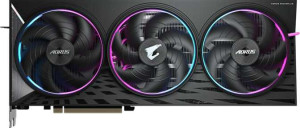
Gigabyte Aorus Radeon RX 9070 XT Elite
Nvidia GeForce RTX 5080

Gigabyte Aorus Radeon RX 9070 XT Elite Nvidia GeForce RTX 5080

Overview

Welcome to our in-depth specification comparison between the Gigabyte Aorus Radeon RX 9070 XT Elite and the Nvidia GeForce RTX 5080. These two high-end graphics cards represent the latest flagship ambitions from AMD and Nvidia, and choosing between them is far from straightforward. We examine the key battlegrounds of raw performance and memory bandwidth, architectural differences, power consumption, and connectivity to help you decide which card best suits your needs.

Common Features

  • Both products support Double Precision Floating Point (DPFP).
  • Both products come with 16GB of VRAM.
  • Both products use a 256-bit memory bus width.
  • ECC memory is supported on both products.
  • Both products support DirectX 12 Ultimate.
  • Both products support OpenGL version 4.6.
  • Multi-display technology is supported on both products.
  • Ray tracing is supported on both products.
  • 3D support is available on both products.
  • XeSS (XMX) is not available on either product.
  • LHR is not present on either product.
  • Both products support up to 4 displays.
  • Both products feature an HDMI output with HDMI version 2.1b.
  • Neither product has USB-C ports.
  • Neither product has DVI outputs.
  • Neither product has mini DisplayPort outputs.
  • Both products use PCIe version 5.
  • Air-water cooling is not available on either product.

Main Differences

  • GPU base clock speed is 1870 MHz on Gigabyte Aorus Radeon RX 9070 XT Elite and 2300 MHz on Nvidia GeForce RTX 5080.
  • GPU turbo clock speed is 3100 MHz on Gigabyte Aorus Radeon RX 9070 XT Elite and 2620 MHz on Nvidia GeForce RTX 5080.
  • Pixel rate is 396.8 GPixel/s on Gigabyte Aorus Radeon RX 9070 XT Elite and 293.4 GPixel/s on Nvidia GeForce RTX 5080.
  • Floating-point performance is 50.79 TFLOPS on Gigabyte Aorus Radeon RX 9070 XT Elite and 56.34 TFLOPS on Nvidia GeForce RTX 5080.
  • Texture rate is 793.6 GTexels/s on Gigabyte Aorus Radeon RX 9070 XT Elite and 880 GTexels/s on Nvidia GeForce RTX 5080.
  • GPU memory speed is 2518 MHz on Gigabyte Aorus Radeon RX 9070 XT Elite and 1875 MHz on Nvidia GeForce RTX 5080.
  • Shading units total 4096 on Gigabyte Aorus Radeon RX 9070 XT Elite and 10752 on Nvidia GeForce RTX 5080.
  • Texture mapping units (TMUs) number 256 on Gigabyte Aorus Radeon RX 9070 XT Elite and 336 on Nvidia GeForce RTX 5080.
  • Render output units (ROPs) number 128 on Gigabyte Aorus Radeon RX 9070 XT Elite and 112 on Nvidia GeForce RTX 5080.
  • Effective memory speed is 20000 MHz on Gigabyte Aorus Radeon RX 9070 XT Elite and 30000 MHz on Nvidia GeForce RTX 5080.
  • Maximum memory bandwidth is 644.6 GB/s on Gigabyte Aorus Radeon RX 9070 XT Elite and 960 GB/s on Nvidia GeForce RTX 5080.
  • VRAM type is GDDR6 on Gigabyte Aorus Radeon RX 9070 XT Elite and GDDR7 on Nvidia GeForce RTX 5080.
  • OpenCL version is 2.2 on Gigabyte Aorus Radeon RX 9070 XT Elite and 3 on Nvidia GeForce RTX 5080.
  • DLSS support is present on Nvidia GeForce RTX 5080 but not available on Gigabyte Aorus Radeon RX 9070 XT Elite.
  • The Gigabyte Aorus Radeon RX 9070 XT Elite uses AMD SAM while the Nvidia GeForce RTX 5080 uses Intel Resizable BAR.
  • RGB lighting is present on Gigabyte Aorus Radeon RX 9070 XT Elite but not available on Nvidia GeForce RTX 5080.
  • HDMI port count is 2 on Gigabyte Aorus Radeon RX 9070 XT Elite and 1 on Nvidia GeForce RTX 5080.
  • DisplayPort output count is 2 on Gigabyte Aorus Radeon RX 9070 XT Elite and 3 on Nvidia GeForce RTX 5080.
  • GPU architecture is RDNA 4.0 on Gigabyte Aorus Radeon RX 9070 XT Elite and Blackwell on Nvidia GeForce RTX 5080.
  • Thermal Design Power (TDP) is 304W on Gigabyte Aorus Radeon RX 9070 XT Elite and 360W on Nvidia GeForce RTX 5080.
  • Semiconductor size is 4 nm on Gigabyte Aorus Radeon RX 9070 XT Elite and 5 nm on Nvidia GeForce RTX 5080.
  • Transistor count is 53900 million on Gigabyte Aorus Radeon RX 9070 XT Elite and 45600 million on Nvidia GeForce RTX 5080.
  • Card width is 339 mm on Gigabyte Aorus Radeon RX 9070 XT Elite and 304 mm on Nvidia GeForce RTX 5080.
  • Card height is 136 mm on Gigabyte Aorus Radeon RX 9070 XT Elite and 137 mm on Nvidia GeForce RTX 5080.
Specs Comparison
Gigabyte Aorus Radeon RX 9070 XT Elite

Gigabyte Aorus Radeon RX 9070 XT Elite

Nvidia GeForce RTX 5080

Nvidia GeForce RTX 5080

Performance:
GPU clock speed 1870 MHz 2300 MHz
GPU turbo 3100 MHz 2620 MHz
pixel rate 396.8 GPixel/s 293.4 GPixel/s
floating-point performance 50.79 TFLOPS 56.34 TFLOPS
texture rate 793.6 GTexels/s 880 GTexels/s
GPU memory speed 2518 MHz 1875 MHz
shading units 4096 10752
texture mapping units (TMUs) 256 336
render output units (ROPs) 128 112
Has Double Precision Floating Point (DPFP)

The clock speed story here is counterintuitive. The RTX 5080 starts higher at a base of 2300 MHz, but the Aorus RX 9070 XT rockets past it under load with a turbo of 3100 MHz versus the 5080's 2620 MHz. This nearly 500 MHz turbo advantage for the AMD card reflects a fundamentally different architectural approach: fewer, faster-clocked compute units versus Nvidia's strategy of deploying a vastly larger number of shading units (10,752 on the 5080 versus 4,096 on the 9070 XT). In practice, raw clock speed alone does not determine performance — what matters is how many operations are completed per second.

When translating those clocks into throughput, the results split by workload type. The RTX 5080 leads in floating-point compute at 56.34 TFLOPS versus 50.79 TFLOPS, and in texture throughput at 880 GTexels/s versus 793.6 GTexels/s — advantages that benefit heavily shaded or compute-intensive scenes. The Aorus RX 9070 XT, however, flips the result for pixel output: its 396.8 GPixel/s pixel rate significantly outpaces the 5080's 293.4 GPixel/s, driven by its higher ROP count (128 vs. 112) combined with its higher turbo clock. This translates to a tangible rasterization edge in fill-rate-bound scenarios. The 9070 XT also pairs this with considerably faster memory at 2518 MHz versus the 5080's 1875 MHz, which helps feed its pipeline efficiently.

Overall, neither card dominates unconditionally. The RTX 5080 holds a clear edge in raw compute and texturing throughput, which favors complex shader workloads and GPU-accelerated tasks. The Aorus RX 9070 XT counters with a meaningful lead in pixel fill rate and memory speed, suggesting stronger performance in traditional rasterized rendering pipelines. Both support Double Precision Floating Point. For pure rasterization efficiency the 9070 XT has a structural advantage; for compute-heavy or texture-saturated workloads, the 5080 pulls ahead.

Memory:
effective memory speed 20000 MHz 30000 MHz
maximum memory bandwidth 644.6 GB/s 960 GB/s
VRAM 16GB 16GB
GDDR version GDDR6 GDDR7
memory bus width 256-bit 256-bit
Supports ECC memory

Both cards arrive with identical 16GB of VRAM over a 256-bit bus, which sets a common capacity baseline — plenty for current high-resolution gaming and most professional workloads. Where they sharply diverge is in memory generation and the bandwidth it delivers. The RTX 5080 uses GDDR7, while the Aorus RX 9070 XT relies on GDDR6, and that generational gap compounds directly into throughput: the 5080 achieves an effective speed of 30,000 MHz versus the 9070 XT's 20,000 MHz — a 50% deficit for the AMD card.

That speed gap materializes into a decisive bandwidth advantage for Nvidia. The RTX 5080 delivers 960 GB/s of peak memory bandwidth against the 9070 XT's 644.6 GB/s — a difference of over 315 GB/s. In practice, memory bandwidth is the pipeline that feeds the GPU's compute cores; when it is constrained, even a fast GPU can stall waiting for data. At high resolutions or with demanding texture assets, this bandwidth gap can directly translate into smoother frame delivery and less stuttering in memory-bound scenarios.

Both cards support ECC memory, which is a useful feature for workstation and compute use cases where data integrity matters. But on the memory subsystem as a whole, the RTX 5080 holds a clear and significant advantage, driven entirely by its GDDR7 technology. The Aorus RX 9070 XT's GDDR6 implementation is competitive for its class, but it cannot close a gap this large through clock speeds or bus width alone.

Features:
DirectX version DirectX 12 Ultimate DirectX 12 Ultimate
OpenGL version 4.6 4.6
OpenCL version 2.2 3
Supports multi-display technology
supports ray tracing
Supports 3D
supports DLSS
has XeSS (XMX)
AMD SAM / Intel Resizable BAR AMD SAM Intel Resizable BAR
has LHR
has RGB lighting
supported displays 4 4

At the foundation, these two cards share the same essential feature tier: DirectX 12 Ultimate, OpenGL 4.6, ray tracing support, and the ability to drive up to 4 displays simultaneously. For the vast majority of gaming and productivity scenarios, this common ground means neither card is locked out of any major rendering feature set or modern API.

The most consequential divergence is upscaling. The RTX 5080 supports DLSS, Nvidia's AI-driven upscaling technology, which allows the GPU to render at a lower internal resolution and reconstruct a higher-quality image — often with minimal visual compromise and significant frame rate gains. The Aorus RX 9070 XT lacks DLSS and instead relies on AMD's own upscaling ecosystem (not listed in the provided specs as a distinct feature entry). For users who game primarily in titles with strong DLSS integration, this is a practical, session-to-session advantage for the Nvidia card. The RTX 5080 also edges ahead on OpenCL 3 versus the 9070 XT's OpenCL 2.2, which matters for GPU-accelerated compute workloads and certain creative applications that leverage newer OpenCL features.

One minor lifestyle differentiator: the Aorus RX 9070 XT includes RGB lighting, while the RTX 5080 does not — relevant for aesthetics-focused builds but irrelevant to performance. On balance, the RTX 5080 holds a functional edge in this group, primarily due to DLSS support, which has broad real-world game compatibility and tangible frame rate implications that the 9070 XT cannot directly replicate from the specs provided here.

Ports:
has an HDMI output
HDMI ports 2 1
HDMI version HDMI 2.1b HDMI 2.1b
DisplayPort outputs 2 3
USB-C ports 0 0
DVI outputs 0 0
mini DisplayPort outputs 0 0

Both cards top out at four total display outputs and share the same HDMI 2.1b standard, so neither has an edge in maximum display count or HDMI bandwidth. The difference lies entirely in how those four ports are distributed. The Aorus RX 9070 XT offers 2 HDMI + 2 DisplayPort, while the RTX 5080 flips that balance to 1 HDMI + 3 DisplayPort.

In practice, this split matters depending on your display setup. Users running multiple HDMI-connected devices — such as a TV alongside a monitor, or a capture device — will find the 9070 XT's dual HDMI configuration more immediately convenient, eliminating the need for adapters. The RTX 5080's three DisplayPort outputs, on the other hand, suit multi-monitor desktop users who typically rely on DisplayPort for high-refresh or high-resolution panels, and who only need HDMI as a secondary connection.

Neither layout is objectively superior — the right choice depends entirely on the user's existing display hardware. However, since HDMI-to-DisplayPort adapters are common and inexpensive while the reverse is less straightforward, the RTX 5080's extra DisplayPort output offers marginally more flexibility for enthusiast multi-monitor configurations. For anyone with multiple HDMI displays, the Aorus RX 9070 XT is the more plug-and-play option. Overall, this group is effectively a tie in capability, with port layout preference determining the winner for any individual user.

General info:
GPU architecture RDNA 4.0 Blackwell
release date March 2025 January 2025
Thermal Design Power (TDP) 304W 360W
PCI Express (PCIe) version 5 5
semiconductor size 4 nm 5 nm
number of transistors 53900 million 45600 million
Has air-water cooling
width 339 mm 304 mm
height 136 mm 137 mm

The silicon story here is one of the more interesting in this comparison. The Aorus RX 9070 XT is built on a 4 nm process and packs 53,900 million transistors, while the RTX 5080 uses a 5 nm node with 45,600 million transistors. AMD's smaller node allows it to fit more transistors into less die area, which contributes directly to its lower power envelope — and that gap is significant. The 9070 XT carries a TDP of 304W against the RTX 5080's 360W, a difference of 56W that adds up meaningfully in sustained workloads, both in electricity draw and heat expelled into the case.

From a physical standpoint, the RTX 5080 is actually the more compact card at 304 mm in length versus the 9070 XT's 339 mm, despite its higher power draw — a reminder that card length is driven by cooler design choices rather than chip size alone. Heights are nearly identical at roughly 136–137 mm, so both cards occupy a similar vertical footprint in a chassis. Both use PCIe 5.0, meaning neither is held back by interface bandwidth on a modern motherboard.

On the fundamentals of this group, the Aorus RX 9070 XT holds a clear efficiency advantage: a more advanced manufacturing node, more transistors, and a notably lower TDP. For users in thermally constrained cases, smaller power supplies, or those mindful of long-term running costs, the 9070 XT presents a more power-efficient foundation. The RTX 5080's 360W demand requires more headroom from both the PSU and the cooling solution, which is a practical consideration beyond raw performance.
Comparison Summary & Verdict

After a thorough look at the specs, both cards clearly target enthusiast-level users but cater to different priorities. The Gigabyte Aorus Radeon RX 9070 XT Elite stands out with a higher GPU turbo clock of 3100 MHz, a superior pixel rate, more transistors packed into a smaller 4 nm process, RGB lighting, and dual HDMI outputs, making it a compelling choice for users who value clock speed headroom and connectivity flexibility. The Nvidia GeForce RTX 5080, on the other hand, leads in raw memory bandwidth at 960 GB/s, GDDR7 memory, higher shading unit count, floating-point performance, and the exclusive advantage of DLSS support, making it the stronger pick for compute-heavy workloads and AI-accelerated gaming. Both share 16GB VRAM, PCIe 5, ray tracing, and DirectX 12 Ultimate support, so the decision ultimately comes down to your specific workflow and ecosystem preference.

Gigabyte Aorus Radeon RX 9070 XT Elite
Buy Gigabyte Aorus Radeon RX 9070 XT Elite if...

Buy the Gigabyte Aorus Radeon RX 9070 XT Elite if you want a higher turbo clock speed, a more advanced 4 nm chip with more transistors, RGB lighting, and dual HDMI outputs at a likely lower power draw of 304W.

Nvidia GeForce RTX 5080
Buy Nvidia GeForce RTX 5080 if...

Buy the Nvidia GeForce RTX 5080 if you prioritize superior memory bandwidth with GDDR7, a higher shading unit count, DLSS support for AI-accelerated gaming, and more DisplayPort outputs.