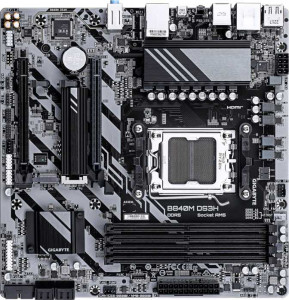
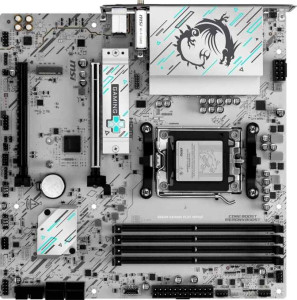
Both boards share the same essential platform foundation: the AM5 socket, B840 chipset, and Micro-ATX form factor, making them direct competitors targeting the same build scenarios. They also match on HDMI 2.1 output, overclocking support, a single CPU socket, no integrated graphics, and an identical 3-year warranty. Their physical dimensions are virtually the same at roughly 244 mm × 244 mm, so case compatibility is a non-issue when choosing between them.
The real differentiation lies in connectivity and convenience features. The MSI B840M Gaming Plus Wi-Fi 6E includes built-in Wi-Fi 6E and Bluetooth, which eliminates the need for a separate wireless adapter — a meaningful cost and slot saving for builds without easy Ethernet access. It also adds RGB lighting for aesthetics and, more practically, an easy BIOS reset mechanism, which is a genuine quality-of-life advantage when troubleshooting boot failures or bad overclocks. The Gigabyte B840M DS3H, by contrast, offers none of those, but counters with dual BIOS — a hardware-level failsafe that lets the board recover from a corrupted firmware flash automatically, something the MSI lacks entirely.
For most users, the MSI holds a clear overall edge in this group: wireless connectivity alone justifies its position for anyone building in a location without a wired network drop, and the easy BIOS reset adds everyday convenience. The Gigabyte's dual BIOS is a valuable safety net for enthusiasts who flash firmware frequently, but it is a narrower use case. If wireless is irrelevant to your build and firmware resilience is a priority, the Gigabyte makes sense; otherwise, the MSI offers more practical value out of the box.