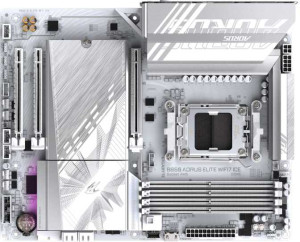
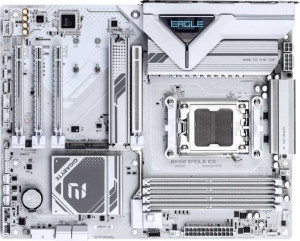
At a foundational level, these two boards share the same DNA: both use the AM5 socket with a B850 chipset on a standard ATX form factor (244 × 305 mm), support overclocking, feature RGB lighting, include dual BIOS for firmware recovery, and come with a 3-year warranty. For a builder focused purely on platform capabilities and physical fit, either board slots into the same case and pairs with the same CPU lineup.
The decisive split in this group comes down to wireless connectivity. The Aorus Elite WiFi7 Ice includes both Wi-Fi and Bluetooth, while the Eagle Ice offers neither. This is not a minor footnote: Wi-Fi 7 delivers significantly higher throughput and lower latency than previous generations, making it relevant not just for convenience but for high-bandwidth use cases. Bluetooth adds value for peripherals, audio devices, and system management without dongles. The Eagle Ice forces you to either run an Ethernet cable or purchase a separate wireless adapter — adding cost and an occupied PCIe or USB slot.
For most users, the Aorus Elite WiFi7 Ice holds a clear advantage in this group strictly because of its integrated wireless stack. The Eagle Ice is evenly matched on every other general specification, so if you have a guaranteed wired Ethernet connection and no need for Bluetooth, the gap narrows — but the Elite's inclusion of Wi-Fi 7 and Bluetooth at no extra platform complexity gives it a meaningful real-world edge for the majority of builds.