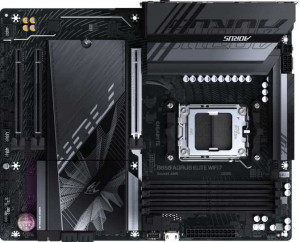
Gigabyte B850 Aorus Elite WiFi7
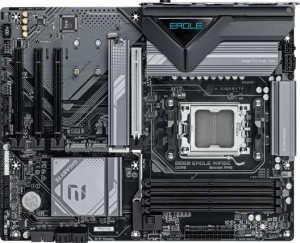
Gigabyte B850 Eagle WiFi6E

Gigabyte B850 Aorus Elite WiFi7 Gigabyte B850 Eagle WiFi6E

Overview

Welcome to our in-depth specification comparison between the Gigabyte B850 Aorus Elite WiFi7 and the Gigabyte B850 Eagle WiFi6E. Both boards share the same AM5 socket, B850 chipset, and ATX form factor, making them natural rivals in the mid-range motherboard segment. The real battlegrounds lie in their wireless connectivity standards, rear port configurations, and feature sets aimed at different types of builders. Read on to see how every spec stacks up before making your decision.

Common Features

  • Both products use the AM5 CPU socket.
  • Both products feature the B850 chipset.
  • Both products come in the ATX form factor.
  • Wi-Fi connectivity is supported on both products.
  • Bluetooth is available on both products.
  • Overclocking is supported on both products.
  • Easy BIOS reset is not available on either product.
  • Dual BIOS is present on both products.
  • Both products support a maximum memory amount of 256GB.
  • Both products support a maximum RAM speed of 5200 MHz and an overclocked RAM speed of 8200 MHz.
  • Both products have 4 memory slots and support DDR5 memory across 2 memory channels.
  • ECC memory is not supported on either product.
  • Both products have 2 USB 3.2 Gen 2 ports (USB-A), 4 USB 2.0 ports, and 1 DisplayPort output.
  • USB 3.2 Gen 2x2, USB 4 40Gbps, USB 4 20Gbps, Thunderbolt 3, and Thunderbolt 4 ports are not available on either product.
  • Both products include 2 USB 3.2 Gen 1 ports and 4 USB 2.0 ports through expansion, along with 2 USB 3.0 ports through expansion.
  • Both products have 4 SATA 3 connectors, 6 fan headers, 3 M.2 sockets, and a TPM connector.
  • U.2 sockets are not present on either product.
  • Both products have 1 PCIe 5.0 x16 slot and no PCIe 4.0, 3.0, or 2.0 x16 slots, PCI slots, PCIe x4 slots, or PCIe x8 slots.
  • Both products support 7.1 audio channels.
  • Both products support RAID 0, RAID 1, RAID 5, and RAID 10 (1+0), while RAID 0+1 is not supported on either product.

Main Differences

  • Wi-Fi version support extends to Wi-Fi 7 (802.11be) on Gigabyte B850 Aorus Elite WiFi7, while Gigabyte B850 Eagle WiFi6E tops out at Wi-Fi 6E (802.11ax).
  • Bluetooth version is 5.4 on Gigabyte B850 Aorus Elite WiFi7 and 5.3 on Gigabyte B850 Eagle WiFi6E.
  • RGB lighting is present on Gigabyte B850 Aorus Elite WiFi7 but not available on Gigabyte B850 Eagle WiFi6E.
  • USB 3.2 Gen 1 ports (USB-A) count is 5 on Gigabyte B850 Aorus Elite WiFi7 and 2 on Gigabyte B850 Eagle WiFi6E.
  • A USB 3.2 Gen 2 port (USB-C) is present on Gigabyte B850 Aorus Elite WiFi7 but not available on Gigabyte B850 Eagle WiFi6E.
  • A USB 3.2 Gen 1 port (USB-C) is present on Gigabyte B850 Eagle WiFi6E but not available on Gigabyte B850 Aorus Elite WiFi7.
  • An HDMI output is present on Gigabyte B850 Eagle WiFi6E but not available on Gigabyte B850 Aorus Elite WiFi7.
  • A PS/2 port is present on Gigabyte B850 Eagle WiFi6E but not available on Gigabyte B850 Aorus Elite WiFi7.
  • PCIe x1 slot count is 2 on Gigabyte B850 Aorus Elite WiFi7 and 3 on Gigabyte B850 Eagle WiFi6E.
  • An S/PDIF Out port is present on Gigabyte B850 Aorus Elite WiFi7 but not available on Gigabyte B850 Eagle WiFi6E.
  • Audio connector count is 2 on Gigabyte B850 Aorus Elite WiFi7 and 3 on Gigabyte B850 Eagle WiFi6E.
Specs Comparison
Gigabyte B850 Aorus Elite WiFi7

Gigabyte B850 Aorus Elite WiFi7

Gigabyte B850 Eagle WiFi6E

Gigabyte B850 Eagle WiFi6E

General info:
CPU socket AM5 AM5
chipset B850 B850
form factor ATX ATX
release date January 2025 January 2025
supports Wi-Fi
Wi-Fi version Wi-Fi 4 (802.11n), Wi-Fi 5 (802.11ac), Wi-Fi 6 (802.11ax), Wi-Fi 6E (802.11ax), Wi-Fi 7 (802.11be) Wi-Fi 4 (802.11n), Wi-Fi 5 (802.11ac), Wi-Fi 6 (802.11ax), Wi-Fi 6E (802.11ax)
Has Bluetooth
Bluetooth version 5.4 5.3
Easy to overclock
has RGB lighting
Easy to reset BIOS
Has dual BIOS
has aptX
CPU sockets 1 1
Has integrated graphics
warranty period 3 years 3 years
height 244 mm 244 mm
width 305 mm 305 mm
Has integrated CPU

Both the Gigabyte B850 Aorus Elite WiFi7 and the Gigabyte B850 Eagle WiFi6E share the same foundational platform: the AM5 socket, B850 chipset, and standard ATX form factor at identical dimensions (244 × 305 mm). They both support overclocking, include dual BIOS for recovery safety, carry a 3-year warranty, and lack integrated graphics or CPU — so for the vast majority of platform-level decisions, these two boards are functionally equivalent.

The most meaningful differentiator is wireless connectivity. The Aorus Elite supports Wi-Fi 7 (802.11be), while the Eagle tops out at Wi-Fi 6E (802.11ax). Wi-Fi 7 brings significantly higher theoretical throughput, lower latency, and multi-link operation — advantages that matter if you have a Wi-Fi 7 router and demand peak wireless performance for gaming or large file transfers. Similarly, the Aorus Elite's Bluetooth 5.4 offers modest improvements in reliability and connection efficiency over the Eagle's Bluetooth 5.3, though this gap is unlikely to be noticeable in everyday use. The Eagle also lacks RGB lighting, which the Aorus Elite includes — a purely aesthetic distinction, but relevant for builders planning a themed system.

Overall, the Aorus Elite WiFi7 holds a clear edge in this category, driven entirely by its superior wireless stack. If you own or plan to upgrade to a Wi-Fi 7 router, that advantage is tangible. For users content with Wi-Fi 6E and indifferent to RGB, the Eagle delivers an identical core platform at what is typically a lower price point.
Memory:
maximum memory amount 256GB 256GB
RAM speed (max) 5200 MHz 5200 MHz
overclocked RAM speed 8200 MHz 8200 MHz
memory slots 4 4
DDR memory version 5 5
memory channels 2 2
Supports ECC memory

The Gigabyte B850 Aorus Elite WiFi7 and the Gigabyte B850 Eagle WiFi6E have identical specifications when it comes to memory. Both motherboards support a maximum memory amount of 256GB, feature 4 memory slots, and utilize DDR5 memory. The RAM speed (max) is the same for both, reaching 5200 MHz, and both motherboards support overclocked RAM speeds up to 8200 MHz. Additionally, both products use a dual-channel memory configuration and do not support ECC memory.

Since all memory-related specifications are the same for both the Aorus Elite WiFi7 and the Eagle WiFi6E, there are no differences to note in this category. Users can expect similar memory performance and capacity from either product, with no distinction in speed, channels, or compatibility features.

Overall, the memory specifications for both motherboards are virtually identical, offering 256GB capacity, fast speeds, and dual-channel support, making them equally suited for high-performance memory configurations.

Ports:
USB 3.2 Gen 2 ports (USB-A) 2 2
USB 3.2 Gen 1 ports (USB-A) 5 2
USB 3.2 Gen 2 ports (USB-C) 1 0
USB 3.2 Gen 1 ports (USB-C) 0 1
USB 2.0 ports 4 4
USB 3.2 Gen 2x2 ports 0 0
USB 4 40Gbps ports 0 0
USB 4 20Gbps ports 0 0
Thunderbolt 4 ports 0 0
Thunderbolt 3 ports 0 0
has an HDMI output
DisplayPort outputs 1 1
RJ45 ports 1 1
Has USB Type-C
eSATA ports 0 0
DVI outputs 0 0
has a VGA connector
PS/2 ports 0 1

The Gigabyte B850 Aorus Elite WiFi7 and the Gigabyte B850 Eagle WiFi6E both offer a range of ports, with some key differences. Both motherboards include 2 USB 3.2 Gen 2 USB-A ports and 4 USB 2.0 ports. The Aorus Elite WiFi7 has 5 USB 3.2 Gen 1 USB-A ports, while the Eagle WiFi6E only has 2. The Aorus Elite WiFi7 also provides 1 USB 3.2 Gen 2 USB-C port, whereas the Eagle WiFi6E has 1 USB 3.2 Gen 1 USB-C port. Both motherboards feature USB Type-C support, but only the Aorus Elite WiFi7 offers a Gen 2 version of the USB-C port.

On the video output front, the Aorus Elite WiFi7 lacks an HDMI output but includes a DisplayPort output, while the Eagle WiFi6E provides an HDMI output in addition to its DisplayPort output. Both motherboards are equipped with 1 RJ45 port for Ethernet connectivity. Additionally, the Aorus Elite WiFi7 has no PS/2 ports, while the Eagle WiFi6E includes 1 PS/2 port. Neither motherboard offers eSATA ports, DVI outputs, or VGA connectors.

In summary, while both motherboards have similar port options overall, the Aorus Elite WiFi7 stands out with its additional USB 3.2 Gen 1 USB-A ports, Gen 2 USB-C port, and absence of HDMI. The Eagle WiFi6E, on the other hand, includes an HDMI output and a PS/2 port, which the Aorus Elite WiFi7 lacks.

Connectors:
USB 3.2 Gen 1 ports (through expansion) 2 2
USB 2.0 ports (through expansion) 4 4
SATA 3 connectors 4 4
fan headers 6 6
USB 3.0 ports (through expansion) 2 2
M.2 sockets 3 3
Has TPM connector
U.2 sockets 0 0
Has mSATA connector
SATA 2 connectors 0 0

The Gigabyte B850 Aorus Elite WiFi7 and the Gigabyte B850 Eagle WiFi6E are identical in terms of connectors. Both motherboards offer 2 USB 3.2 Gen 1 ports through expansion, 4 USB 2.0 ports through expansion, 2 USB 3.0 ports through expansion, and 4 SATA 3 connectors. Additionally, both have 6 fan headers and 3 M.2 sockets. They also share the presence of a TPM connector, though neither has a U.2 socket, an mSATA connector, or SATA 2 connectors.

There are no differences between the two products in this category. Both motherboards offer the same set of connectors, providing users with similar expansion options for storage, fans, and USB devices.

In summary, when it comes to connectors, the Aorus Elite WiFi7 and Eagle WiFi6E are perfectly matched, with no discrepancies between the two models in terms of available ports and expansion options.

Expansion slots:
PCIe 4.0 x16 slots 0 0
PCIe 5.0 x16 slots 1 1
PCIe 3.0 x16 slots 0 0
PCIe x1 slots 2 3
PCI slots 0 0
PCIe 2.0 x16 slots 0 0
PCIe x4 slots 0 0
PCIe x8 slots 0 0

The Gigabyte B850 Aorus Elite WiFi7 and the Gigabyte B850 Eagle WiFi6E share several similarities in their expansion slot configurations, with both featuring 1 PCIe 5.0 x16 slot. However, there are differences in the number of PCIe x1 slots. The Aorus Elite WiFi7 includes 2 PCIe x1 slots, while the Eagle WiFi6E has 3 PCIe x1 slots. Both motherboards lack PCIe 4.0 x16 slots, PCIe 3.0 x16 slots, PCI slots, PCIe 2.0 x16 slots, PCIe x4 slots, and PCIe x8 slots.

Overall, both motherboards offer very similar expansion slot options, with the main distinction being that the Eagle WiFi6E provides one additional PCIe x1 slot compared to the Aorus Elite WiFi7. Other than that, the configuration is nearly identical between the two models, with no other notable differences in slot types or availability.

In summary, while the two products are very close in terms of expansion slots, the Gigabyte B850 Eagle WiFi6E has a slight edge with one more PCIe x1 slot compared to the Aorus Elite WiFi7, but otherwise, both motherboards provide the same range of expansion options.

Audio:
audio channels 7.1 7.1
Has S/PDIF Out port
audio connectors 2 3

The Gigabyte B850 Aorus Elite WiFi7 and the Gigabyte B850 Eagle WiFi6E both support 7.1 audio channels, ensuring high-quality audio output. However, there are some differences in the audio features. The Aorus Elite WiFi7 includes an S/PDIF Out port, allowing for digital audio output, while the Eagle WiFi6E does not have this port. Additionally, the Aorus Elite WiFi7 is equipped with 2 audio connectors, while the Eagle WiFi6E offers 3 audio connectors.

While both motherboards provide similar 7.1 channel audio capabilities, the Aorus Elite WiFi7 has the advantage of an S/PDIF Out port, which is absent on the Eagle WiFi6E. On the other hand, the Eagle WiFi6E has one more audio connector than the Aorus Elite WiFi7, offering slightly more flexibility in terms of physical audio device connections.

In summary, the Aorus Elite WiFi7 excels with the inclusion of the S/PDIF Out port, while the Eagle WiFi6E offers an extra audio connector, giving users a trade-off between digital audio output and physical connection options.

Storage:
Supports RAID 1
Supports RAID 10 (1+0)
Supports RAID 5
Supports RAID 0
Supports RAID 0+1

The Gigabyte B850 Aorus Elite WiFi7 and the Gigabyte B850 Eagle WiFi6E both support a range of RAID configurations, including RAID 1, RAID 10 (1+0), RAID 5, and RAID 0. Neither motherboard supports RAID 0+1. These storage features are identical for both products, meaning there is no difference in terms of RAID support between the two models.

Both motherboards offer the same RAID functionality, allowing users to configure storage arrays for redundancy and performance. RAID 1, RAID 10, RAID 5, and RAID 0 are supported on both, giving users flexibility for their storage setups.

In summary, the storage capabilities of the Aorus Elite WiFi7 and Eagle WiFi6E are exactly the same, with both supporting the same set of RAID configurations and no difference in storage-related features.

Comparison Summary & Verdict

After examining every specification, both boards deliver a solid foundation with identical memory support, storage options, and expansion capabilities. The Gigabyte B850 Aorus Elite WiFi7 pulls ahead for enthusiasts who demand cutting-edge wireless performance, offering Wi-Fi 7 and Bluetooth 5.4, a richer rear USB layout with more USB-A ports and a USB-C Gen 2 port, RGB lighting, and an S/PDIF digital audio output. The Gigabyte B850 Eagle WiFi6E, on the other hand, caters to users who value practical legacy connectivity, bringing an HDMI output, a PS/2 port, an extra PCIe x1 slot, and one additional audio jack. Neither board is objectively superior; the right choice depends entirely on your specific build requirements and peripheral ecosystem.

Gigabyte B850 Aorus Elite WiFi7
Buy Gigabyte B850 Aorus Elite WiFi7 if...

Buy the Gigabyte B850 Aorus Elite WiFi7 if you want the latest Wi-Fi 7 wireless standard, more rear USB-A ports, a USB-C Gen 2 connector, RGB lighting, and a digital S/PDIF audio output.

Gigabyte B850 Eagle WiFi6E
Buy Gigabyte B850 Eagle WiFi6E if...

Buy the Gigabyte B850 Eagle WiFi6E if you need a built-in HDMI output, a PS/2 port for legacy peripherals, an extra PCIe x1 slot, or an additional analog audio connector.