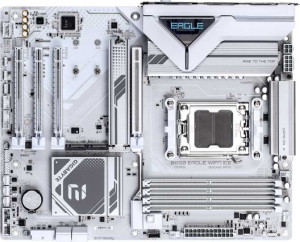
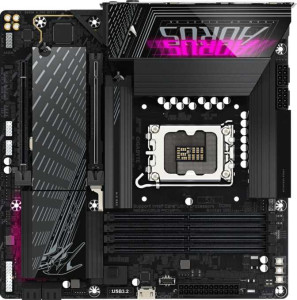
The most fundamental split between these two boards is platform allegiance. The Gigabyte B850 Eagle Wi-Fi7 Ice uses an AM5 socket paired with the B850 chipset, targeting AMD Ryzen processors, while the Gigabyte B860M Aorus Pro WiFi7 uses an LGA 1851 socket with the B860 chipset, designed for Intel's current-generation CPUs. This means these boards are not cross-comparable by preference alone — your CPU choice makes the decision for you. Neither platform has an inherent advantage from the specs provided here.
Form factor is the second major differentiator. The Eagle Wi-Fi7 Ice is a full-size ATX board (305 × 244 mm), offering more room for expansion slots, VRM circuitry, and airflow routing inside a mid-tower or larger case. The Aorus Pro WiFi7 is Micro-ATX (244 × 244 mm), making it the better fit for compact builds — but that smaller footprint typically means fewer PCIe slots and a more constrained layout. One meaningful advantage the Aorus Pro WiFi7 holds is its dual BIOS feature, which the Eagle lacks. In practice, dual BIOS provides a hardware-level recovery fallback if a firmware update goes wrong, a genuinely useful safeguard for less experienced builders or anyone who updates firmware frequently.
Beyond those differences, the two boards are remarkably well-matched in this category: both support Wi-Fi 7 (including all prior Wi-Fi generations), Bluetooth 5.4, HDMI 2.1, RGB lighting, a 3-year warranty, and both are rated as easy to overclock. Neither offers an easy BIOS reset mechanism or aptX audio. Overall, if form factor is neutral for your build, the Aorus Pro WiFi7 earns a modest edge in this group thanks to its dual BIOS safety net — but the more decisive factor here is simply which CPU platform you are building on.