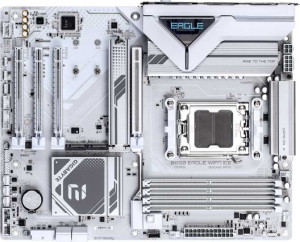
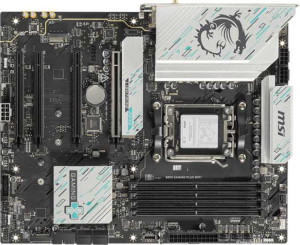
Both boards share the same fundamental platform: the AM5 socket with a B850 chipset in a standard ATX form factor. They are virtually identical twins at the connectivity level — both support the full Wi-Fi 7 (802.11be) stack down to Wi-Fi 4, pair it with Bluetooth 5.4 for lower latency and improved range over older BT versions, and both carry a 3-year warranty. For a buyer focused purely on wireless capability or platform compatibility, there is nothing to separate them here.
The meaningful divergence appears in BIOS resilience features. The MSI B850 Gaming Plus WiFi offers both an easy BIOS reset mechanism and a dual BIOS chip, while the Gigabyte B850 Eagle Wi-Fi7 Ice has neither. In practice, dual BIOS acts as a safety net: if a firmware flash goes wrong or corruption occurs, the board can automatically fall back to the backup chip, avoiding a potentially unbootable system. An easy reset button further lowers the barrier for recovering from a bad overclock or misconfiguration without needing to dig for the clear-CMOS jumper. These are not exotic features, but they meaningfully reduce risk for users who push settings or update firmware frequently.
In this spec group, the MSI B850 Gaming Plus WiFi holds a clear practical edge. The shared strengths — Wi-Fi 7, Bluetooth 5.4, overclocking support, RGB, and identical warranty — make the platform parity a wash, but the addition of dual BIOS and an easy BIOS reset gives MSI a tangible reliability advantage that the Gigabyte simply does not offer at this tier.