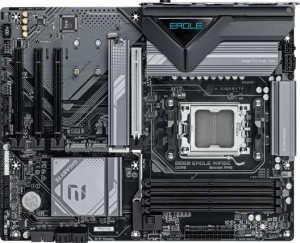
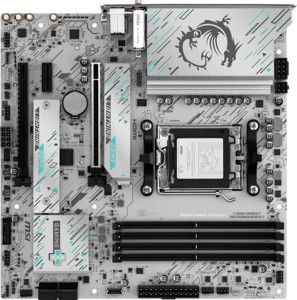
Both boards share the same AM5 socket and B850 chipset foundation, and both support overclocking, dual BIOS, and identical HDMI 2.1 output — so on paper they serve the same platform and use case. The most structural difference is form factor: the Gigabyte B850 Eagle WiFi6E is a full-size ATX board (305 × 244 mm), while the MSI B850M Gaming Plus Wi-Fi is a compact Micro-ATX (243.8 × 243.8 mm). This matters when choosing a case — the MSI fits smaller builds, while the Gigabyte offers more room for expansion slots and potentially better component spacing.
On wireless connectivity, the MSI has a tangible edge: it supports Wi-Fi 7 (802.11be), the latest standard offering significantly higher throughput and lower latency than Wi-Fi 6E, which is the ceiling on the Gigabyte. Its Bluetooth 5.4 also edges out the Gigabyte's 5.3, though the real-world difference there is minimal. More practically, the MSI also wins on usability features — it includes RGB lighting for those who care about aesthetics, and critically, it supports easy BIOS reset, which the Gigabyte does not. For less experienced builders or overclockers who may need to recover from a bad BIOS setting, that is a meaningful convenience advantage.
Overall, the MSI B850M Gaming Plus Wi-Fi holds a clear edge in this general category: it offers newer wireless technology, a more user-friendly BIOS reset mechanism, and added RGB — all while fitting into a smaller footprint. The Gigabyte's ATX size is only an advantage if you specifically need the extra expansion space that a larger board provides. For most users, the MSI delivers more features per square centimeter, with no meaningful trade-offs on the core specs both boards share equally.