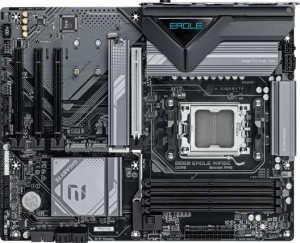
Both boards share the same foundational DNA: the AM5 socket, B850 chipset, and standard ATX form factor, meaning they target the same platform and fit the same cases. Overclocking support, a dual BIOS, HDMI 2.1 output, and a 3-year warranty are also common to both — so for core platform compatibility, neither board has an edge.
The meaningful differences emerge in the details. The MSI MAG B850 Tomahawk Max WiFi supports Wi-Fi 7 (802.11be), while the Gigabyte tops out at Wi-Fi 6E. In practice, Wi-Fi 7 delivers significantly higher theoretical throughput and lower latency, particularly on congested networks, and is future-proof for routers that are only now entering the mainstream. The MSI also edges ahead on Bluetooth 5.4 versus 5.3 on the Gigabyte — a minor but real improvement in connection stability and energy efficiency. Additionally, the MSI includes an easy BIOS reset mechanism and RGB lighting, whereas the Gigabyte offers neither; the former is a genuine convenience during troubleshooting, while the latter is purely aesthetic.
Overall, the MSI MAG B850 Tomahawk Max WiFi holds a clear advantage in this category. Wi-Fi 7 support alone is a substantive, future-oriented differentiator, and the easier BIOS reset adds practical value. The Gigabyte B850 Eagle WiFi6E is not deficient in any critical way, but it offers less connectivity headroom and fewer quality-of-life features for what is likely a comparable price tier.