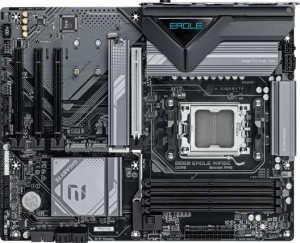
Both boards share the same AM5 socket and B850 chipset foundation, meaning they target the same generation of AMD processors with identical platform-level overclocking support. Connectivity basics are also aligned: both include Bluetooth 5.3 and Wi-Fi as standard, and carry a 3-year warranty. Neither board features RGB lighting or an easy BIOS reset mechanism, so users looking for those conveniences will need to look elsewhere regardless of which they choose.
The most meaningful divergence in this group is threefold. First, form factor: the Gigabyte B850 Eagle WiFi6E is a full ATX board (305 × 244 mm), while the Sapphire Pulse B850M Wi-Fi is Micro-ATX (244 × 235 mm). This directly determines case compatibility — the Gigabyte requires a mid-tower or larger, whereas the Sapphire fits in smaller Micro-ATX enclosures, making it the only viable option for compact builds. Second, the Gigabyte supports Wi-Fi 6E (802.11ax), adding access to the 6 GHz band for reduced congestion and potentially lower latency in dense wireless environments, while the Sapphire tops out at Wi-Fi 6. Third, the Gigabyte includes a dual BIOS feature — a hardware-level safety net that lets the board recover from a failed firmware update automatically — which the Sapphire lacks entirely.
In terms of general platform specs, these two boards are closely matched, but the Gigabyte holds a clear edge for users who prioritize resilience (dual BIOS) and future-ready wireless (Wi-Fi 6E), provided they have the case space for an ATX build. The Sapphire is the logical pick for anyone working within a compact chassis constraint, accepting the trade-offs on wireless range and BIOS redundancy in exchange for a smaller footprint.