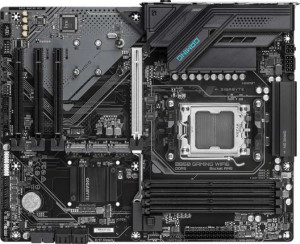
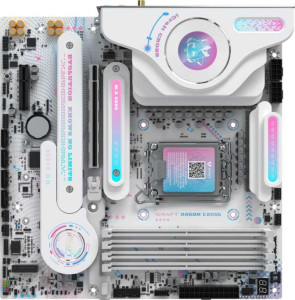
The most fundamental difference here is platform: the Gigabyte B850 Gaming WiFi6 uses the AM5 socket for AMD Ryzen processors, while the Maxsun iCraft B860M Cross uses LGA 1851 for Intel's latest generation. This is a decisive compatibility split — your CPU choice locks you into one board or the other, making this less a comparison of quality and more a matter of ecosystem. Beyond the socket, form factor diverges significantly: the Gigabyte is a full ATX board (305×244 mm), offering more expansion slots and easier cable management in mid-to-full tower cases, while the Maxsun is a compact Micro-ATX (245×245 mm), better suited for smaller builds where footprint matters.
On connectivity, both boards support Wi-Fi 6 and Bluetooth 5.3, but the Maxsun edges ahead by also including Wi-Fi 6E (the 6 GHz band), which delivers less congestion and higher throughput in dense network environments. The Gigabyte counters with a newer HDMI 2.1 output — relevant if you plan to drive a high-refresh 4K display directly from the board — versus the Maxsun's HDMI 2.0, which caps out at 4K/60Hz. Both boards support overclocking and include dual BIOS, a valuable safety net for failed firmware updates. However, the Maxsun adds an easy BIOS reset mechanism and RGB lighting, small but practical quality-of-life features for builders who want aesthetics or simpler troubleshooting.
In summary, neither board has a sweeping general advantage — they target entirely different CPU platforms. Within their respective ecosystems, the Maxsun iCraft B860M Cross holds a modest edge in wireless connectivity (Wi-Fi 6E) and usability (BIOS reset, RGB), while the Gigabyte B850 Gaming WiFi6 offers a larger form factor and a superior HDMI output. Both carry identical 3-year warranties, so long-term support is a wash.