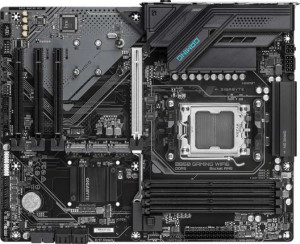
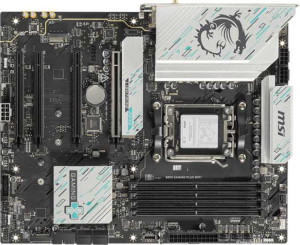
Both boards share the same foundational platform: the AM5 socket with a B850 chipset in a standard ATX form factor, with virtually identical physical dimensions. They support overclocking, include dual BIOS, and carry the same 3-year warranty — so the baseline value proposition is well matched. Neither board integrates a CPU or graphics, as expected at this tier.
The clearest differentiator is wireless connectivity. The MSI B850 Gaming Plus WiFi extends to Wi-Fi 6E and Wi-Fi 7 (802.11be), while the Gigabyte caps at Wi-Fi 6 (802.11ax). In practice, Wi-Fi 7 delivers substantially higher throughput and lower latency — particularly relevant if you are on a compatible router and in a congested environment. The MSI also edges ahead on Bluetooth 5.4 versus 5.3, offering marginally improved range and connection stability. Additionally, the MSI includes RGB lighting and an easy BIOS reset mechanism, which the Gigabyte lacks — the latter being a genuine quality-of-life advantage during troubleshooting or failed overclocks.
For this spec group, the MSI B850 Gaming Plus WiFi holds a clear edge: its superior wireless stack (especially Wi-Fi 7 future-proofing), easier BIOS recovery, and RGB support all add tangible value without any apparent trade-off in the shared specs. The Gigabyte is not a weak board by any means, but head-to-head on general features, the MSI offers more for users who want longevity in their wireless hardware.