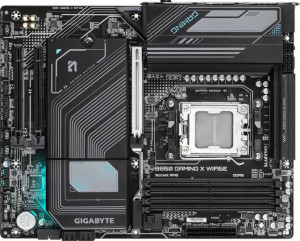
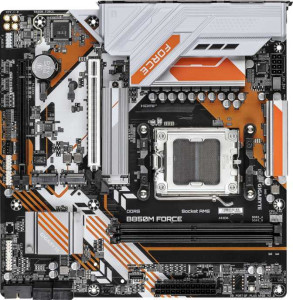
On the shared fundamentals, both boards run DDR5 memory across dual channels with a native speed ceiling of 5200 MHz — so out-of-the-box performance with a standard DDR5 kit is identical. The real divergence appears when you look at slots and capacity: the Gaming X WiFi6E provides 4 DIMM slots and supports up to 256 GB, while the B850M Force is limited to 2 slots and a 128 GB maximum. For most gaming or everyday workloads this gap is irrelevant, but for memory-intensive tasks like video editing, 3D rendering, or running multiple virtual machines, the Gaming X WiFi6E's headroom is a tangible long-term advantage — you can start with two sticks and expand later without replacing anything.
The overclocking picture is more nuanced. The B850M Force posts a notably higher maximum overclocked speed of 9600 MHz versus 8200 MHz on the Gaming X WiFi6E. In practice, reaching those top-end figures requires carefully selected memory kits and careful tuning, and real-world gains at those frequencies are marginal for most use cases — but enthusiasts chasing peak memory bandwidth will find the Force's ceiling more ambitious. Offsetting this, the Force is the only one of the two to support ECC memory, which provides error-correcting capability valuable in workstation or light server contexts where data integrity is critical.
The verdict here depends entirely on use case. The Gaming X WiFi6E holds the edge for expandability and raw capacity, making it the stronger long-term platform for power users. The B850M Force counters with a higher overclock ceiling and ECC support, which targets a narrower but distinct audience — memory tuners and reliability-focused workstation builders who can live within the two-slot constraint.