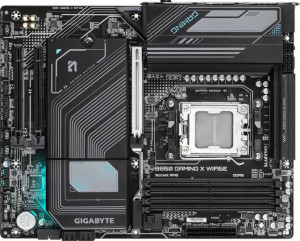
Gigabyte B850 Gaming X WiFi6E
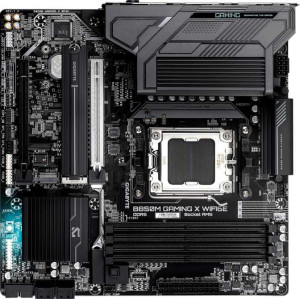
Gigabyte B850M Gaming X WiFi6E

Gigabyte B850 Gaming X WiFi6E Gigabyte B850M Gaming X WiFi6E

Overview

Welcome to our in-depth specification face-off between the Gigabyte B850 Gaming X WiFi6E and the Gigabyte B850M Gaming X WiFi6E. Both boards share the same AM5 socket and B850 chipset foundation, making this a fascinating comparison of two siblings that diverge in meaningful ways. The key battlegrounds include form factor and physical size, the number of expansion and storage options, and how each board handles connectivity and headers for different build scenarios.

Common Features

  • Both products use the AM5 CPU socket.
  • Both products feature the B850 chipset.
  • Wi-Fi is supported on both products.
  • Both products support Wi-Fi 4 (802.11n), Wi-Fi 5 (802.11ac), Wi-Fi 6 (802.11ax), and Wi-Fi 6E (802.11ax).
  • Bluetooth is available on both products.
  • Both products have Bluetooth version 5.3.
  • Both products include an HDMI 2.1 port.
  • Overclocking is supported on both products.
  • Both products support a maximum memory amount of 256GB.
  • Both products support a maximum RAM speed of 5200 MHz.
  • Both products support an overclocked RAM speed of 8200 MHz.
  • Both products have 4 memory slots.
  • Both products use DDR5 memory.
  • Both products feature 2 memory channels.
  • ECC memory is not supported on either product.
  • Both products include 1 USB 3.2 Gen 1 port (USB-C).
  • Both products include 1 USB 3.2 Gen 2 port (USB-A).
  • Both products include 1 USB 3.2 Gen 2 port (USB-C).
  • USB 3.2 Gen 2x2, USB 4 40Gbps, USB 4 20Gbps, Thunderbolt 3, and Thunderbolt 4 ports are not available on either product.
  • Both products have 2 USB 3.2 Gen 1 ports through expansion.
  • Both products have 4 USB 2.0 ports through expansion.
  • Both products include 4 SATA 3 connectors.
  • A TPM connector is present on both products.
  • An mSATA connector is not available on either product.
  • Both products have 0 SATA 2 connectors.
  • Both products feature 1 PCIe 5.0 x16 slot.
  • PCIe 4.0 x16, PCIe 3.0 x16, PCIe 2.0 x16, PCIe x8, and PCI slots are not available on either product.
  • Both products support 7.1 audio channels.
  • Both products have 3 audio connectors.
  • An S/PDIF Out port is not available on either product.
  • Both products support RAID 0, RAID 1, RAID 5, and RAID 10 (1+0).
  • RAID 0+1 is not supported on either product.

Main Differences

  • The form factor is ATX on Gigabyte B850 Gaming X WiFi6E and Micro-ATX on Gigabyte B850M Gaming X WiFi6E.
  • The width is 305 mm on Gigabyte B850 Gaming X WiFi6E and 244 mm on Gigabyte B850M Gaming X WiFi6E.
  • USB 3.2 Gen 1 ports (USB-A) count is 3 on Gigabyte B850 Gaming X WiFi6E and 2 on Gigabyte B850M Gaming X WiFi6E.
  • USB 2.0 ports count is 3 on Gigabyte B850 Gaming X WiFi6E and 4 on Gigabyte B850M Gaming X WiFi6E.
  • DisplayPort outputs count is 1 on Gigabyte B850 Gaming X WiFi6E and 2 on Gigabyte B850M Gaming X WiFi6E.
  • A PS/2 port is present on Gigabyte B850 Gaming X WiFi6E but not available on Gigabyte B850M Gaming X WiFi6E.
  • Fan headers count is 6 on Gigabyte B850 Gaming X WiFi6E and 4 on Gigabyte B850M Gaming X WiFi6E.
  • M.2 sockets count is 3 on Gigabyte B850 Gaming X WiFi6E and 2 on Gigabyte B850M Gaming X WiFi6E.
  • PCIe x1 slots count is 2 on Gigabyte B850 Gaming X WiFi6E and 0 on Gigabyte B850M Gaming X WiFi6E.
  • PCIe x4 slots count is 0 on Gigabyte B850 Gaming X WiFi6E and 1 on Gigabyte B850M Gaming X WiFi6E.
Specs Comparison
Gigabyte B850 Gaming X WiFi6E

Gigabyte B850 Gaming X WiFi6E

Gigabyte B850M Gaming X WiFi6E

Gigabyte B850M Gaming X WiFi6E

General info:
CPU socket AM5 AM5
chipset B850 B850
form factor ATX Micro-ATX
release date January 2025 January 2025
supports Wi-Fi
Wi-Fi version Wi-Fi 4 (802.11n), Wi-Fi 5 (802.11ac), Wi-Fi 6 (802.11ax), Wi-Fi 6E (802.11ax) Wi-Fi 4 (802.11n), Wi-Fi 5 (802.11ac), Wi-Fi 6 (802.11ax), Wi-Fi 6E (802.11ax)
Has Bluetooth
Bluetooth version 5.3 5.3
HDMI version HDMI 2.1 HDMI 2.1
Easy to overclock
has RGB lighting
Easy to reset BIOS
Has dual BIOS
has aptX
CPU sockets 1 1
Has integrated graphics
warranty period 3 years 3 years
height 244 mm 244 mm
width 305 mm 244 mm
Has integrated CPU

At their core, the Gigabyte B850 Gaming X WiFi6E and the B850M Gaming X WiFi6E share the same fundamental DNA: both use the AM5 socket with the B850 chipset, support overclocking, include dual BIOS, RGB lighting, Wi-Fi 6E with Bluetooth 5.3, and carry a 3-year warranty. For a buyer evaluating platform features and connectivity, these two boards are essentially identical on paper.

The single defining difference between them is form factor. The standard model is a full ATX board at 305 × 244 mm, while the ″M″ variant is Micro-ATX at 244 × 244 mm — roughly 20% smaller in footprint. In practice, this means the Micro-ATX fits in more compact cases and smaller builds, but may offer fewer expansion slots and less physical space for VRM components or additional connectors — trade-offs that would be visible in the other spec groups. If you are building in a mid-tower or full-tower with no size constraints, the ATX variant gives more flexibility; if space is at a premium, the Micro-ATX is the pragmatic choice.

For general platform features alone, the two boards are evenly matched — neither holds an advantage in chipset capability, wireless standard, or software features. The decision here comes down entirely to case compatibility and build size requirements, not feature differentiation.

Memory:
maximum memory amount 256GB 256GB
RAM speed (max) 5200 MHz 5200 MHz
overclocked RAM speed 8200 MHz 8200 MHz
memory slots 4 4
DDR memory version 5 5
memory channels 2 2
Supports ECC memory

When it comes to memory, there is nothing to separate these two boards — every single specification is identical. Both support DDR5 RAM across 4 slots in a dual-channel configuration, with a native ceiling of 5200 MHz and an overclocked ceiling reaching up to 8200 MHz. That overclocking headroom is notably generous, covering the full range of high-performance DDR5 kits currently on the market.

The 256 GB maximum capacity across four slots means each slot supports up to 64 GB modules — enough for even the most memory-intensive workloads like video editing, 3D rendering, or virtualization. Neither board supports ECC memory, which is expected at this chipset tier and only relevant to workstation or server use cases anyway.

This group is a complete tie. Buyers choosing between these two boards will find zero differentiation in memory capability — the ATX versus Micro-ATX form factor decision made in the general specs carries all the weight here, not memory support.

Ports:
USB 3.2 Gen 2 ports (USB-A) 1 1
USB 3.2 Gen 1 ports (USB-A) 3 2
USB 3.2 Gen 2 ports (USB-C) 1 1
USB 3.2 Gen 1 ports (USB-C) 0 0
USB 2.0 ports 3 4
USB 3.2 Gen 2x2 ports 0 0
USB 4 40Gbps ports 0 0
USB 4 20Gbps ports 0 0
Thunderbolt 4 ports 0 0
Thunderbolt 3 ports 0 0
has an HDMI output
DisplayPort outputs 1 2
RJ45 ports 1 1
Has USB Type-C
eSATA ports 0 0
DVI outputs 0 0
has a VGA connector
PS/2 ports 1 0

Two differences stand out immediately in the rear I/O. The B850M Gaming X WiFi6E (Micro-ATX) offers 2 DisplayPort outputs compared to just 1 on the full ATX model — a meaningful advantage for anyone running integrated graphics across multiple monitors without a discrete GPU. Meanwhile, the ATX board includes a PS/2 port, a legacy connector absent on the Micro-ATX; this matters only to users with older keyboards or mice, which is a narrow but real use case.

Beyond those two points, the boards are nearly equivalent. Both provide one USB 3.2 Gen 2 Type-A and one USB 3.2 Gen 2 Type-C for fast 10 Gbps transfers, a single RJ45 Ethernet jack, and HDMI output. The ATX edges ahead with 3 USB 3.2 Gen 1 Type-A ports versus 2 on the Micro-ATX, but the Micro-ATX compensates with 4 USB 2.0 ports versus 3 — so total USB port counts are effectively the same, just distributed differently across speed tiers.

On balance, the B850M holds a slight edge in this category specifically due to its dual DisplayPort outputs, which add genuine multi-display flexibility. For users who prioritize legacy input device support, the ATX's PS/2 port is a small but unique advantage. Neither board dominates outright, but the display output difference is the more practically impactful distinction for most buyers.

Connectors:
USB 3.2 Gen 1 ports (through expansion) 2 2
USB 2.0 ports (through expansion) 4 4
SATA 3 connectors 4 4
fan headers 6 4
USB 3.0 ports (through expansion) 2 2
M.2 sockets 3 2
Has TPM connector
U.2 sockets 0 0
Has mSATA connector
SATA 2 connectors 0 0

Two internal connector specs separate these boards. The full ATX B850 Gaming X WiFi6E provides 3 M.2 sockets versus 2 on the Micro-ATX variant, and 6 fan headers compared to just 4. Everything else — SATA ports, expansion USB headers, TPM connector — is identical between them.

The M.2 difference is the more consequential one. A third M.2 slot means the ATX board can accommodate an additional NVMe SSD without touching any of the 4 SATA ports, which is valuable for builds that want fast dedicated storage for the OS, a game library drive, and a scratch or backup drive simultaneously — all at full NVMe speeds. On the Micro-ATX, the same use case would require routing at least one drive through SATA, with the associated throughput trade-off. The extra 2 fan headers on the ATX board similarly benefit larger, more complex cooling setups — think multi-radiator liquid cooling or high-airflow cases with six or more fans — where the Micro-ATX could require a fan hub to manage all headers.

The B850 Gaming X WiFi6E (ATX) holds a clear edge here, particularly for storage-heavy or thermally demanding builds. The Micro-ATX's reduced M.2 and fan header counts are a direct consequence of its smaller PCB, and for compact builds these limits are unlikely to matter — but for power users maximizing storage or cooling flexibility, the ATX board is the stronger choice in this category.

Expansion slots:
PCIe 4.0 x16 slots 0 0
PCIe 5.0 x16 slots 1 1
PCIe 3.0 x16 slots 0 0
PCIe x1 slots 2 0
PCI slots 0 0
PCIe 2.0 x16 slots 0 0
PCIe x4 slots 0 1
PCIe x8 slots 0 0

Both boards lead with a single PCIe 5.0 x16 slot — the primary GPU slot — which is the most important spec here. PCIe 5.0 doubles the bandwidth of PCIe 4.0, ensuring neither board will bottleneck current or near-future discrete graphics cards. On that front, they are perfectly matched.

The secondary slots tell a different story depending on your expansion needs. The ATX B850 Gaming X WiFi6E adds 2 PCIe x1 slots, which are well-suited for add-in cards like sound cards, USB expansion cards, or capture cards that don't require high bandwidth. The Micro-ATX B850M, by contrast, offers a single PCIe x4 slot instead — narrower in quantity but wider in bandwidth per slot, making it more appropriate for cards that benefit from more lanes, such as a NVMe expansion card or a higher-bandwidth networking adapter.

Neither configuration is objectively superior; they serve different secondary use cases. The ATX board edges ahead for breadth of expansion — two slots means two simultaneous add-in cards — while the B850M's x4 slot offers more per-slot throughput for a single secondary card. Buyers who anticipate multiple low-bandwidth add-in cards will favor the ATX; those needing one higher-bandwidth peripheral card will find the Micro-ATX adequate.

Audio:
audio channels 7.1 7.1
Has S/PDIF Out port
audio connectors 3 3

Audio is another category where these two boards offer no differentiation whatsoever. Both deliver 7.1 surround sound support through 3 analog audio connectors, and neither includes an S/PDIF optical output. The 7.1 channel support is relevant for users with multi-speaker surround setups or high-end headsets that can decode positional audio, while the 3-connector arrangement typically covers line-in, line-out, and microphone at the rear I/O.

The absence of S/PDIF on both boards means users who rely on optical output for external DACs, AV receivers, or certain headphone amplifiers will need to look elsewhere — a dedicated sound card or USB DAC would be the practical workaround. That limitation applies equally to both, so it shifts no advantage either way.

This is a complete tie. Audio hardware and capability are identical across the ATX and Micro-ATX variants, and the form factor decision that distinguishes these two boards has no bearing here at all.

Storage:
Supports RAID 1
Supports RAID 10 (1+0)
Supports RAID 5
Supports RAID 0
Supports RAID 0+1

RAID support is identical across both boards. Each supports RAID 0, RAID 1, RAID 5, and RAID 10 — the four configurations that cover virtually every consumer and prosumer use case. Neither supports RAID 0+1, though in practice RAID 10 achieves the same striping-plus-mirroring outcome with better fault tolerance, making that omission inconsequential.

The practical value of this RAID set is meaningful: RAID 0 delivers performance striping for faster sequential reads and writes, RAID 1 provides straightforward mirroring for redundancy, and RAID 5 and 10 offer more sophisticated balances of speed, capacity, and fault tolerance — useful for home NAS-style setups, content creation workstations, or anyone wanting drive redundancy without a dedicated controller. Having all four available on a mid-range B850 board is a solid inclusion.

With no differences present, this category is a complete tie. Storage configuration flexibility is equal on both the ATX and Micro-ATX variants, and the only factor that would affect real-world RAID potential — available SATA and M.2 ports — was already addressed in the Connectors group, where the ATX board holds an advantage.

Comparison Summary & Verdict

After reviewing every specification, the choice between these two boards comes down to your build goals and case size. The Gigabyte B850 Gaming X WiFi6E is the stronger pick for builders who want a full ATX platform with more room to expand: it offers 3 M.2 sockets, 6 fan headers, 2 PCIe x1 slots, and an extra USB 3.2 Gen 1 Type-A port, making it ideal for enthusiast desktops and high-airflow systems. The Gigabyte B850M Gaming X WiFi6E, on the other hand, fits into a Micro-ATX chassis at just 244 mm wide and trades some expansion for 2 DisplayPort outputs and an additional USB 2.0 port, suiting compact or home-office builds where desk space matters. Both boards are equal in memory capacity, Wi-Fi 6E, Bluetooth 5.3, audio, and RAID support, so neither forces a compromise on core features.

Gigabyte B850 Gaming X WiFi6E
Buy Gigabyte B850 Gaming X WiFi6E if...

Buy the Gigabyte B850 Gaming X WiFi6E if you want a full ATX build with more M.2 storage slots, additional fan headers for advanced cooling, and greater PCIe expansion headroom.

Gigabyte B850M Gaming X WiFi6E
Buy Gigabyte B850M Gaming X WiFi6E if...

Buy the Gigabyte B850M Gaming X WiFi6E if you need a compact Micro-ATX board that fits a smaller case while still offering dual DisplayPort outputs and solid connectivity for everyday builds.