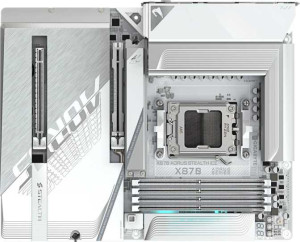
Both boards share the same AM5 socket, confirming compatibility with the same range of AMD Ryzen processors, and both support overclocking — so neither restricts you on the CPU side. The most fundamental split between them, however, is chipset and size: the Aorus Elite runs a B850 chipset in a compact Micro-ATX footprint (244 × 244 mm), while the Aorus Stealth steps up to an X870 chipset in a full ATX format (244 × 305 mm). In practice, X870 is AMD's enthusiast-tier platform, typically unlocking more PCIe lanes, greater bandwidth, and broader connectivity headroom — meaningful if you plan to populate the board with multiple NVMe drives or high-bandwidth expansion cards. The larger ATX chassis also gives builders more physical room for additional slots and headers.
On wireless connectivity, both boards cover Wi-Fi 6E and Bluetooth 5.3, which are more than sufficient for current high-speed routers and peripherals. The Stealth Ice, however, adds Wi-Fi 7 (802.11be) support — a forward-looking advantage for users investing in next-generation networking infrastructure, as Wi-Fi 7 delivers substantially higher throughput and lower latency than 6E. For most users today this difference is negligible, but it becomes relevant as Wi-Fi 7 routers become mainstream.
One noteworthy reversal: the B850M Aorus Elite includes dual BIOS, a hardware-level safety net that lets the board recover from a failed firmware update by switching to a backup chip — the X870 Stealth Ice does not offer this. For overclockers or users who flash BIOS updates frequently, this is a genuine reliability advantage on the smaller board. Both carry the same 3-year warranty. Overall, the X870 Stealth Ice holds a clear edge in platform headroom and future-proofed wireless, but the B850M punches back with dual BIOS protection and a smaller form factor suited to compact builds.