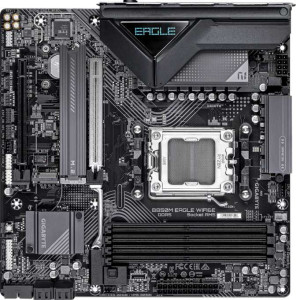
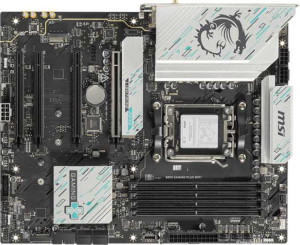
Both boards are built around the AM5 socket and B850 chipset, targeting the same platform with identical overclocking support, RGB lighting, integrated Wi-Fi with Bluetooth, and a 3-year warranty. The most immediate practical difference is form factor: the Gigabyte B850M Eagle Wi-Fi6E is a Micro-ATX board (244 × 244 mm), making it the right choice for compact or mid-tower builds with tighter space constraints, while the MSI B850 Gaming Plus WiFi is a full ATX board (243.8 × 304.8 mm), offering more physical room for additional expansion slots and better airflow routing in larger cases.
On wireless connectivity, both support up to Wi-Fi 6E, but the MSI also adds Wi-Fi 7 (802.11be) — a meaningful forward-looking advantage, as Wi-Fi 7 delivers substantially higher throughput and lower latency for users with compatible routers, now or in the future. Similarly, the MSI edges ahead with Bluetooth 5.4 versus the Gigabyte's 5.3, a minor but measurable improvement in connection stability and coexistence with other wireless devices. On BIOS resilience, the MSI holds a clear practical edge: it supports easy BIOS reset and a dual BIOS, meaning a failed flash or corrupted firmware is far less likely to brick the board — a real-world safety net the Gigabyte lacks entirely.
Overall, the MSI B850 Gaming Plus WiFi has a clear advantage in this group. It offers newer wireless standards, slightly improved Bluetooth, and meaningfully better BIOS recovery options — all of which matter for longevity and ease of use. The Gigabyte's only structural advantage is its smaller footprint, which is only relevant if your build specifically requires a Micro-ATX board.