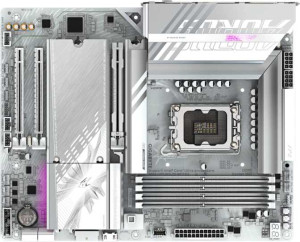
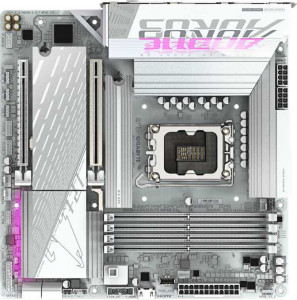
Both boards share the same LGA 1851 socket and B860 chipset, meaning they target identical CPU compatibility and offer the same overclocking headroom within Intel's B-series restrictions. They also match on dual BIOS protection, HDMI 2.1 output, and a 3-year warranty, so neither has a platform-level advantage. The most consequential difference in this group is the form factor: the Aorus Elite WiFi7 Ice is a full ATX board (305 × 244 mm), while the Aorus Elite WiFi6E Ice is Micro-ATX (244 × 244 mm). This directly dictates case compatibility — the Micro-ATX fits in both Micro-ATX and standard ATX cases, but the ATX board requires a mid-tower or larger enclosure.
On wireless connectivity, the gap is meaningful: the WiFi7 Ice supports Wi-Fi 7 (802.11be) and Bluetooth 5.4, while the WiFi6E Ice tops out at Wi-Fi 6E (802.11ax) and Bluetooth 5.3. Wi-Fi 7 delivers significantly higher theoretical throughput and lower latency through Multi-Link Operation, which matters for users on a compatible router. Bluetooth 5.4 adds improved broadcast isochronous channels over 5.3, a modest but real upgrade for audio peripherals. The WiFi6E Ice compensates with RGB lighting, which the WiFi7 Ice entirely lacks — a purely aesthetic difference with no functional impact.
In this group, the Aorus Elite WiFi7 Ice holds a clear edge on connectivity thanks to its newer Wi-Fi and Bluetooth standards, and it is the right choice for users building in a full ATX case who want future-ready wireless. The Aorus Elite WiFi6E Ice is the better fit for compact or mid-range builds where a smaller footprint and built-in RGB aesthetics take priority, and where Wi-Fi 7 is not yet a practical requirement.