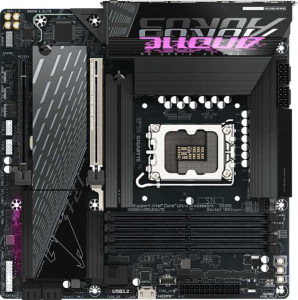
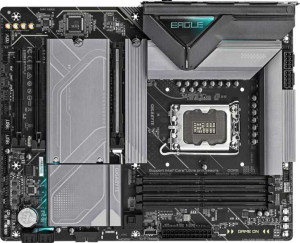
Both boards share the same LGA 1851 socket and are built around Intel's current-generation platform, meaning CPU compatibility is identical. The most immediate structural difference is the form factor: the B860M Aorus Elite is a Micro-ATX (244×244 mm), while the Z890 Eagle is a full ATX (244×305 mm). That extra 61 mm of width on the Z890 Eagle translates to more PCB real estate for additional expansion slots, VRM phases, and routing — relevant if you plan to populate multiple PCIe cards or want more headroom for cooling components.
The chipset difference is the most functionally significant split here. The B860 on the Aorus Elite is Intel's mid-range chipset with restricted overclocking capabilities on memory and limited PCIe lane flexibility, whereas the Z890 on the Eagle is Intel's enthusiast chipset, unlocking full memory overclocking (XMP/EXPO beyond spec) and greater configurability. Both boards are flagged as ″Easy to overclock: YES,″ but in practice the Z890 gives you substantially more tuning latitude — so that shared ″YES″ means more on the Eagle. Notably, the Aorus Elite includes dual BIOS, a meaningful reliability feature that lets the board recover from a failed flash automatically; the Z890 Eagle lacks this, which is a tangible resilience advantage for the B860M in build stability terms.
All other general attributes are identical: both omit Wi-Fi and Bluetooth (requiring add-in cards or adapters for wireless), both include RGB lighting, neither has an integrated CPU or GPU, and both carry a 3-year warranty. On balance, the Z890 Eagle holds the edge for performance-oriented builders who want chipset-level overclocking flexibility and a larger board canvas, while the B860M Aorus Elite counters with a smaller footprint and the practical safety net of dual BIOS — making it the stronger pick for compact or reliability-focused builds.