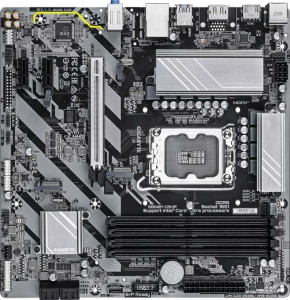
Gigabyte B860M D3HP
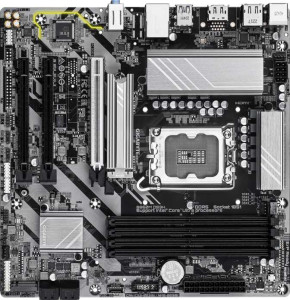
Gigabyte B860M DS3H

Gigabyte B860M D3HP Gigabyte B860M DS3H

Overview

Welcome to our in-depth spec comparison between the Gigabyte B860M D3HP and the Gigabyte B860M DS3H. Both are Micro-ATX motherboards built on the B860 chipset with the LGA 1851 socket, making them closely matched contenders in the budget-to-midrange segment. In this comparison, we examine how they stack up across rear USB connectivity, expansion capabilities, memory support, and storage options to help you decide which board best suits your build.

Common Features

  • Both products use the LGA 1851 CPU socket.
  • Both products feature the B860 chipset.
  • Both products have a Micro-ATX form factor.
  • Neither product supports Wi-Fi.
  • Neither product has Bluetooth.
  • Both products include an HDMI 2.1 port.
  • Both products support overclocking.
  • Neither product has RGB lighting.
  • Both products support a maximum memory amount of 256GB.
  • Both products support a maximum RAM speed of 6400 MHz and an overclocked RAM speed of 9066 MHz.
  • Both products have 4 memory slots and support DDR5 memory in a dual-channel configuration.
  • ECC memory is not supported on either product.
  • Both products have 3 USB 2.0 rear ports, with no USB-C rear ports of any generation.
  • Both products offer 2 M.2 sockets and 4 SATA 3 connectors.
  • Both products include 4 fan headers and a TPM connector.
  • Both products provide 4 USB 2.0 ports and 2 USB 3.2 Gen 1 ports through expansion headers.
  • Both products feature 1 PCIe 5.0 x16 slot and 2 PCIe x1 slots, with no other PCIe slot types present.
  • Both products deliver 7.1-channel audio with 3 audio connectors and no S/PDIF Out port.
  • Both products support RAID 0, RAID 1, RAID 5, and RAID 10, but neither supports RAID 0+1.

Main Differences

  • USB 3.2 Gen 2 ports (USB-A) count is 0 on Gigabyte B860M D3HP and 1 on Gigabyte B860M DS3H.
  • USB 3.2 Gen 1 ports (USB-A) count is 3 on Gigabyte B860M D3HP and 2 on Gigabyte B860M DS3H.
Specs Comparison
Gigabyte B860M D3HP

Gigabyte B860M D3HP

Gigabyte B860M DS3H

Gigabyte B860M DS3H

General info:
CPU socket LGA 1851 LGA 1851
chipset B860 B860
form factor Micro-ATX Micro-ATX
release date January 2025 January 2025
supports Wi-Fi
Has Bluetooth
HDMI version HDMI 2.1 HDMI 2.1
Easy to overclock
has RGB lighting
Easy to reset BIOS
Has dual BIOS
CPU sockets 1 1
Has integrated graphics
warranty period 3 years 3 years
height 244 mm 244 mm
width 244 mm 244 mm
Has integrated CPU

In terms of general characteristics, the Gigabyte B860M D3HP and Gigabyte B860M DS3H are virtually identical. Both boards share the same LGA 1851 socket and B860 chipset, target the same Micro-ATX form factor at an identical 244 × 244 mm footprint, and carry the same 3-year warranty. Neither board includes integrated Wi-Fi, Bluetooth, RGB lighting, an integrated CPU, or integrated graphics, and both expose a single CPU socket with HDMI 2.1 output.

A few shared traits are worth highlighting for buyers: the presence of dual BIOS on both models is a meaningful reliability feature, providing a recovery path if a firmware update goes wrong — something not guaranteed on every entry-level board. Both are also flagged as easy to overclock, which is somewhat notable given the B860 chipset′s general positioning; users should verify exactly which overclocking parameters are unlocked, but it suggests a degree of tuning headroom beyond bare defaults. The absence of an easy BIOS reset mechanism on either board is a minor inconvenience for enthusiasts who push settings aggressively.

Based strictly on the general-info spec group, these two boards are in a dead tie. Every single attribute — dimensions, chipset, socket, features present, features absent, and warranty — is identical. No advantage can be awarded to either model from this data alone; differentiation, if any, must come from other spec groups such as memory, storage, or power delivery.
Memory:
maximum memory amount 256GB 256GB
RAM speed (max) 6400 MHz 6400 MHz
overclocked RAM speed 9066 MHz 9066 MHz
memory slots 4 4
DDR memory version 5 5
memory channels 2 2
Supports ECC memory

The memory specifications for the Gigabyte B860M D3HP and the Gigabyte B860M DS3H are identical. Both motherboards support a maximum memory amount of 256GB and feature 4 memory slots. They also both support DDR5 memory with a maximum RAM speed of 6400 MHz, and can handle overclocked RAM speeds up to 9066 MHz.

Both products have a dual-channel memory configuration and do not support ECC (Error-Correcting Code) memory. With the same memory capabilities and configuration, the two motherboards are practically identical in terms of memory performance and options.

Given these shared specifications, there is no difference in memory support or performance between the two models.

Ports:
USB 3.2 Gen 2 ports (USB-A) 0 1
USB 3.2 Gen 1 ports (USB-A) 3 2
USB 3.2 Gen 2 ports (USB-C) 0 0
USB 3.2 Gen 1 ports (USB-C) 0 0
USB 2.0 ports 3 3
USB 3.2 Gen 2x2 ports 0 0
USB 4 40Gbps ports 0 0
USB 4 20Gbps ports 0 0
Thunderbolt 4 ports 0 0
Thunderbolt 3 ports 0 0
has an HDMI output
DisplayPort outputs 1 1
RJ45 ports 1 1
Has USB Type-C
eSATA ports 0 0
DVI outputs 0 0
has a VGA connector
PS/2 ports 1 1

The Gigabyte B860M D3HP and the Gigabyte B860M DS3H both offer similar port configurations, with a few minor differences. Both motherboards include 3 USB 3.2 Gen 1 ports (USB-A), 3 USB 2.0 ports, and 1 RJ45 port. They also both have an HDMI output and a DisplayPort output, allowing for flexible video connectivity. Additionally, both boards feature 1 PS/2 port.

Where they differ is in the number of USB 3.2 Gen 2 ports (USB-A). The B860M D3HP does not have any, while the B860M DS3H offers 1 USB 3.2 Gen 2 (USB-A) port. Both motherboards lack USB Type-C ports, USB 3.2 Gen 2x2, Thunderbolt 3 or 4 ports, eSATA, DVI, and VGA connectors.

Despite these small variations, the overall port offerings of the two products are quite similar, with the main difference being the additional USB 3.2 Gen 2 port on the B860M DS3H.

Connectors:
USB 3.2 Gen 1 ports (through expansion) 2 2
USB 2.0 ports (through expansion) 4 4
SATA 3 connectors 4 4
fan headers 4 4
USB 3.0 ports (through expansion) 2 2
M.2 sockets 2 2
Has TPM connector
U.2 sockets 0 0
Has mSATA connector
SATA 2 connectors 0 0

The Gigabyte B860M D3HP and the Gigabyte B860M DS3H are identical in their connector offerings. Both motherboards provide 2 USB 3.2 Gen 1 ports, 4 USB 2.0 ports, and 2 USB 3.0 ports through expansion. They also include 4 SATA 3 connectors and 4 fan headers, allowing for ample expansion and cooling options.

Both models feature 2 M.2 sockets, a TPM connector, and lack U.2 and mSATA connectors. Additionally, neither board includes any SATA 2 connectors, ensuring that all SATA ports are of the newer 3.0 variety.

In summary, the connector specifications for the two motherboards are completely aligned, with no differences between them in terms of the available ports and expansion options.

Expansion slots:
PCIe 4.0 x16 slots 0 0
PCIe 5.0 x16 slots 1 1
PCIe 3.0 x16 slots 0 0
PCIe x1 slots 2 2
PCI slots 0 0
PCIe 2.0 x16 slots 0 0
PCIe x4 slots 0 0
PCIe x8 slots 0 0

The expansion slots for the Gigabyte B860M D3HP and the Gigabyte B860M DS3H are identical. Both motherboards feature 1 PCIe 5.0 x16 slot and 2 PCIe x1 slots. Neither motherboard includes PCIe 4.0 x16 slots, PCIe 3.0 x16 slots, PCIe 2.0 x16 slots, PCIe x4 slots, PCIe x8 slots, or PCI slots.

Both products offer the same expansion capabilities, with no differences in the number or type of slots available. This makes the two motherboards equally suited for expansion needs that require PCIe 5.0 x16 or PCIe x1 slots.

In summary, the expansion slots are identical across both models, with no differences between them in terms of slot configuration or types.

Audio:
audio channels 7.1 7.1
Has S/PDIF Out port
audio connectors 3 3

The audio specifications for the Gigabyte B860M D3HP and the Gigabyte B860M DS3H are identical. Both motherboards support 7.1 audio channels and include 3 audio connectors. Additionally, neither motherboard has an S/PDIF Out port, meaning both lack this digital audio output feature.

With the same audio capabilities and configuration, there is no distinction between the two motherboards in terms of audio performance or connectivity.

In summary, both models offer the same audio features, ensuring comparable audio output options.

Storage:
Supports RAID 1
Supports RAID 10 (1+0)
Supports RAID 5
Supports RAID 0
Supports RAID 0+1

The storage capabilities of the Gigabyte B860M D3HP and the Gigabyte B860M DS3H are identical. Both motherboards support RAID 1, RAID 10 (1+0), and RAID 5 configurations, offering flexibility in terms of data redundancy and performance. Neither motherboard supports RAID 0+1, which limits certain RAID setups.

Both products share the same RAID support features, ensuring that users of either motherboard will have access to the same storage management options for performance and reliability.

In conclusion, the storage specifications for the two motherboards are fully aligned, with no differences between them in terms of RAID support.

Comparison Summary & Verdict

The Gigabyte B860M D3HP and Gigabyte B860M DS3H are remarkably similar motherboards, sharing the same B860 chipset, LGA 1851 socket, DDR5 support up to 6400 MHz, dual M.2 sockets, and a full suite of RAID options. The distinction comes down to rear USB layout: the DS3H offers one USB 3.2 Gen 2 (USB-A) port for faster 10 Gbps device transfers, while the D3HP provides three USB 3.2 Gen 1 ports, giving more simultaneous 5 Gbps connections. Choose the D3HP if you regularly connect multiple USB peripherals at once; opt for the DS3H if you prioritize having at least one higher-speed USB port for fast external storage or modern devices.

Gigabyte B860M D3HP
Buy Gigabyte B860M D3HP if...

Buy the Gigabyte B860M D3HP if you need more simultaneous USB 3.2 Gen 1 connections, as it offers three rear USB-A ports at 5 Gbps compared to two on the DS3H.

Gigabyte B860M DS3H
Buy Gigabyte B860M DS3H if...

Buy the Gigabyte B860M DS3H if you want a faster rear USB 3.2 Gen 2 port for 10 Gbps transfers to high-speed external drives or modern peripherals.