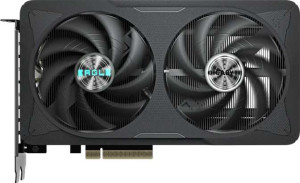
Gigabyte GeForce RTX 5060 Eagle OC
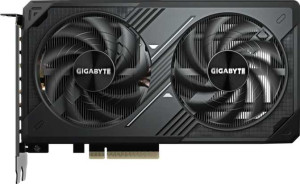
Gigabyte GeForce RTX 5060 WindForce

Gigabyte GeForce RTX 5060 Eagle OC Gigabyte GeForce RTX 5060 WindForce

Overview

Welcome to our detailed spec comparison between the Gigabyte GeForce RTX 5060 Eagle OC and the Gigabyte GeForce RTX 5060 WindForce — two Blackwell-based GPUs from Gigabyte built on the same RTX 5060 foundation. While these cards share a great deal in common, key battlegrounds including GPU turbo clock speeds, physical dimensions, and a handful of feature differences make this a worthwhile comparison for anyone trying to pick the right card for their build.

Common Features

  • Both cards have a base GPU clock speed of 2280 MHz.
  • Both cards have a GPU memory speed of 1750 MHz.
  • Both cards feature 3840 shading units.
  • Both cards have 120 texture mapping units (TMUs).
  • Both cards have 48 render output units (ROPs).
  • Double Precision Floating Point (DPFP) is supported on both cards.
  • Both cards have an effective memory speed of 28000 MHz.
  • Both cards offer a maximum memory bandwidth of 448 GB/s.
  • Both cards come with 8GB of VRAM.
  • Both cards use GDDR7 memory.
  • Both cards have a 128-bit memory bus width.
  • ECC memory is supported on both cards.
  • Both cards support DirectX 12 Ultimate.
  • Both cards support OpenGL 4.6.
  • Both cards support OpenCL 3.
  • Multi-display technology is supported on both cards.
  • Ray tracing is supported on both cards.
  • DLSS is supported on both cards.
  • XeSS (XMX) is not available on either card.
  • Both cards support Intel Resizable BAR.
  • Both cards have 1 HDMI 2.1b output.
  • Both cards have 3 DisplayPort outputs.
  • Neither card has USB-C ports, DVI outputs, or mini DisplayPort outputs.
  • Both cards are based on the Blackwell GPU architecture.
  • Both cards have a Thermal Design Power (TDP) of 145W.
  • Both cards use PCIe 5.
  • Both cards are built on a 5 nm semiconductor process.
  • Both cards feature 21900 million transistors.
  • Neither card uses air-water cooling.

Main Differences

  • GPU turbo clock speed is 2550 MHz on Gigabyte GeForce RTX 5060 Eagle OC and 2497 MHz on Gigabyte GeForce RTX 5060 WindForce.
  • Pixel rate is 122.4 GPixel/s on Gigabyte GeForce RTX 5060 Eagle OC and 119.9 GPixel/s on Gigabyte GeForce RTX 5060 WindForce.
  • Floating-point performance is 19.58 TFLOPS on Gigabyte GeForce RTX 5060 Eagle OC and 19.18 TFLOPS on Gigabyte GeForce RTX 5060 WindForce.
  • Texture rate is 306 GTexels/s on Gigabyte GeForce RTX 5060 Eagle OC and 299.6 GTexels/s on Gigabyte GeForce RTX 5060 WindForce.
  • 3D support is present on Gigabyte GeForce RTX 5060 Eagle OC but not available on Gigabyte GeForce RTX 5060 WindForce.
  • RGB lighting is present on Gigabyte GeForce RTX 5060 WindForce but not available on Gigabyte GeForce RTX 5060 Eagle OC.
  • Width is 208 mm on Gigabyte GeForce RTX 5060 Eagle OC and 199 mm on Gigabyte GeForce RTX 5060 WindForce.
  • Height is 120 mm on Gigabyte GeForce RTX 5060 Eagle OC and 116 mm on Gigabyte GeForce RTX 5060 WindForce.
Specs Comparison
Gigabyte GeForce RTX 5060 Eagle OC

Gigabyte GeForce RTX 5060 Eagle OC

Gigabyte GeForce RTX 5060 WindForce

Gigabyte GeForce RTX 5060 WindForce

Performance:
GPU clock speed 2280 MHz 2280 MHz
GPU turbo 2550 MHz 2497 MHz
pixel rate 122.4 GPixel/s 119.9 GPixel/s
floating-point performance 19.58 TFLOPS 19.18 TFLOPS
texture rate 306 GTexels/s 299.6 GTexels/s
GPU memory speed 1750 MHz 1750 MHz
shading units 3840 3840
texture mapping units (TMUs) 120 120
render output units (ROPs) 48 48
Has Double Precision Floating Point (DPFP)

Both the Eagle OC and the WindForce share an identical foundation: the same 2280 MHz base clock, 3840 shading units, 120 TMUs, 48 ROPs, and 1750 MHz memory speed. This means the two cards are drawing from exactly the same hardware pool — the real-world difference between them comes down entirely to how aggressively the factory overclock is applied.

That gap emerges at boost: the Eagle OC reaches a GPU turbo of 2550 MHz versus the WindForce's 2497 MHz — a delta of 53 MHz, or roughly 2.1%. This directly cascades into every throughput metric. The Eagle OC delivers 19.58 TFLOPS of floating-point performance against the WindForce's 19.18 TFLOPS, a 306 GTexels/s texture fill rate versus 299.6 GTexels/s, and a pixel rate of 122.4 GPixel/s compared to 119.9 GPixel/s. In practice, a ~2% throughput advantage is unlikely to be perceptible in most gaming workloads, but it can matter in sustained GPU-compute tasks or when chasing frame-rate ceilings at lower resolutions.

The Eagle OC holds a narrow but consistent performance edge in this group, driven solely by its higher factory boost clock. Both cards support Double Precision Floating Point, so neither has a qualitative feature advantage. If raw peak throughput is the priority, the Eagle OC wins — but buyers who are comfortable with a manual overclock could likely bring the WindForce to parity, making the clock difference less decisive than it appears on paper.
Memory:
effective memory speed 28000 MHz 28000 MHz
maximum memory bandwidth 448 GB/s 448 GB/s
VRAM 8GB 8GB
GDDR version GDDR7 GDDR7
memory bus width 128-bit 128-bit
Supports ECC memory

Across every memory specification, the Eagle OC and WindForce are identical — and the shared configuration is genuinely impressive. Both cards run 8GB of GDDR7 over a 128-bit bus at an effective speed of 28000 MHz, yielding 448 GB/s of memory bandwidth. GDDR7 is a generational leap over GDDR6X in efficiency and throughput, meaning that 448 GB/s here is delivered with lower latency and power draw than a comparable GDDR6X figure would imply.

The 128-bit bus width is worth contextualizing: at this memory generation, it no longer carries the bottleneck stigma it once did. GDDR7's raw speed compensates substantially, pushing bandwidth figures that previously required a 192-bit or wider interface. For 1080p and 1440p gaming — the natural target resolutions for this GPU tier — 448 GB/s is more than adequate. The 8GB frame buffer is sufficient for most current titles at those resolutions, though it remains a consideration for users running very high texture packs or future-proofing against memory-hungry workloads. ECC memory support on both cards is a minor but notable addition, offering error-correction capability relevant to creators and compute users.

This group is a complete tie. There is no differentiator here — buyers should look to other specification groups, such as cooling or clock speeds, to distinguish between these two cards.

Features:
DirectX version DirectX 12 Ultimate DirectX 12 Ultimate
OpenGL version 4.6 4.6
OpenCL version 3 3
Supports multi-display technology
supports ray tracing
Supports 3D
supports DLSS
has XeSS (XMX)
AMD SAM / Intel Resizable BAR Intel Resizable BAR Intel Resizable BAR
has LHR
has RGB lighting
supported displays 4 4

The feature set of these two cards is nearly identical where it counts most. Both support DirectX 12 Ultimate, ray tracing, and DLSS — the trifecta that defines a modern gaming GPU. DirectX 12 Ultimate ensures compatibility with the full suite of next-gen rendering features, ray tracing enables hardware-accelerated lighting and shadow effects in supported titles, and DLSS provides AI-driven upscaling that can recover significant frame rates with minimal visual cost. Intel Resizable BAR support is also shared, allowing the CPU to access the full GPU frame buffer simultaneously and providing a modest but real performance uplift in compatible systems.

Two specs diverge. The Eagle OC supports 3D output while the WindForce does not — a feature relevant only to users with 3D displays or VR setups that rely on this signal path, making it niche but potentially decisive for that specific audience. Going the other direction, the WindForce includes RGB lighting where the Eagle OC does not, which is purely an aesthetic consideration for system builders who prioritize a lit, coordinated build interior.

Neither difference has any bearing on gaming or compute performance, so the conclusion here depends entirely on the buyer's profile. The Eagle OC has a functional edge for 3D display users; the WindForce holds the aesthetic advantage for RGB-focused builds. For everyone else, this group is effectively a tie.

Ports:
has an HDMI output
HDMI ports 1 1
HDMI version HDMI 2.1b HDMI 2.1b
DisplayPort outputs 3 3
USB-C ports 0 0
DVI outputs 0 0
mini DisplayPort outputs 0 0

Port configuration is identical on both cards: one HDMI 2.1b output and three DisplayPort outputs, for a total of four simultaneous display connections — which aligns with the four supported displays noted in the Features group. HDMI 2.1b is the latest revision of the standard, capable of driving 4K at high refresh rates and 8K output, making it well-suited for modern TVs and high-end monitors alike. The three DisplayPort outputs give multi-monitor users plenty of flexibility without needing adapters.

The absence of USB-C is worth noting for users who own monitors that accept video over USB-C or Thunderbolt — those setups would require an adapter. However, since neither card offers it, this is a shared constraint rather than a differentiator. Legacy DVI and mini DisplayPort connections are also absent on both, which is consistent with modern GPU design and only relevant to users still running older displays.

This group is a complete tie. The port layout is well-rounded for the target use case of this GPU tier, and there is no connectivity advantage on either side.

General info:
GPU architecture Blackwell Blackwell
release date May 2025 May 2025
Thermal Design Power (TDP) 145W 145W
PCI Express (PCIe) version 5 5
semiconductor size 5 nm 5 nm
number of transistors 21900 million 21900 million
Has air-water cooling
width 208 mm 199 mm
height 120 mm 116 mm

At the silicon level, these two cards are indistinguishable. Both are built on NVIDIA's Blackwell architecture using a 5nm process with 21.9 billion transistors, and both carry a 145W TDP — meaning identical power delivery requirements and expected thermal output. PCIe 5.0 support is shared as well, though at this GPU tier the bandwidth headroom of PCIe 5.0 over 4.0 is largely theoretical rather than practically impactful.

The one concrete differentiator in this group is physical size. The Eagle OC measures 208 × 120 mm while the WindForce comes in at 199 × 116 mm — about 9mm shorter and 4mm less tall. That gap is modest in absolute terms, but it can matter in compact or mid-tower cases where GPU clearance is tight. The WindForce's smaller footprint gives it a slight installation advantage in space-constrained builds, whereas the Eagle OC's larger body may be partly attributable to its more aggressive cooling solution, as suggested by its higher factory boost clock seen in the Performance group.

For general build compatibility, the WindForce holds a minor edge thanks to its more compact dimensions. For users with full-size cases, however, the size difference is unlikely to factor into the decision at all, making this group essentially a tie for the majority of buyers.

Comparison Summary & Verdict

Both the Gigabyte GeForce RTX 5060 Eagle OC and the Gigabyte GeForce RTX 5060 WindForce are highly capable cards sharing identical memory configurations, the same 145W TDP, and the same core feature set including ray tracing and DLSS support. The key distinction lies in performance headroom and physical traits: the Eagle OC edges ahead with a higher GPU turbo clock of 2550 MHz, delivering slightly better pixel and texture throughput, and also adds 3D support for compatible displays. The WindForce, on the other hand, is the more compact option at 199 mm wide and brings RGB lighting to the table for those who value aesthetics. Choose the Eagle OC if raw performance is your priority; opt for the WindForce if you need a smaller card or want a bit of visual flair in your build.

Gigabyte GeForce RTX 5060 Eagle OC
Buy Gigabyte GeForce RTX 5060 Eagle OC if...

Buy the Gigabyte GeForce RTX 5060 Eagle OC if you want the higher GPU turbo clock speed and slightly better overall performance, or if 3D display support is important to your setup.

Gigabyte GeForce RTX 5060 WindForce
Buy Gigabyte GeForce RTX 5060 WindForce if...

Buy the Gigabyte GeForce RTX 5060 WindForce if you need a more compact card that fits tighter cases, or if RGB lighting is a priority for your build aesthetic.