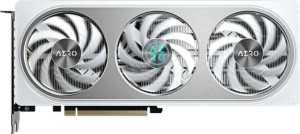
Gigabyte GeForce RTX 5060 Ti Aero OC 8GB
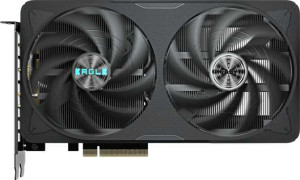
Gigabyte GeForce RTX 5060 Ti Eagle OC 16GB

Gigabyte GeForce RTX 5060 Ti Aero OC 8GB Gigabyte GeForce RTX 5060 Ti Eagle OC 16GB

Overview

Welcome to our in-depth specification comparison between the Gigabyte GeForce RTX 5060 Ti Aero OC 8GB and the Gigabyte GeForce RTX 5060 Ti Eagle OC 16GB. Both cards are built on the same Blackwell architecture and share a 180W TDP, yet they diverge in meaningful ways across VRAM capacity, raw clock performance, and physical dimensions. Read on to see how these two mid-range contenders stack up across every key specification.

Common Features

  • Both cards share a base GPU clock speed of 2407 MHz.
  • Both cards have a GPU memory speed of 1750 MHz.
  • Both cards feature 4608 shading units.
  • Both cards include 144 texture mapping units (TMUs).
  • Both cards have 48 render output units (ROPs).
  • Double Precision Floating Point (DPFP) is supported on both cards.
  • Both cards have an effective memory speed of 28000 MHz.
  • Both cards offer a maximum memory bandwidth of 448 GB/s.
  • Both cards use GDDR7 memory.
  • Both cards have a 128-bit memory bus width.
  • ECC memory support is available on both cards.
  • Both cards support DirectX 12 Ultimate.
  • Both cards support OpenGL version 4.6.
  • Both cards support OpenCL version 3.
  • Multi-display technology is supported on both cards.
  • Ray tracing is supported on both cards.
  • 3D support is available on both cards.
  • DLSS support is available on both cards.
  • XeSS (XMX) support is not available on either card.
  • Both cards include one HDMI 2.1b output and three DisplayPort outputs, with no USB-C, DVI, or mini DisplayPort outputs.
  • Both cards are built on the Blackwell GPU architecture.
  • Both cards have a Thermal Design Power (TDP) of 180W.
  • Both cards use PCIe version 5.
  • Both cards are manufactured on a 5 nm process with 21,900 million transistors.
  • Air-water cooling is not available on either card.

Main Differences

  • GPU turbo clock speed is 2647 MHz on the Gigabyte GeForce RTX 5060 Ti Aero OC 8GB and 2617 MHz on the Gigabyte GeForce RTX 5060 Ti Eagle OC 16GB.
  • Pixel rate is 127.1 GPixel/s on the Gigabyte GeForce RTX 5060 Ti Aero OC 8GB and 125.6 GPixel/s on the Gigabyte GeForce RTX 5060 Ti Eagle OC 16GB.
  • Floating-point performance is 24.39 TFLOPS on the Gigabyte GeForce RTX 5060 Ti Aero OC 8GB and 24.12 TFLOPS on the Gigabyte GeForce RTX 5060 Ti Eagle OC 16GB.
  • Texture rate is 381.2 GTexels/s on the Gigabyte GeForce RTX 5060 Ti Aero OC 8GB and 376.8 GTexels/s on the Gigabyte GeForce RTX 5060 Ti Eagle OC 16GB.
  • VRAM is 8GB on the Gigabyte GeForce RTX 5060 Ti Aero OC 8GB and 16GB on the Gigabyte GeForce RTX 5060 Ti Eagle OC 16GB.
  • Width is 281 mm on the Gigabyte GeForce RTX 5060 Ti Aero OC 8GB and 215 mm on the Gigabyte GeForce RTX 5060 Ti Eagle OC 16GB.
  • Height is 117 mm on the Gigabyte GeForce RTX 5060 Ti Aero OC 8GB and 122 mm on the Gigabyte GeForce RTX 5060 Ti Eagle OC 16GB.
Specs Comparison
Gigabyte GeForce RTX 5060 Ti Aero OC 8GB

Gigabyte GeForce RTX 5060 Ti Aero OC 8GB

Gigabyte GeForce RTX 5060 Ti Eagle OC 16GB

Gigabyte GeForce RTX 5060 Ti Eagle OC 16GB

Performance:
GPU clock speed 2407 MHz 2407 MHz
GPU turbo 2647 MHz 2617 MHz
pixel rate 127.1 GPixel/s 125.6 GPixel/s
floating-point performance 24.39 TFLOPS 24.12 TFLOPS
texture rate 381.2 GTexels/s 376.8 GTexels/s
GPU memory speed 1750 MHz 1750 MHz
shading units 4608 4608
texture mapping units (TMUs) 144 144
render output units (ROPs) 48 48
Has Double Precision Floating Point (DPFP)

At their core, both the Gigabyte RTX 5060 Ti Aero OC 8GB and the Eagle OC 16GB are built on the same GPU silicon: identical 4608 shading units, 144 TMUs, 48 ROPs, and the same 1750 MHz memory speed. They also share the same base clock of 2407 MHz and both support Double Precision Floating Point, confirming there is no architectural difference between them. The real-world performance floor of these two cards is effectively the same.

The only meaningful divergence in this group lies in the boost clock. The Aero OC reaches a GPU turbo of 2647 MHz, while the Eagle OC is factory-tuned to 2617 MHz — a gap of 30 MHz, or roughly 1.1%. This small advantage propagates consistently across every derived metric: the Aero OC edges ahead with 24.39 TFLOPS of floating-point throughput versus 24.12 TFLOPS, a pixel rate of 127.1 GPixel/s versus 125.6 GPixel/s, and a texture rate of 381.2 GTexels/s versus 376.8 GTexels/s. In practice, a ~1% clock advantage translates to differences well within the margin of frame-time variability — imperceptible in gaming workloads.

On raw GPU performance alone, the Aero OC 8GB holds a marginal edge due to its higher boost clock, but the gap is so narrow that it will never be noticeable in actual use. The performance group effectively results in a near-tie, and any purchase decision between these two cards should hinge on other factors — most obviously the significant difference in VRAM capacity — rather than this negligible clock speed delta.
Memory:
effective memory speed 28000 MHz 28000 MHz
maximum memory bandwidth 448 GB/s 448 GB/s
VRAM 8GB 16GB
GDDR version GDDR7 GDDR7
memory bus width 128-bit 128-bit
Supports ECC memory

Both cards use the same GDDR7 memory running at an effective 28000 MHz across a 128-bit bus, yielding identical maximum bandwidth of 448 GB/s. That bandwidth figure is the pipeline through which all texture data, frame buffers, and compute workloads flow — and since it is equal here, neither card has an inherent throughput advantage at any given moment.

Where these two cards diverge decisively is in raw capacity: the Eagle OC carries 16GB of VRAM versus the Aero OC's 8GB. This distinction matters far more than the bandwidth parity might suggest. VRAM capacity determines how large a scene, texture set, or dataset can reside on-GPU before the system must resort to slower system memory. At higher resolutions, with modern titles pushing high-res texture packs, or in content creation and AI workloads, 8GB can become a hard ceiling — triggering stutters or outright failure to load assets — while 16GB provides meaningful headroom to operate comfortably above that threshold.

The memory group has a clear winner: the Eagle OC 16GB. Despite sharing every other memory specification with the Aero OC, double the VRAM capacity is a substantial and practical advantage that will be felt in demanding gaming scenarios today and will become increasingly relevant as future titles and applications push memory requirements higher.

Features:
DirectX version DirectX 12 Ultimate DirectX 12 Ultimate
OpenGL version 4.6 4.6
OpenCL version 3 3
Supports multi-display technology
supports ray tracing
Supports 3D
supports DLSS
has XeSS (XMX)
AMD SAM / Intel Resizable BAR Intel Resizable BAR Intel Resizable BAR
has LHR
has RGB lighting
supported displays 4 4

Across every feature listed in this group, the Aero OC 8GB and the Eagle OC 16GB are completely identical. Both support DirectX 12 Ultimate — the current gold standard for gaming APIs, enabling features like hardware-accelerated ray tracing, mesh shaders, and variable rate shading. Ray tracing support is confirmed for both, as is DLSS, NVIDIA's AI-driven upscaling technology that allows the GPU to render at a lower internal resolution and reconstruct a higher-quality image, effectively boosting frame rates with minimal visual cost.

Both cards also support up to 4 simultaneous displays, Intel Resizable BAR (which allows the CPU to access the full GPU frame buffer at once, offering small but real performance gains in supported titles), and carry no LHR restrictions — a non-issue for most buyers today but worth noting for those running compute workloads. RGB lighting is present on both, leaving aesthetic customization on equal footing as well.

This group is a complete tie. There is not a single feature differentiator between the two cards — every capability, API version, and technology is shared. The features category offers no basis whatsoever for choosing one over the other.

Ports:
has an HDMI output
HDMI ports 1 1
HDMI version HDMI 2.1b HDMI 2.1b
DisplayPort outputs 3 3
USB-C ports 0 0
DVI outputs 0 0
mini DisplayPort outputs 0 0

The port configuration on both cards is identical: one HDMI 2.1b output and three DisplayPort outputs, totaling four display connections — matching the maximum supported display count noted in the Features group. HDMI 2.1b is the latest revision of the standard, capable of handling 4K at high refresh rates and 8K output, making it well-suited for modern monitors and TVs alike without any adapter required.

Neither card offers a USB-C output, which rules out direct connection to USB-C monitors or use as a DisplayPort Alt Mode source without an active adapter. For the vast majority of desktop monitor setups, however, this is unlikely to be a limiting factor given the three full-size DisplayPort outputs already available.

As with the Features group, this is an unambiguous tie. Every port type, count, and version is shared between the Aero OC 8GB and the Eagle OC 16GB, giving neither card any connectivity advantage over the other.

General info:
GPU architecture Blackwell Blackwell
release date April 2025 April 2025
Thermal Design Power (TDP) 180W 180W
PCI Express (PCIe) version 5 5
semiconductor size 5 nm 5 nm
number of transistors 21900 million 21900 million
Has air-water cooling
width 281 mm 215 mm
height 117 mm 122 mm

Underneath, these two cards are built on the exact same foundation: NVIDIA's Blackwell architecture, fabricated on a 5nm process with 21,900 million transistors, drawing 180W via PCIe 5. Identical TDP means identical power delivery and cooling demands from the system — the same PSU headroom and airflow considerations apply to both. Neither card offers liquid cooling, so thermal performance will come down entirely to each model's cooler design.

The one tangible differentiator in this group is physical size. The Aero OC measures 281mm in length, while the Eagle OC is notably more compact at 215mm — a 66mm difference that is significant in practice. Smaller cases, mini-ITX and micro-ATX builds in particular, often have strict GPU length limits, and the Eagle OC's shorter footprint makes it the more broadly compatible choice for space-constrained systems. The Aero OC is marginally slimmer in height at 117mm versus the Eagle OC's 122mm, but that 5mm gap is unlikely to affect slot clearance in any realistic build.

For general build compatibility, the Eagle OC 16GB holds a clear advantage thanks to its substantially shorter length. Builders working with compact chassis will find it far easier to accommodate, while the Aero OC's extra length may require careful case measurement before purchase.

Comparison Summary & Verdict

After examining every specification, the choice between these two cards comes down to your priorities. The Gigabyte GeForce RTX 5060 Ti Aero OC 8GB holds a slight edge in raw speed, with a higher GPU turbo clock of 2647 MHz, a pixel rate of 127.1 GPixel/s, and floating-point performance of 24.39 TFLOPS, making it the better pick for users who want maximum frame-rate headroom at 1080p. The Gigabyte GeForce RTX 5060 Ti Eagle OC 16GB, on the other hand, doubles the VRAM to 16GB, which is a decisive advantage for content creators, modders, and gamers running memory-intensive workloads or targeting higher resolutions. Both cards are otherwise functionally identical, sharing GDDR7 memory, a 128-bit bus, ray tracing, DLSS, and the same port layout. Choose the Aero OC for speed; choose the Eagle OC for memory headroom and future-proofing.

Gigabyte GeForce RTX 5060 Ti Aero OC 8GB
Buy Gigabyte GeForce RTX 5060 Ti Aero OC 8GB if...

Buy the Gigabyte GeForce RTX 5060 Ti Aero OC 8GB if you prioritize slightly higher clock speeds and peak raw performance, and 8GB of VRAM is sufficient for your typical gaming workloads.

Gigabyte GeForce RTX 5060 Ti Eagle OC 16GB
Buy Gigabyte GeForce RTX 5060 Ti Eagle OC 16GB if...

Buy the Gigabyte GeForce RTX 5060 Ti Eagle OC 16GB if you need double the VRAM for memory-intensive tasks such as high-resolution gaming, modding, or GPU-accelerated creative workloads.