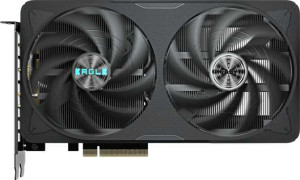
Gigabyte GeForce RTX 5060 Ti Eagle OC 16GB
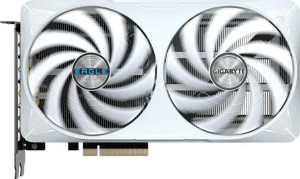
Gigabyte GeForce RTX 5060 Ti Eagle OC Ice 16GB

Gigabyte GeForce RTX 5060 Ti Eagle OC 16GB Gigabyte GeForce RTX 5060 Ti Eagle OC Ice 16GB

Overview

Welcome to our detailed spec comparison between the Gigabyte GeForce RTX 5060 Ti Eagle OC 16GB and the Gigabyte GeForce RTX 5060 Ti Eagle OC Ice 16GB. Both cards are built on the modern Blackwell architecture and sit within the same product family, making this a particularly close head-to-head. In this comparison, we examine their performance figures, memory configurations, feature sets, and connectivity options to help you understand exactly where these two cards stand relative to each other.

Common Features

  • Both cards have a GPU clock speed of 2407 MHz.
  • Both cards have a GPU turbo speed of 2617 MHz.
  • Both cards deliver a pixel rate of 125.6 GPixel/s.
  • Both cards offer 24.12 TFLOPS of floating-point performance.
  • Both cards have a texture rate of 376.8 GTexels/s.
  • Both cards have a GPU memory speed of 1750 MHz.
  • Both cards have 4608 shading units.
  • Both cards have 144 texture mapping units (TMUs).
  • Both cards have an effective memory speed of 28000 MHz.
  • Both cards offer a maximum memory bandwidth of 448 GB/s.
  • Both cards come with 16GB of VRAM.
  • Both cards use GDDR7 memory.
  • Both cards have a 128-bit memory bus width.
  • ECC memory is supported on both cards.
  • Both cards support DirectX 12 Ultimate.
  • Both cards support OpenGL version 4.6.
  • Both cards support OpenCL version 3.
  • Multi-display technology is supported on both cards.
  • Ray tracing is supported on both cards.
  • 3D support is available on both cards.
  • DLSS is supported on both cards.
  • XeSS (XMX) support is not available on either card.
  • Both cards have an HDMI output.
  • Both cards have 1 HDMI port.
  • Both cards use HDMI version 2.1b.
  • Both cards have 3 DisplayPort outputs.
  • Neither card has USB-C ports.
  • Neither card has DVI outputs.
  • Neither card has mini DisplayPort outputs.
  • Both cards use the Blackwell GPU architecture.
  • Both cards have a Thermal Design Power (TDP) of 180W.
  • Both cards use PCIe version 5.
  • Both cards are built on a 5 nm semiconductor process.
  • Both cards have 21900 million transistors.
  • Air-water cooling is not available on either card.
  • Both cards have a width of 215 mm.
  • Both cards have a height of 122 mm.
Specs Comparison
Gigabyte GeForce RTX 5060 Ti Eagle OC 16GB

Gigabyte GeForce RTX 5060 Ti Eagle OC 16GB

Gigabyte GeForce RTX 5060 Ti Eagle OC Ice 16GB

Gigabyte GeForce RTX 5060 Ti Eagle OC Ice 16GB

Performance:
GPU clock speed 2407 MHz 2407 MHz
GPU turbo 2617 MHz 2617 MHz
pixel rate 125.6 GPixel/s 125.6 GPixel/s
floating-point performance 24.12 TFLOPS 24.12 TFLOPS
texture rate 376.8 GTexels/s 376.8 GTexels/s
GPU memory speed 1750 MHz 1750 MHz
shading units 4608 4608
texture mapping units (TMUs) 144 144
render output units (ROPs) 48 48
Has Double Precision Floating Point (DPFP)

In the Performance category, the Gigabyte GeForce RTX 5060 Ti Eagle OC 16GB and the Gigabyte GeForce RTX 5060 Ti Eagle OC Ice 16GB are, in every measurable way, identical. Both cards share the same 2407 MHz base clock and 2617 MHz boost clock, the same 4608 shading units, 144 TMUs, and 48 ROPs, and both run their GDDR7 memory at 1750 MHz. This translates to an identical 24.12 TFLOPS of floating-point throughput, a 376.8 GTexel/s texture fill rate, and a 125.6 GPixel/s pixel rate across the board.

Those figures are worth contextualizing: 24 TFLOPS of FP32 performance places this GPU firmly in the upper mid-range tier, capable of handling demanding rasterized workloads at 1440p and providing a solid foundation for ray-tracing and AI-accelerated rendering pipelines. The 48 ROPs are the throughput ceiling for pixel output — relevant in high-resolution or high-refresh-rate scenarios — and both cards hit that ceiling at exactly the same point. Double Precision Floating Point support is present on both, though it is rarely a deciding factor for gaming use cases.

The verdict here is a complete tie. There is zero performance differentiation between these two variants at the silicon level. Any real-world difference in gaming benchmarks would fall entirely within margin-of-error variance. Buyers choosing between them should focus exclusively on other spec groups — such as cooling solution, physical dimensions, or aesthetics — since raw GPU performance will not separate them.
Memory:
effective memory speed 28000 MHz 28000 MHz
maximum memory bandwidth 448 GB/s 448 GB/s
VRAM 16GB 16GB
GDDR version GDDR7 GDDR7
memory bus width 128-bit 128-bit
Supports ECC memory

Memory configuration is often where GPU variants diverge most sharply — but that is not the case here. Both the Eagle OC 16GB and the Eagle OC Ice 16GB deploy an identical memory subsystem: 16GB of GDDR7 running at an effective speed of 28000 MHz across a 128-bit bus, delivering 448 GB/s of peak bandwidth.

That bandwidth figure deserves attention. Achieving 448 GB/s through a 128-bit interface — rather than the wider 192-bit or 256-bit buses found on higher-end cards — is made possible specifically by GDDR7's generational efficiency gains. For a mid-range GPU, this is a strong result, and the 16GB capacity is genuinely future-proof for 1440p workloads and comfortably handles large texture assets and AI model weights. ECC memory support on both cards is a minor but notable addition, offering error-correction that is more relevant to workstation or compute use cases than gaming.

As with the performance group, this is an unambiguous tie. Every memory specification — capacity, type, speed, bus width, and bandwidth — is a perfect match between the two variants. Memory subsystem quality will play no role in a buyer's decision between these two cards.

Features:
DirectX version DirectX 12 Ultimate DirectX 12 Ultimate
OpenGL version 4.6 4.6
OpenCL version 3 3
Supports multi-display technology
supports ray tracing
Supports 3D
supports DLSS
has XeSS (XMX)
AMD SAM / Intel Resizable BAR Intel Resizable BAR Intel Resizable BAR
has LHR
has RGB lighting
supported displays 4 4

Feature parity continues to define this comparison. Both the Eagle OC 16GB and the Eagle OC Ice 16GB carry DirectX 12 Ultimate support — the current gold standard for modern gaming APIs, enabling mesh shaders, variable rate shading, and DirectX Raytracing. Paired with ray tracing and DLSS support, these cards are well-equipped for the current and near-future game library. DLSS in particular is a meaningful real-world advantage over competing hardware, as it leverages AI-based upscaling to recover significant frame rates with minimal visual fidelity loss.

On the practical side, both cards support up to 4 simultaneous displays and include Intel Resizable BAR, which allows the CPU to access the full GPU frame buffer at once rather than in smaller chunks — a feature that yields measurable performance gains in a growing number of titles. The absence of LHR (Lite Hash Rate) on both is also worth noting for buyers who care about compute flexibility. RGB lighting is present on both variants, which matters for system builders prioritizing aesthetics.

There is nothing to separate these two cards on features — every capability, API version, and technology flag is a mirror image. This group, like the others before it, results in a complete tie. The decision between these two variants must hinge on factors outside of feature sets entirely.

Ports:
has an HDMI output
HDMI ports 1 1
HDMI version HDMI 2.1b HDMI 2.1b
DisplayPort outputs 3 3
USB-C ports 0 0
DVI outputs 0 0
mini DisplayPort outputs 0 0

Both the Eagle OC 16GB and the Eagle OC Ice 16GB offer an identical port layout: 3 DisplayPort outputs and 1 HDMI 2.1b port, totaling four physical display connections — consistent with the four-display limit noted in the Features group. The combination is practical and well-suited to the card's target audience, covering both multi-monitor desktop setups and living room or single-display gaming scenarios without requiring adapters.

HDMI 2.1b is the headline here in terms of real-world relevance. It supports up to 10K resolution and, more practically, enables 4K at 144Hz or 1080p at 480Hz over a single cable — making it a capable connection for high-refresh-rate displays and modern TVs alike. The three DisplayPort outputs round out the selection for users running multiple monitors or high-bandwidth professional displays. The absence of USB-C and DVI outputs is unremarkable at this product tier; DVI is effectively obsolete, and USB-C display output is more common on workstation-class or laptop GPUs.

Predictably, this group is another tie. Port selection is identical across both variants in type, count, and version. Connectivity will not influence the choice between these two cards in any meaningful way.

General info:
GPU architecture Blackwell Blackwell
release date April 2025 April 2025
Thermal Design Power (TDP) 180W 180W
PCI Express (PCIe) version 5 5
semiconductor size 5 nm 5 nm
number of transistors 21900 million 21900 million
Has air-water cooling
width 215 mm 215 mm
height 122 mm 122 mm

At the foundational level, both the Eagle OC 16GB and the Eagle OC Ice 16GB are built on the same silicon: NVIDIA's Blackwell architecture, fabbed on a 5nm process node with 21.9 billion transistors. The move to 5nm is significant in context — it enables higher transistor density and improved power efficiency compared to prior generations, which is part of how NVIDIA extracts competitive performance from a 180W TDP. That power envelope is relatively modest for this performance tier, meaning both cards should be manageable in mid-tower builds without demanding exotic power delivery.

The physical footprint is also identical: 215mm wide and 122mm tall, which places these firmly in a standard dual-slot, mid-length form factor. Builders working with smaller cases will find both cards equally accommodating. PCIe 5.0 compatibility future-proofs the interface for next-generation motherboards, though in practice PCIe bandwidth is not a bottleneck at this GPU tier even on PCIe 4.0 systems. Neither card offers liquid or hybrid cooling, both relying entirely on air cooling solutions.

Once again, every data point in this group is a complete tie. The Eagle OC Ice variant's differentiation — suggested by its name — does not manifest in any of the general specifications provided here. Buyers will need to look beyond these core attributes to find any distinction between the two models.

Comparison Summary & Verdict

After a thorough review of all available specifications, the Gigabyte GeForce RTX 5060 Ti Eagle OC 16GB and the Gigabyte GeForce RTX 5060 Ti Eagle OC Ice 16GB are identical across every measurable category covered here. Both deliver the same 2617 MHz boost clock, the same 16GB of GDDR7 memory on a 128-bit bus with 448 GB/s bandwidth, and the same 180W TDP on a PCIe 5.0 interface. Features such as ray tracing, DLSS, and DirectX 12 Ultimate are equally present on both. Given no differentiating specs in this dataset, your choice between the two will most likely come down to aesthetics, regional availability, or pricing at the time of purchase.

Gigabyte GeForce RTX 5060 Ti Eagle OC 16GB
Buy Gigabyte GeForce RTX 5060 Ti Eagle OC 16GB if...

Buy the Gigabyte GeForce RTX 5060 Ti Eagle OC 16GB if it is available at a lower price or you prefer its specific aesthetic design, as its technical specifications are identical to the Ice variant.

Gigabyte GeForce RTX 5060 Ti Eagle OC Ice 16GB
Buy Gigabyte GeForce RTX 5060 Ti Eagle OC Ice 16GB if...

Buy the Gigabyte GeForce RTX 5060 Ti Eagle OC Ice 16GB if its visual design appeals to you or it is more readily available in your region, since it shares every technical specification with the standard Eagle OC model.