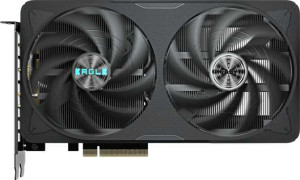
Gigabyte GeForce RTX 5060 Ti Eagle OC 16GB
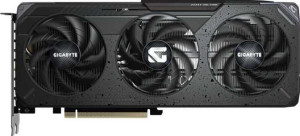
Gigabyte GeForce RTX 5060 Ti Gaming OC 16GB

Gigabyte GeForce RTX 5060 Ti Eagle OC 16GB Gigabyte GeForce RTX 5060 Ti Gaming OC 16GB

Overview

When choosing between the Gigabyte GeForce RTX 5060 Ti Eagle OC 16GB and the Gigabyte GeForce RTX 5060 Ti Gaming OC 16GB, buyers are navigating two compelling takes on the same Blackwell GPU core. Both cards share an identical 16GB GDDR7 memory configuration and a 180W TDP, yet they diverge in ways that matter: peak boost clock speeds, raw compute throughput, and physical dimensions all tell different stories. Read on to see how these two cards stack up across every key specification.

Common Features

  • Both cards have a base GPU clock speed of 2407 MHz.
  • Both cards have a GPU memory speed of 1750 MHz.
  • Both cards feature 4608 shading units.
  • Both cards have 144 texture mapping units (TMUs).
  • Both cards have 48 render output units (ROPs).
  • Double Precision Floating Point (DPFP) is supported on both cards.
  • Both cards have an effective memory speed of 28000 MHz.
  • Both cards offer a maximum memory bandwidth of 448 GB/s.
  • Both cards come with 16GB of VRAM.
  • Both cards use GDDR7 memory.
  • Both cards have a 128-bit memory bus width.
  • ECC memory is supported on both cards.
  • Both cards support DirectX 12 Ultimate.
  • Both cards support OpenGL version 4.6.
  • Both cards support OpenCL version 3.
  • Multi-display technology is supported on both cards.
  • Ray tracing is supported on both cards.
  • 3D technology is supported on both cards.
  • DLSS is supported on both cards.
  • XeSS (XMX) is not available on either card.
  • Both cards have one HDMI 2.1b output.
  • Both cards feature 3 DisplayPort outputs.
  • Neither card has USB-C, DVI, or mini DisplayPort outputs.
  • Both cards are based on the Blackwell GPU architecture.
  • Both cards have a Thermal Design Power (TDP) of 180W.
  • Both cards use PCIe version 5.
  • Both cards are manufactured on a 5 nm semiconductor process.
  • Both cards contain 21900 million transistors.
  • Air-water cooling is not available on either card.

Main Differences

  • GPU turbo clock speed is 2617 MHz on the Gigabyte GeForce RTX 5060 Ti Eagle OC 16GB and 2647 MHz on the Gigabyte GeForce RTX 5060 Ti Gaming OC 16GB.
  • Pixel rate is 125.6 GPixel/s on the Gigabyte GeForce RTX 5060 Ti Eagle OC 16GB and 127.1 GPixel/s on the Gigabyte GeForce RTX 5060 Ti Gaming OC 16GB.
  • Floating-point performance is 24.12 TFLOPS on the Gigabyte GeForce RTX 5060 Ti Eagle OC 16GB and 24.39 TFLOPS on the Gigabyte GeForce RTX 5060 Ti Gaming OC 16GB.
  • Texture rate is 376.8 GTexels/s on the Gigabyte GeForce RTX 5060 Ti Eagle OC 16GB and 381.2 GTexels/s on the Gigabyte GeForce RTX 5060 Ti Gaming OC 16GB.
  • Card width is 215 mm on the Gigabyte GeForce RTX 5060 Ti Eagle OC 16GB and 281 mm on the Gigabyte GeForce RTX 5060 Ti Gaming OC 16GB.
  • Card height is 122 mm on the Gigabyte GeForce RTX 5060 Ti Eagle OC 16GB and 119 mm on the Gigabyte GeForce RTX 5060 Ti Gaming OC 16GB.
Specs Comparison
Gigabyte GeForce RTX 5060 Ti Eagle OC 16GB

Gigabyte GeForce RTX 5060 Ti Eagle OC 16GB

Gigabyte GeForce RTX 5060 Ti Gaming OC 16GB

Gigabyte GeForce RTX 5060 Ti Gaming OC 16GB

Performance:
GPU clock speed 2407 MHz 2407 MHz
GPU turbo 2617 MHz 2647 MHz
pixel rate 125.6 GPixel/s 127.1 GPixel/s
floating-point performance 24.12 TFLOPS 24.39 TFLOPS
texture rate 376.8 GTexels/s 381.2 GTexels/s
GPU memory speed 1750 MHz 1750 MHz
shading units 4608 4608
texture mapping units (TMUs) 144 144
render output units (ROPs) 48 48
Has Double Precision Floating Point (DPFP)

At the core, both the Eagle OC and Gaming OC variants share an identical foundation: the same 2407 MHz base clock, 4608 shading units, 144 TMUs, 48 ROPs, and 1750 MHz memory speed. This means that under light or sustained workloads where the GPU does not fully boost, both cards will perform identically — the architectural silicon is the same.

The only meaningful performance differentiator lies in the GPU turbo (boost) clock. The Gaming OC reaches 2647 MHz versus the Eagle OC′s 2617 MHz — a gap of just 30 MHz, or roughly 1.1%. This directly explains the downstream differences: the Gaming OC edges ahead with 24.39 TFLOPS of floating-point throughput versus 24.12 TFLOPS, and a texture rate of 381.2 GTexels/s against 376.8 GTexels/s. In real-world gaming and rendering scenarios, a sub-2% delta of this kind will not produce a perceptible frame rate difference — it falls well within benchmark noise and thermal variance.

The Gaming OC holds a marginal technical edge in the Performance category strictly due to its higher boost clock, but the advantage is so slim that it will be imperceptible in practice. Both cards support Double Precision Floating Point, which is relevant for compute tasks but inconsequential for gaming. If raw peak performance on paper is the deciding factor, the Gaming OC wins — otherwise, this group is effectively a tie.

Memory:
effective memory speed 28000 MHz 28000 MHz
maximum memory bandwidth 448 GB/s 448 GB/s
VRAM 16GB 16GB
GDDR version GDDR7 GDDR7
memory bus width 128-bit 128-bit
Supports ECC memory

The memory subsystem is completely identical between the Eagle OC and Gaming OC: both carry 16GB of GDDR7 VRAM across a 128-bit bus, running at an effective 28000 MHz for a maximum bandwidth of 448 GB/s. There is no distinguishing factor here whatsoever.

What is worth contextualizing is how capable this shared configuration actually is. GDDR7 is the latest generation of graphics memory, and at 28 Gbps per pin it compensates meaningfully for the relatively narrow 128-bit bus — delivering bandwidth figures that would have required a 192-bit GDDR6 bus to match. The 16GB capacity is generous for a mid-range card and future-proofs the GPU well against memory-hungry titles, high-resolution texture packs, and AI-assisted rendering workloads. ECC memory support is an added note of robustness, primarily relevant for professional or compute use cases rather than gaming.

This category is a dead tie. Every memory specification is shared down to the last detail, so memory performance will be a non-factor when choosing between these two cards.

Features:
DirectX version DirectX 12 Ultimate DirectX 12 Ultimate
OpenGL version 4.6 4.6
OpenCL version 3 3
Supports multi-display technology
supports ray tracing
Supports 3D
supports DLSS
has XeSS (XMX)
AMD SAM / Intel Resizable BAR Intel Resizable BAR Intel Resizable BAR
has LHR
has RGB lighting
supported displays 4 4

Feature parity is total between the Eagle OC and Gaming OC. Both support DirectX 12 Ultimate and ray tracing, meaning neither card has any advantage when it comes to accessing modern rendering pipelines or next-generation visual effects in supported titles. DLSS support is present on both, which is arguably the most practically impactful feature here — NVIDIA′s AI-driven upscaling can dramatically boost frame rates at minimal visual cost, particularly relevant in ray-traced scenarios where raw performance headroom is consumed quickly.

Both cards support up to 4 simultaneous displays and include Intel Resizable BAR, which allows the CPU to access the full GPU frame buffer at once rather than in small chunks — a feature that can yield modest but real performance gains in supported games and requires no user configuration beyond a compatible platform. RGB lighting is present on both, leaving aesthetics entirely to personal taste and case compatibility rather than any spec-driven distinction.

There is no differentiating factor in this category. Every feature — from API support to display count to software capabilities — is identical across both cards, making the Features group a complete tie.

Ports:
has an HDMI output
HDMI ports 1 1
HDMI version HDMI 2.1b HDMI 2.1b
DisplayPort outputs 3 3
USB-C ports 0 0
DVI outputs 0 0
mini DisplayPort outputs 0 0

Connectivity is identical on both cards: each offers 3 DisplayPort outputs and 1 HDMI 2.1b port, totaling four physical outputs — which aligns with the four-display maximum established in the Features group. The absence of USB-C, DVI, and mini DisplayPort is consistent with modern GPU design priorities and is unlikely to be a limitation for the vast majority of users.

HDMI 2.1b is worth noting as a meaningful capability in its own right — it supports up to 10K resolution and very high refresh rates, making it fully compatible with the latest high-bandwidth displays and home theater setups. The three DisplayPort outputs similarly ensure that users running multi-monitor workstations or high-refresh gaming arrays are well covered without needing adapters.

No differentiation exists here. The port layout and versions are a mirror image between the Eagle OC and Gaming OC, making this category another complete tie.

General info:
GPU architecture Blackwell Blackwell
release date April 2025 April 2025
Thermal Design Power (TDP) 180W 180W
PCI Express (PCIe) version 5 5
semiconductor size 5 nm 5 nm
number of transistors 21900 million 21900 million
Has air-water cooling
width 215 mm 281 mm
height 122 mm 119 mm

Both cards are built on the same Blackwell architecture, manufactured on a 5nm process with 21.9 billion transistors, and share an identical 180W TDP. This means power requirements, platform compatibility (both use PCIe 5.0), and thermal output are equal — neither card will demand more from a PSU or case airflow than the other.

The one genuinely practical differentiator in this group is physical size. The Eagle OC measures 215mm in length, while the Gaming OC stretches to 281mm — a difference of 66mm, or roughly 31% longer. In real-world terms, this is a meaningful case compatibility concern: smaller mid-tower and mini-ITX cases that can comfortably fit the Eagle OC may not clear the Gaming OC at all. Users building in compact enclosures should measure their available GPU clearance carefully before choosing the Gaming OC.

On general specifications, these cards are otherwise equivalent. But the Eagle OC holds a clear practical advantage for space-constrained builds, while the Gaming OC′s larger footprint typically accommodates a bigger cooler — a trade-off relevant to thermal performance, though cooling data falls outside this group′s scope.

Comparison Summary & Verdict

After a thorough side-by-side review, both cards prove to be closely matched siblings sharing the same Blackwell architecture, 16GB GDDR7 memory, 448 GB/s bandwidth, and a full feature set including ray tracing and DLSS. The edge in outright performance goes to the Gigabyte GeForce RTX 5060 Ti Gaming OC 16GB, which pulls ahead with a higher GPU turbo clock of 2647 MHz, 24.39 TFLOPS of floating-point performance, and a superior texture rate of 381.2 GTexels/s. However, the Gigabyte GeForce RTX 5060 Ti Eagle OC 16GB makes a strong case for users working with compact builds, thanks to its notably smaller 215 mm width versus the Gaming OC's 281 mm, making it significantly easier to fit into tighter PC cases. If maximum performance within a standard-sized build is the priority, the Gaming OC is the stronger choice; if compact form factor matters most, the Eagle OC is the clear pick.

Gigabyte GeForce RTX 5060 Ti Eagle OC 16GB
Buy Gigabyte GeForce RTX 5060 Ti Eagle OC 16GB if...

Buy the Gigabyte GeForce RTX 5060 Ti Eagle OC 16GB if you have a compact or small-form-factor PC case, as its significantly smaller 215 mm width makes it far easier to fit into tighter builds.

Gigabyte GeForce RTX 5060 Ti Gaming OC 16GB
Buy Gigabyte GeForce RTX 5060 Ti Gaming OC 16GB if...

Buy the Gigabyte GeForce RTX 5060 Ti Gaming OC 16GB if you want the highest possible performance, as it offers a faster GPU turbo clock, higher floating-point throughput, and a better texture rate than the Eagle OC.