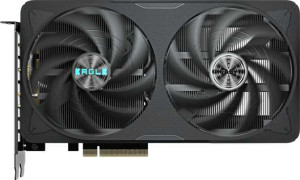
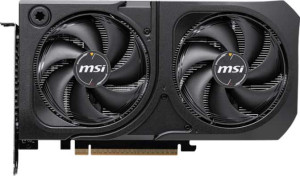
At the foundation, both the Gigabyte Eagle OC and the MSI Shadow 2X Plus are built on identical silicon: the same 4608 shading units, 144 TMUs, 48 ROPs, and a base GPU clock of 2407 MHz — confirming these are the same underlying GPU with no architectural differences between them. Memory bandwidth is also equally matched at 1750 MHz. The real divergence comes down to how aggressively each board partner has tuned the boost clock.
The Gigabyte Eagle OC pulls ahead with a higher GPU turbo of 2617 MHz versus the MSI Shadow 2X Plus at 2572 MHz — a gap of 45 MHz, or roughly 1.7%. This translates directly into the derived performance metrics: the Eagle OC delivers 24.12 TFLOPS of floating-point throughput against 23.7 TFLOPS for the Shadow 2X Plus, and leads in both pixel rate (125.6 vs 123.5 GPixel/s) and texture rate (376.8 vs 370.4 GTexels/s). In practice, these margins are slim — users are unlikely to notice a tangible fps difference in games — but they reflect a more confident factory overclock on the Gigabyte side.
The edge goes to the Gigabyte Eagle OC on performance. It offers a measurably higher boost clock and slightly better throughput across every computed metric. That said, the advantage is narrow enough that real-world rendering performance will be virtually indistinguishable between the two; the decision is unlikely to hinge on these specs alone and may more reasonably come down to cooling design, noise levels, or price.