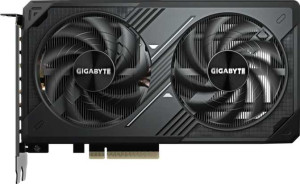
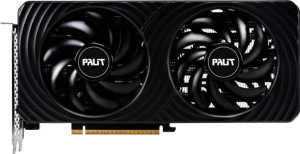
At their core, both the Gigabyte WindForce OC and the Palit Dual are built on identical silicon: the same 3840 shading units, 120 TMUs, 48 ROPs, and a base GPU clock of 2280 MHz. This means their theoretical performance ceiling is governed by the same architecture, and any real-world difference between them comes down almost entirely to factory overclocking — specifically, the boost clock.
That is where a small but measurable gap emerges. The Gigabyte WindForce OC boosts to 2512 MHz, while the Palit Dual reaches 2497 MHz — a difference of 15 MHz. This modest overclock translates directly into the downstream figures: the WindForce OC edges ahead with 19.29 TFLOPS of floating-point performance versus 19.18 TFLOPS, and a texture rate of 301.4 GTexels/s against 299.6 GTexels/s. In practice, these deltas are under 1% and would be indistinguishable in the vast majority of gaming workloads or benchmarks — they fall well within frame-to-frame variance.
Both cards share identical memory speeds and full support for Double Precision Floating Point, so there is no differentiation on those fronts. The Gigabyte WindForce OC holds a narrow performance edge on paper due to its higher factory boost clock, but it should be understood as a marginal advantage rather than a meaningful generational gap. For all practical purposes, these two cards are performance equals, and a buyer's decision should hinge on factors outside this spec group.