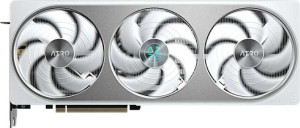
At first glance, the Gigabyte RTX 5070 Aero OC appears competitive on clocks alone — its 2625 MHz turbo actually exceeds the MSI RTX 5070 Ti Ventus 3X's 2452 MHz by a notable margin. However, clock speed is only one dimension of GPU performance. The 5070 Ti Ventus brings substantially more silicon to the table: 8960 shading units versus 6144 on the Aero OC, along with 280 TMUs and 96 ROPs compared to 192 and 80, respectively. These are not incremental gaps — the 5070 Ti carries roughly 46% more shader processors, which directly translates to wider parallel compute throughput.
The downstream impact of that hardware gap is reflected in the key throughput metrics. The 5070 Ti Ventus delivers 43.94 TFLOPS of floating-point performance versus 32.26 TFLOPS for the Aero OC — a difference of over 36% in raw compute. Similarly, its texture fill rate of 686.6 GTexels/s dwarfs the Aero OC's 504 GTexels/s, meaning the 5070 Ti can push more textured geometry per second, which matters in high-resolution or heavily detailed scenes. The pixel rate edge (235.4 vs 210 GPixel/s) also favors the 5070 Ti, pointing to a higher potential ceiling in rasterization-heavy workloads. Both cards share an identical 1750 MHz memory speed and both support Double Precision Floating Point, so those are non-differentiators.
The MSI RTX 5070 Ti Ventus 3X holds a clear and decisive performance advantage in this group. The Aero OC's higher turbo clock is a real but insufficient offset — when a GPU has 46% more execution units, no clock speed lead realistically bridges that gap in sustained workloads. Users prioritizing maximum rendering throughput, compute performance, or headroom at higher resolutions should lean firmly toward the 5070 Ti Ventus.