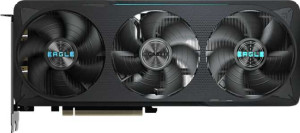
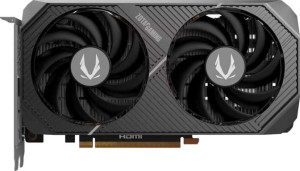
At first glance, the clock speeds of these two cards look nearly identical — the RTX 5070 Eagle OC SFF runs a 2325 MHz base and 2587 MHz turbo, while the RTX 5050 Twin Edge OC actually edges it out slightly on turbo at 2602 MHz. However, clock speed alone tells almost nothing about real-world GPU performance. What matters is how many execution units are running at that speed — and here, the two cards are worlds apart.
The RTX 5070 Eagle OC SFF carries 6144 shading units, 192 TMUs, and 80 ROPs, compared to 2560 shading units, 80 TMUs, and 32 ROPs on the RTX 5050. This roughly 2.4× advantage in execution resources translates directly into the compute numbers: 31.79 TFLOPS of floating-point performance versus just 13.32 TFLOPS, and a texture fill rate of 496.7 GTexels/s against 208.2 GTexels/s. In practice, this means the RTX 5070 can push far more geometry, shading complexity, and ray-tracing workloads per frame — the gap will be especially visible at higher resolutions or with demanding visual effects enabled.
The one area where the RTX 5050 holds a genuine hardware advantage is memory speed, at 2500 MHz versus 1750 MHz on the RTX 5070 — though the real-world impact of this depends on memory bus width and total bandwidth, which are not captured in this spec group alone. Both cards support Double Precision Floating Point, making them both technically viable for compute tasks, though the RTX 5070's raw TFLOPS lead makes it substantially more capable there too. Overall, the RTX 5070 Eagle OC SFF holds a commanding performance advantage in this group across every meaningful compute metric.