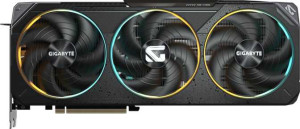
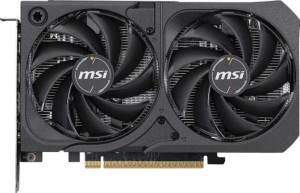
At first glance, the clock speeds of both cards look remarkably close — the RTX 5070 Gaming OC runs a base of 2325 MHz and a turbo of 2625 MHz, while the RTX 5050 Shadow 2X sits at 2317 MHz base and 2572 MHz turbo. This near-parity might suggest comparable performance, but clock speed alone is deeply misleading without accounting for the number of execution units behind it.
The real story is in the silicon: the RTX 5070 Gaming OC deploys 6144 shading units, 192 TMUs, and 80 ROPs, versus 2560 shading units, 80 TMUs, and 32 ROPs on the RTX 5050. That roughly 2.4× advantage in raw compute resources translates directly into the headline numbers — 32.26 TFLOPS of floating-point performance and a texture rate of 504 GTexels/s for the 5070, compared to 13.17 TFLOPS and 205.8 GTexels/s for the 5050. In practice, this gap means the 5070 can handle far more complex geometry, higher-resolution textures, and heavier shader workloads simultaneously — think the difference between smooth 4K gaming with ray tracing enabled versus more constrained 1080p or 1440p scenarios.
Both cards share the same GPU memory speed of 1750 MHz and both support Double Precision Floating Point, which matters for compute-adjacent tasks. However, these commonalities do not close the performance gap in any meaningful way. The RTX 5070 Gaming OC holds a decisive and comprehensive advantage across every performance metric in this group — it is not a marginal win but a categorical one, making the 5050 Shadow 2X a product clearly aimed at a different, more budget-conscious tier.