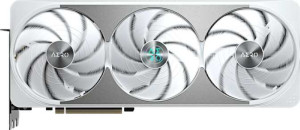
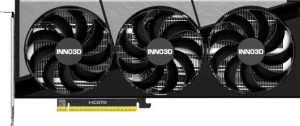
Both cards share an identical base GPU clock of 2295 MHz, which means neither has a head start before boost kicks in. Once under load, however, the Inno3D RTX 5080 X3 OC pulls ahead with a turbo clock of 2640 MHz versus 2588 MHz on the Gigabyte RTX 5070 Ti Aero OC — a modest ~2% clock advantage that alone would not be decisive, but it compounds with the 5080's larger silicon.
The more meaningful gap lies in the raw computational hardware. The 5080 X3 OC fields 10,752 shading units, 336 TMUs, and 112 ROPs compared to the 5070 Ti's 8,960 shaders, 280 TMUs, and 96 ROPs — roughly a 20% wider execution engine across the board. Combined with the higher boost clock and faster 1875 MHz memory (vs. 1750 MHz), this translates into floating-point throughput of 56.77 TFLOPS on the 5080 versus 46.38 TFLOPS on the 5070 Ti, a ~22% compute advantage. In practice, that delta is felt in heavily shaded scenes, ray-tracing workloads, and GPU-compute tasks where parallelism scales with shader count.
The 5080 X3 OC also holds a clear edge in rasterization throughput: its 295.7 GPixel/s pixel fill rate and 887 GTexels/s texture rate outpace the 5070 Ti Aero OC's 248.4 GPixel/s and 724.6 GTexels/s by roughly 19–22%, which directly benefits high-resolution, high-refresh-rate gaming. Both cards support Double Precision Floating Point, so neither has an exclusive advantage for professional compute. Overall, the Inno3D RTX 5080 X3 OC holds a clear and consistent performance advantage across every metric in this group — the 5070 Ti Aero OC is not far behind, but the 5080's wider GPU and faster memory give it a substantial lead that will be visible at demanding settings.