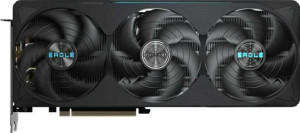
At their core, both GPUs share identical foundational hardware: 8960 shading units, 280 TMUs, 96 ROPs, and a base clock of 2295 MHz — meaning neither card has a silicon-level advantage out of the box. The real performance story begins under load, where factory overclocking separates them. The Gigabyte Eagle OC SFF boosts to 2542 MHz, while the MSI Shadow 3X tops out at 2452 MHz — a difference of 90 MHz that flows directly into every derived performance metric.
That boost clock gap translates into measurable, if modest, real-world advantages for the Gigabyte: 45.55 TFLOPS of floating-point throughput versus 43.94 TFLOPS for the MSI (about 3.7% more), a texture fill rate of 711.8 GTexels/s against 686.6 GTexels/s, and a pixel rate of 244 GPixel/s versus 235.4 GPixel/s. In practice, these margins translate to a slight edge in compute-heavy workloads and in scenarios where sustained high-frequency operation matters — such as raytracing, AI-accelerated rendering, or running games at the GPU's thermal limit for extended sessions. Both cards share the same 1750 MHz memory speed, so bandwidth is not a differentiating factor here.
The Gigabyte Eagle OC SFF holds a clear but narrow performance edge in this group, driven entirely by its higher factory boost clock. For users who prioritize maximum out-of-the-box throughput without manual overclocking, it is the stronger choice. However, the ~3.7% performance delta is small enough that real-world framerate differences in most games will be difficult to perceive, making the gap more relevant for professional compute tasks than for typical gaming use.