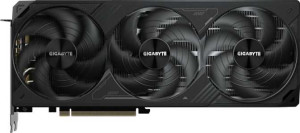
At their core, both the Gigabyte WindForce OC SFF and the MSI Inspire 3X OC Plus share an identical architectural foundation: the same 2295 MHz base clock, the same 8960 shading units, 280 TMUs, 96 ROPs, and 1750 MHz memory speed. This means the vast majority of their compute pipeline is identical, and in sustained workloads that don't fully leverage boost headroom, users should expect near-indistinguishable performance between the two cards.
The only meaningful differentiator within this group is the GPU turbo clock: the Gigabyte boosts to 2497 MHz versus the MSI's 2482 MHz — a gap of 15 MHz, or roughly 0.6%. This small but real difference cascades into the derived metrics: the Gigabyte edges ahead in floating-point performance (44.75 TFLOPS vs. 44.48), pixel rate (239.7 vs. 238.3 GPixel/s), and texture rate (699.2 vs. 695 GTexels/s). In practice, a sub-1% clock advantage rarely produces a perceptible frame-rate difference in gaming, though it could matter at the margins in compute-heavy or GPU-limited scenarios.
On balance, the Gigabyte WindForce OC SFF holds a narrow but consistent performance edge across every throughput metric in this group, all stemming from its slightly higher boost clock. The MSI Inspire 3X OC Plus is not meaningfully slower — real-world results will fall within the margin of measurement noise — but if raw peak performance is the sole criterion, the Gigabyte is the technical winner here.