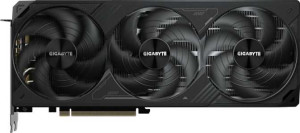
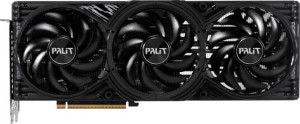
At their core, both the Gigabyte WindForce OC SFF and the Palit GamingPro-S are built on identical silicon configurations: the same 8960 shading units, 280 TMUs, 96 ROPs, and a base GPU clock of 2295 MHz. Memory bandwidth potential is also equal, with both running at 1750 MHz GPU memory speed. This means that under light or thermally constrained workloads where neither card reaches its boost ceiling, performance will be effectively indistinguishable.
The meaningful divergence appears at peak boost. The Gigabyte WindForce OC SFF sustains a higher GPU turbo of 2497 MHz versus 2452 MHz on the Palit GamingPro-S — a difference of 45 MHz, or roughly 1.8%. This higher ceiling directly cascades into every throughput metric: the WindForce OC SFF delivers 44.75 TFLOPS of floating-point performance against 43.94 TFLOPS, a 699.2 GTexels/s texture rate versus 686.6 GTexels/s, and a pixel rate of 239.7 GPixel/s compared to 235.4 GPixel/s. In practice, these gains translate to a modest but real advantage in GPU-bound scenarios — particularly in compute-heavy or high-resolution rendering tasks where sustained boost clocks matter most.
Overall, the Gigabyte WindForce OC SFF holds a clear, if slim, performance edge in this group, entirely attributable to its higher factory boost clock. The Palit GamingPro-S is not far behind, but buyers prioritizing peak throughput — whether for gaming at maximum settings or GPU compute workloads — will find the WindForce OC SFF the stronger choice based strictly on these specs.