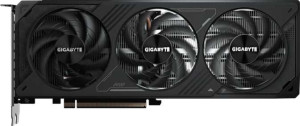
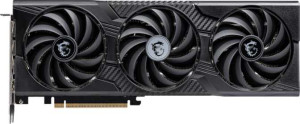
At their core, the Gigabyte GeForce RTX 5070 WindForce OC SFF and the MSI GeForce RTX 5070 Gaming Duke 3X OC are built on an identical architectural foundation: the same 6144 shading units, 192 TMUs, 80 ROPs, and a matching base clock of 2325 MHz with identical memory speeds of 1750 MHz. This means both cards draw from the same raw hardware pool and will behave nearly identically under sustained, thermally-limited workloads.
The only measurable separation between them lies in their boost clocks. The MSI Duke 3X OC reaches a turbo of 2557 MHz versus the Gigabyte WindForce OC SFF's 2542 MHz — a 15 MHz or roughly 0.6% difference. This marginal advantage cascades into the derived metrics: the MSI edges ahead with 31.42 TFLOPS of floating-point performance versus 31.24 TFLOPS, and a texture rate of 490.9 GTexels/s compared to 488.1 GTexels/s. In practice, these differences fall well below the threshold of perceptibility in games or creative workloads — no benchmark or real-world scenario would reliably distinguish the two on performance alone.
On performance, this group is effectively a tie. The MSI Gaming Duke 3X OC holds a technically higher boost clock and fractionally better throughput figures, but the gap is so small that it carries no practical significance. A buyer choosing between these two cards should look elsewhere — form factor, cooling solution, acoustics, or price — rather than raw GPU performance to make their decision.