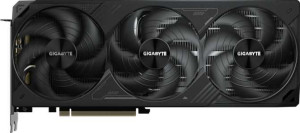
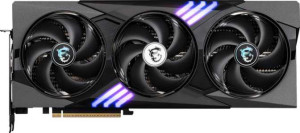
Both the Gigabyte RTX 5080 WindForce OC SFF and the MSI RTX 5070 Ti Gaming Trio Plus share an identical base GPU clock of 2295 MHz, meaning neither card enjoys a raw frequency advantage at the silicon level. The real divergence begins under sustained load: the 5080 WindForce boosts to 2670 MHz versus the 5070 Ti's 2452 MHz — a 218 MHz gap that translates directly into higher throughput across every rendering workload.
That clock advantage is compounded by a significantly larger shader array. The 5080 WindForce deploys 10,752 shading units, 336 TMUs, and 112 ROPs, compared to the 5070 Ti's 8,960, 280, and 96 respectively. More shading units mean more parallel computation per frame, more TMUs accelerate texture throughput, and more ROPs increase the rate at which pixels are written to the framebuffer — all of which matter at high resolutions and with demanding post-processing. This is reflected in the headline numbers: the 5080 WindForce delivers 57.42 TFLOPS of floating-point performance and a pixel fill rate of 299 GPixel/s, versus the 5070 Ti's 43.94 TFLOPS and 235.4 GPixel/s — roughly a 30% lead in both metrics. Memory bandwidth also skews toward the 5080, with a GPU memory speed of 1,875 MHz against 1,750 MHz on the 5070 Ti.
Both cards support Double Precision Floating Point (DPFP), which matters for compute and professional workloads beyond gaming. Overall, the Gigabyte RTX 5080 WindForce OC SFF holds a clear and consistent performance advantage across every measured metric in this group — the only tie is the base clock. Users prioritizing raw throughput, high-resolution gaming, or compute-heavy tasks will find a meaningful lead here in favor of the 5080.