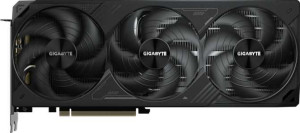
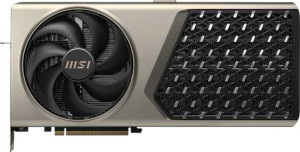
Both the Gigabyte RTX 5080 WindForce OC SFF and the MSI RTX 5080 Expert OC share an identical foundation: the same 2295 MHz base clock, the same shader, TMU, and ROP counts (10752 / 336 / 112), and the same 1875 MHz memory speed. This means the two cards are drawing from exactly the same silicon resources and memory bandwidth — the real differentiator lives entirely in how aggressively each manufacturer pushes the boost clock.
That differentiator is real but modest. The MSI Expert OC reaches a GPU turbo of 2715 MHz versus the Gigabyte WindForce OC SFF's 2670 MHz — a 45 MHz gap, or roughly 1.7%. This directly cascades into every throughput metric: the MSI edges ahead with 58.38 TFLOPS of floating-point performance versus 57.42 TFLOPS, and a texture rate of 912.2 GTexels/s against 897.1 GTexels/s. In practice, the ~1 TFLOP difference is unlikely to be perceptible in gaming frame rates, but it can translate to a small, measurable advantage in GPU-compute workloads such as AI inference, video encoding, or simulation tasks that run for extended periods.
On balance, the MSI Expert OC holds a narrow but consistent performance edge in this group, courtesy of its higher boost clock. For pure gaming use, the gap is effectively negligible. For users who also leverage the card for creative or compute work where sustained throughput matters, the MSI's slightly higher ceiling gives it a real, if small, advantage. The Gigabyte WindForce OC SFF trades none of the core hardware — only the peak clock — so buyers prioritizing form factor or thermals over that last 1–2% of headroom may find the tradeoff worthwhile.