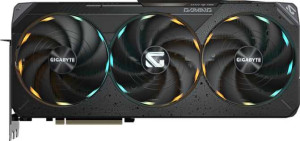
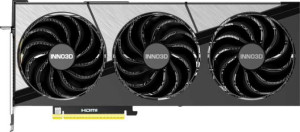
Both cards share the same 2017 MHz base clock, identical shader and texture unit counts (21,760 shaders, 680 TMUs, 176 ROPs), and the same 1750 MHz memory speed — confirming they are built on the same silicon with the same memory subsystem. The real divergence appears the moment boost clocks kick in: the Gigabyte Gaming OC sustains a 2550 MHz turbo versus the Inno3D X3's 2407 MHz, a gap of roughly 6%. Because GPU throughput scales directly with clock speed when all other units are equal, this single difference cascades across every performance metric.
That clock advantage translates directly into the derived numbers: the Gaming OC delivers 111 TFLOPS of floating-point performance and a texture fill rate of 1734 GTexels/s, while the X3 reaches 104.8 TFLOPS and 1636.8 GTexels/s respectively. In practice, higher TFLOPS means more headroom for compute-heavy workloads — ray tracing, AI-assisted rendering, and shader-intensive scenes — while a greater texture fill rate benefits texture-rich environments where the GPU must sample and filter large numbers of textures per frame. The pixel rate gap (448.8 vs. 423.6 GPixel/s) similarly favors the Gigabyte card, which matters most at very high resolutions where pixel output becomes the bottleneck.
The Gigabyte GeForce RTX 5090 Gaming OC holds a clear performance edge in this group. The advantage is not architectural — the underlying GPU is identical — but the higher factory overclock unlocks meaningfully more throughput across rendering, compute, and fill-rate workloads. The Inno3D X3 is not slow by any measure, but buyers prioritizing peak performance from the same RTX 5090 chip should favour the Gigabyte variant based strictly on these specs.