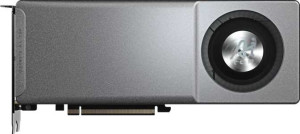
Gigabyte Radeon AI Pro R9700 AI Top
Nvidia RTX Pro 4500 Blackwell

Gigabyte Radeon AI Pro R9700 AI Top Nvidia RTX Pro 4500 Blackwell

Overview

Welcome to our in-depth specification face-off between the Gigabyte Radeon AI Pro R9700 AI Top and the Nvidia RTX Pro 4500 Blackwell — two professional-grade graphics cards built for demanding workloads. Both cards share a 32GB VRAM pool and ray tracing support, yet they diverge sharply across memory technology, raw compute throughput, and power efficiency. Read on as we break down every key metric to help you decide which card best fits your workflow.

Common Features

  • Both products support Double Precision Floating Point (DPFP).
  • Both products come with 32GB of VRAM.
  • Both products use a 256-bit memory bus width.
  • ECC memory is supported on both products.
  • Both products support OpenGL version 4.6.
  • Multi-display technology is supported on both products.
  • Ray tracing is supported on both products.
  • 3D support is available on both products.
  • XeSS (XMX) is not available on either product.
  • LHR is not present on either product.
  • RGB lighting is not featured on either product.
  • Both products support up to 4 displays.
  • Neither product has any USB-C ports.
  • Neither product has any DVI outputs.
  • Neither product has any mini DisplayPort outputs.
  • Both products use PCI Express (PCIe) version 5.
  • Air-water cooling is not available on either product.

Main Differences

  • GPU clock speed is 1660 MHz on Gigabyte Radeon AI Pro R9700 AI Top and 1590 MHz on Nvidia RTX Pro 4500 Blackwell.
  • GPU turbo speed is 2920 MHz on Gigabyte Radeon AI Pro R9700 AI Top and 2617 MHz on Nvidia RTX Pro 4500 Blackwell.
  • Pixel rate is 373.8 GPixel/s on Gigabyte Radeon AI Pro R9700 AI Top and 293.1 GPixel/s on Nvidia RTX Pro 4500 Blackwell.
  • Floating-point performance is 47.84 TFLOPS on Gigabyte Radeon AI Pro R9700 AI Top and 54.94 TFLOPS on Nvidia RTX Pro 4500 Blackwell.
  • Texture rate is 747.5 GTexels/s on Gigabyte Radeon AI Pro R9700 AI Top and 858.4 GTexels/s on Nvidia RTX Pro 4500 Blackwell.
  • GPU memory speed is 2518 MHz on Gigabyte Radeon AI Pro R9700 AI Top and 1750 MHz on Nvidia RTX Pro 4500 Blackwell.
  • Shading units number 4096 on Gigabyte Radeon AI Pro R9700 AI Top and 10496 on Nvidia RTX Pro 4500 Blackwell.
  • Texture mapping units (TMUs) total 256 on Gigabyte Radeon AI Pro R9700 AI Top and 328 on Nvidia RTX Pro 4500 Blackwell.
  • Render output units (ROPs) total 128 on Gigabyte Radeon AI Pro R9700 AI Top and 112 on Nvidia RTX Pro 4500 Blackwell.
  • Effective memory speed is 20100 MHz on Gigabyte Radeon AI Pro R9700 AI Top and 28000 MHz on Nvidia RTX Pro 4500 Blackwell.
  • Maximum memory bandwidth is 640 GB/s on Gigabyte Radeon AI Pro R9700 AI Top and 896 GB/s on Nvidia RTX Pro 4500 Blackwell.
  • The Gigabyte Radeon AI Pro R9700 AI Top uses GDDR6 memory, while the Nvidia RTX Pro 4500 Blackwell uses GDDR7.
  • DirectX 12 Ultimate is supported on Gigabyte Radeon AI Pro R9700 AI Top, whereas Nvidia RTX Pro 4500 Blackwell supports DirectX 12.
  • OpenCL version is 2.2 on Gigabyte Radeon AI Pro R9700 AI Top and 3 on Nvidia RTX Pro 4500 Blackwell.
  • The Gigabyte Radeon AI Pro R9700 AI Top features AMD SAM, while the Nvidia RTX Pro 4500 Blackwell features Intel Resizable BAR.
  • An HDMI output is present on Gigabyte Radeon AI Pro R9700 AI Top but not available on Nvidia RTX Pro 4500 Blackwell.
  • DisplayPort outputs number 3 on Gigabyte Radeon AI Pro R9700 AI Top and 4 on Nvidia RTX Pro 4500 Blackwell.
  • GPU architecture is RDNA 4.0 on Gigabyte Radeon AI Pro R9700 AI Top and Blackwell on Nvidia RTX Pro 4500 Blackwell.
  • Thermal Design Power (TDP) is 300W on Gigabyte Radeon AI Pro R9700 AI Top and 200W on Nvidia RTX Pro 4500 Blackwell.
  • Semiconductor size is 4 nm on Gigabyte Radeon AI Pro R9700 AI Top and 5 nm on Nvidia RTX Pro 4500 Blackwell.
  • The number of transistors is 53900 million on Gigabyte Radeon AI Pro R9700 AI Top and 45600 million on Nvidia RTX Pro 4500 Blackwell.
Specs Comparison
Gigabyte Radeon AI Pro R9700 AI Top

Gigabyte Radeon AI Pro R9700 AI Top

Nvidia RTX Pro 4500 Blackwell

Nvidia RTX Pro 4500 Blackwell

Performance:
GPU clock speed 1660 MHz 1590 MHz
GPU turbo 2920 MHz 2617 MHz
pixel rate 373.8 GPixel/s 293.1 GPixel/s
floating-point performance 47.84 TFLOPS 54.94 TFLOPS
texture rate 747.5 GTexels/s 858.4 GTexels/s
GPU memory speed 2518 MHz 1750 MHz
shading units 4096 10496
texture mapping units (TMUs) 256 328
render output units (ROPs) 128 112
Has Double Precision Floating Point (DPFP)

Looking at raw clock speeds, the Gigabyte Radeon AI Pro R9700 AI Top holds a clear advantage: its base clock of 1660 MHz and turbo of 2920 MHz outpace the RTX Pro 4500 Blackwell's 1590 / 2617 MHz, and its memory runs at a significantly faster 2518 MHz versus 1750 MHz. Higher clocks and faster memory bandwidth typically translate to snappier frame delivery and quicker data throughput per shader cycle, which benefits workloads that are clock-sensitive rather than parallelism-bound.

However, the Nvidia RTX Pro 4500 Blackwell counters with a fundamentally wider compute architecture. Its 10,496 shading units dwarf the R9700's 4,096, and this raw parallelism is what drives its superior 54.94 TFLOPS of floating-point performance versus 47.84 TFLOPS — a roughly 15% compute advantage. The RTX Pro 4500 also leads in texture throughput (858.4 GTexels/s vs 747.5 GTexels/s), meaning it can process textured geometry faster in complex scenes. The R9700 does reclaim the lead in pixel fill rate (373.8 GPixel/s vs 293.1 GPixel/s), which favors high-resolution rasterization workloads where ROPs are the bottleneck.

Both GPUs support Double Precision Floating Point, making neither uniquely disqualified for professional compute tasks requiring FP64 precision. Overall, the RTX Pro 4500 Blackwell holds the edge for compute-heavy and AI-oriented workloads thanks to its massively wider shader array and higher TFLOPS, while the R9700 AI Top's clock speed and pixel rate advantage gives it a nod in rasterization-heavy scenarios. For raw parallel compute performance, the RTX Pro 4500 is the stronger card in this group.
Memory:
effective memory speed 20100 MHz 28000 MHz
maximum memory bandwidth 640 GB/s 896 GB/s
VRAM 32GB 32GB
GDDR version GDDR6 GDDR7
memory bus width 256-bit 256-bit
Supports ECC memory

Both GPUs arrive with identical 32GB VRAM and a 256-bit memory bus, meaning neither has a capacity or width advantage — a useful baseline for memory-intensive professional workloads like large model inference or high-resolution content creation. Where they diverge sharply is in memory generation: the R9700 AI Top uses GDDR6, while the RTX Pro 4500 Blackwell steps up to the newer GDDR7 standard.

That generational gap has a direct and significant impact on throughput. The RTX Pro 4500 achieves an effective memory speed of 28000 MHz and a peak bandwidth of 896 GB/s, compared to the R9700's 20100 MHz and 640 GB/s — a roughly 40% bandwidth advantage. In bandwidth-bound workloads — think large matrix operations in AI inference, high-polygon scene traversal, or simulation tasks that continuously stream data to and from VRAM — this gap directly translates into faster completion times and less stalling on memory fetches.

Both cards support ECC memory, which is a prerequisite for professional and scientific environments where data integrity is non-negotiable. That parity aside, the memory subsystem verdict is clear: the RTX Pro 4500 Blackwell holds a decisive edge here, with GDDR7 delivering substantially higher bandwidth over the same bus width — a meaningful advantage for any workload where memory throughput is the limiting factor.

Features:
DirectX version DirectX 12 Ultimate DirectX 12
OpenGL version 4.6 4.6
OpenCL version 2.2 3
Supports multi-display technology
supports ray tracing
Supports 3D
has XeSS (XMX)
AMD SAM / Intel Resizable BAR AMD SAM Intel Resizable BAR
has LHR
has RGB lighting
supported displays 4 4

The most consequential difference in this group is the DirectX implementation. The R9700 AI Top supports DirectX 12 Ultimate, which is a strict superset of the plain DirectX 12 found on the RTX Pro 4500. DirectX 12 Ultimate formally certifies support for advanced rendering features — including mesh shaders, sampler feedback, and higher-tier DirectX Raytracing — meaning the R9700 is better positioned for modern game engines and visualization tools that target these capabilities explicitly.

The RTX Pro 4500 counters with OpenCL 3.0 versus the R9700's OpenCL 2.2. For users running GPU-accelerated compute workflows that rely on the OpenCL API — certain scientific simulation tools, cross-platform AI frameworks, or legacy professional software — the newer OpenCL version offers broader feature coverage and improved compatibility with modern compute specifications. Both cards share identical OpenGL 4.6 support, so legacy OpenGL-dependent professional applications are on equal footing.

Beyond those two distinctions, the feature sets are remarkably symmetrical: both support ray tracing, multi-display output across up to 4 displays, and their respective resizable BAR implementations (AMD SAM vs Intel Resizable BAR) are platform-specific optimizations that depend on the host system rather than indicating a clear advantage for either card. On balance, this group is a split: the R9700 AI Top edges ahead for graphics and rendering feature completeness via DirectX 12 Ultimate, while the RTX Pro 4500 has the advantage for OpenCL-based compute workflows.

Ports:
has an HDMI output
DisplayPort outputs 3 4
USB-C ports 0 0
DVI outputs 0 0
mini DisplayPort outputs 0 0

The display output configurations here reflect two different philosophies. The RTX Pro 4500 Blackwell goes all-in on 4 DisplayPort outputs and omits HDMI entirely, while the R9700 AI Top offers 3 DisplayPort outputs plus a dedicated HDMI port. The practical implication is straightforward: the RTX Pro 4500 can drive one more display natively, which matters in dense multi-monitor workstation setups where every output counts.

The R9700's inclusion of HDMI, however, is a meaningful convenience factor. HDMI remains the dominant interface on consumer monitors, projectors, and AV equipment, meaning the R9700 can connect to a broader range of displays without requiring an adapter. The RTX Pro 4500's lack of any HDMI output means users relying on HDMI-only screens will need a DisplayPort-to-HDMI adapter — a minor but real friction point in mixed-display environments.

Neither card offers USB-C, mini DisplayPort, or DVI outputs, so those are non-factors. The verdict depends on the use case: for a pure professional multi-monitor workstation where all displays are DisplayPort-native, the RTX Pro 4500 has the edge with its extra output. For users who need flexible compatibility with HDMI displays alongside DisplayPort monitors, the R9700 AI Top is the more versatile choice out of the box.

General info:
GPU architecture RDNA 4.0 Blackwell
release date July 2025 March 2025
Thermal Design Power (TDP) 300W 200W
PCI Express (PCIe) version 5 5
semiconductor size 4 nm 5 nm
number of transistors 53900 million 45600 million
Has air-water cooling
width 267 mm 266.7 mm
height 111 mm 111.8 mm

The most striking contrast in this group is power consumption. The R9700 AI Top carries a 300W TDP versus the RTX Pro 4500 Blackwell's notably lower 200W — a 50% difference that has real consequences for workstation builders. Higher TDP means greater demands on PSU headroom, chassis airflow, and sustained thermal management. In dense or thermally constrained workstations, the RTX Pro 4500's efficiency advantage translates directly into lower operating temperatures, quieter fan behavior, and reduced electricity costs over continuous workloads.

On the silicon side, the R9700 is built on a 4nm process node and packs 53.9 billion transistors, compared to the RTX Pro 4500's 5nm node and 45.6 billion transistors. The R9700's denser, more advanced node is part of why it achieves higher transistor counts — and those additional transistors underpin its broader shader and compute resources seen in other spec groups. Both cards use PCIe 5.0, ensuring neither will be constrained by interface bandwidth on a modern platform.

Physically, the two cards are essentially identical in footprint — within a millimeter in both width and height — so slot compatibility and case clearance are a non-issue when choosing between them. The clear winner in this group is the RTX Pro 4500 Blackwell, whose 100W lower TDP makes it significantly more power-efficient and workstation-friendly, a meaningful advantage for always-on professional environments where thermal and energy budgets matter.

Comparison Summary & Verdict

After examining every specification, a clear picture emerges for each card. The Gigabyte Radeon AI Pro R9700 AI Top leads in GPU clock speed, pixel rate, and transistor count, and uniquely offers an HDMI output alongside DirectX 12 Ultimate support — making it a compelling choice for users who need high pixel throughput and broader display connectivity. The Nvidia RTX Pro 4500 Blackwell, on the other hand, pulls ahead with significantly higher floating-point performance (54.94 TFLOPS), superior texture rate, faster GDDR7 memory delivering 896 GB/s of bandwidth, and a notably lower 200W TDP — a meaningful advantage for professionals running sustained compute or AI workloads where power efficiency and memory bandwidth are critical priorities.

Gigabyte Radeon AI Pro R9700 AI Top
Buy Gigabyte Radeon AI Pro R9700 AI Top if...

Buy the Gigabyte Radeon AI Pro R9700 AI Top if you need higher GPU clock speeds, broader display connectivity including HDMI, DirectX 12 Ultimate support, and do not have strict power consumption constraints.

Nvidia RTX Pro 4500 Blackwell
Buy Nvidia RTX Pro 4500 Blackwell if...

Buy the Nvidia RTX Pro 4500 Blackwell if your workloads demand superior floating-point performance, faster GDDR7 memory bandwidth, and a significantly lower 200W power draw for sustained professional or AI compute tasks.