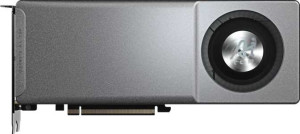
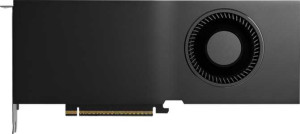
At first glance, the Gigabyte Radeon AI Pro R9700 AI Top appears competitive on clock speeds, running a higher base of 1660 MHz and a turbo of 2920 MHz versus the Nvidia RTX Pro 5000 Blackwell's 1590 MHz and 2617 MHz respectively. However, raw clock speed is only one part of the performance equation — the width of the parallel processing pipeline matters far more for throughput-heavy workloads. This is where the two GPUs diverge sharply: the RTX Pro 5000 deploys 14,080 shading units, 440 TMUs, and 176 ROPs, dwarfing the R9700's 4,096 shading units, 256 TMUs, and 128 ROPs. More shader processors mean the GPU can handle vastly more parallel threads simultaneously — critical for rendering, compute, and AI inference tasks.
The downstream impact of that architectural gap is clearly visible in the throughput metrics. The RTX Pro 5000 delivers 73.69 TFLOPS of floating-point performance compared to the R9700's 47.84 TFLOPS — a lead of roughly 54%. Its texture rate of 1,151 GTexels/s versus 747.5 GTexels/s and pixel rate of 460.6 GPixel/s versus 373.8 GPixel/s reinforce that advantage across all major rendering dimensions. The only metric where the R9700 leads is memory clock speed (2,518 MHz vs. 1,750 MHz), which can benefit bandwidth-sensitive workloads, though this alone cannot compensate for the deficit in compute density. Both cards support Double Precision Floating Point (DPFP), making them equally viable for professional simulation and scientific workloads that require 64-bit precision.
The RTX Pro 5000 Blackwell holds a clear and decisive performance advantage in this group. Its superior shading unit count translates directly into higher throughput across floating-point compute, texturing, and rasterization — the metrics that matter most for GPU-intensive professional and AI workloads. The R9700 AI Top's faster memory speed is a genuine but narrow upside that is unlikely to close the overall performance gap in practice.