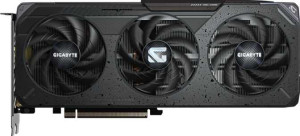
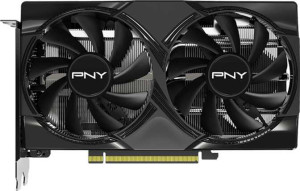
The raw throughput numbers tell a striking story here. The Gigabyte RX 9060 XT delivers 27.2 TFLOPS of floating-point performance against the PNY RTX 5060's 19.47 TFLOPS — a roughly 40% advantage that directly reflects compute headroom for shader-heavy workloads, ray tracing calculations, and general rendering throughput. Its pixel rate of 212.5 GPixel/s versus the RTX 5060's 121.7 GPixel/s is equally telling: higher pixel fill rate means the GPU can push more pixels to the framebuffer per second, which matters most at higher resolutions and in fill-rate-bound scenarios. The texture rate gap mirrors this, with the RX 9060 XT at 425 GTexels/s compared to 304.2 GTexels/s, giving it a clear advantage in texture-heavy environments.
The clock speed picture is more nuanced. The RTX 5060 leads on base clock (2280 MHz vs 1900 MHz), suggesting more stable sustained performance under load. However, the RX 9060 XT's boost clock of 3320 MHz is dramatically higher than the RTX 5060's 2535 MHz — and it is this turbo headroom that largely explains the throughput advantages seen above. The RTX 5060 compensates with significantly more shading units (3840 vs 2048), which can benefit highly parallelized workloads, but this advantage is clearly outweighed in the aggregate throughput metrics by the RX 9060 XT's superior clock scaling. Memory speed also favors the RX 9060 XT at 2518 MHz versus 1750 MHz, meaning faster data delivery to the GPU cores. Both cards support Double Precision Floating Point, so neither holds an exclusive advantage for compute tasks requiring DPFP.
Overall, the Gigabyte RX 9060 XT holds a clear performance edge in this group across nearly every throughput-oriented metric — TFLOPS, pixel rate, texture rate, and memory speed. The PNY RTX 5060's higher shading unit count is a genuine architectural differentiator, but based solely on the provided specs, it does not translate into a comparable aggregate performance lead. Users prioritizing raw GPU horsepower based on these figures should favor the RX 9060 XT.