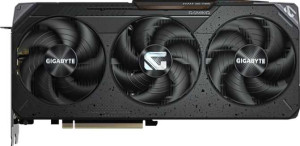
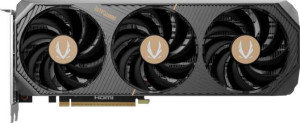
At first glance, the Zotac RTX 5070 Ti appears to hold a hardware advantage with 8960 shading units versus the Gigabyte RX 9070 XT's 4096 — more than double. However, raw shader counts are architecture-dependent and do not translate linearly into performance. When you look at the metrics that actually reflect throughput, the picture reverses: the RX 9070 XT delivers 50.14 TFLOPS of floating-point performance and a 391.7 GPixel/s pixel fill rate, compared to the RTX 5070 Ti's 44.48 TFLOPS and 238.3 GPixel/s. This means AMD's architecture is extracting significantly more work per shader unit, which translates to better raw compute throughput and rasterization capacity in practice.
Clock behavior also tells an interesting story. The RTX 5070 Ti runs at a steady 2295–2482 MHz — a tight, consistent boost window that favors stability. The RX 9070 XT operates very differently: a low base of 1660 MHz that rockets to 3060 MHz under turbo. This aggressive boost strategy is what enables its superior throughput figures, though it may also mean the GPU is more sensitive to thermal and power headroom. On memory bandwidth, the 9070 XT again leads with a 2518 MHz memory speed versus the 5070 Ti's 1750 MHz, giving it a faster data pipeline to feed its execution units.
Based strictly on the provided performance specs, the Gigabyte RX 9070 XT holds a clear edge in every major throughput metric — floating-point performance, pixel rate, texture rate, and memory speed — despite having fewer shading units on paper. The RTX 5070 Ti's higher TMU count (280 vs. 256) is a modest counterpoint, but it is not enough to close the gap. For workloads that stress raw GPU compute and fill rate, the RX 9070 XT is the stronger performer based on this data.