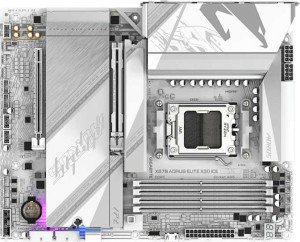
Gigabyte X870 Aorus Elite X3D Ice
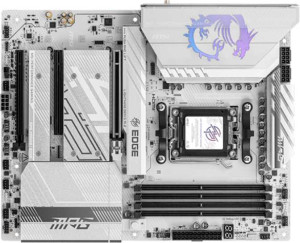
MSI MPG B850 Edge Ti WiFi

Gigabyte X870 Aorus Elite X3D Ice MSI MPG B850 Edge Ti WiFi

Overview

Welcome to our in-depth specification face-off between the Gigabyte X870 Aorus Elite X3D Ice and the MSI MPG B850 Edge Ti WiFi — two compelling AM5 motherboards targeting enthusiast builders. Both boards share a strong foundation, but key battlegrounds emerge around chipset capability, connectivity options, expansion slot configurations, and storage support. Read on to see how these two platforms stack up across every major spec category.

Common Features

  • Both boards use the AM5 CPU socket.
  • Both boards have an ATX form factor.
  • Wi-Fi is supported on both boards, covering Wi-Fi 4, Wi-Fi 5, Wi-Fi 6, Wi-Fi 6E, and Wi-Fi 7.
  • Bluetooth 5.4 is available on both boards.
  • Both boards feature HDMI 2.1 output.
  • Overclocking is supported on both boards.
  • Both boards support up to 256GB of maximum memory.
  • Both boards have 4 memory slots.
  • Both boards use DDR5 memory.
  • Both boards operate on 2 memory channels.
  • ECC memory is not supported on either board.
  • Both boards include 2 USB 3.2 Gen 2 ports (USB-A).
  • Neither board has any USB 3.2 Gen 1 ports (USB-C).
  • Neither board has any USB 3.2 Gen 2x2 ports.
  • Neither board has any USB 4 20Gbps ports.
  • Neither board has any Thunderbolt 3 ports.
  • Both boards have an HDMI output.
  • Neither board has any DisplayPort outputs.
  • Both boards have 1 RJ45 port.
  • Both boards provide 4 USB 3.2 Gen 1 ports through expansion.
  • Both boards provide 1 USB 3.2 Gen 2x2 port through expansion.
  • Both boards provide 4 USB 2.0 ports through expansion.
  • Both boards have 8 fan headers.
  • Both boards have 4 M.2 sockets.
  • Both boards include a TPM connector.
  • Neither board has any U.2 sockets.
  • Both boards have 1 PCIe 5.0 x16 slot.
  • Neither board has any PCIe 3.0 x16 slots.
  • Neither board has any PCI slots.
  • Neither board has any PCIe 2.0 x16 slots.
  • Neither board has any PCIe x8 slots.
  • Both boards have a signal-to-noise ratio (DAC) of 120 dB.
  • Both boards support 7.1 audio channels.
  • An S/PDIF Out port is present on both boards.
  • Both boards have 2 audio connectors.
  • RAID 0 is supported on both boards.
  • RAID 1 is supported on both boards.
  • RAID 10 (1+0) is supported on both boards.
  • RAID 0+1 is not supported on either board.

Main Differences

  • The chipset is X870 on Gigabyte X870 Aorus Elite X3D Ice and B850 on MSI MPG B850 Edge Ti WiFi.
  • The board height is 244 mm on Gigabyte X870 Aorus Elite X3D Ice and 243.8 mm on MSI MPG B850 Edge Ti WiFi.
  • The board width is 305 mm on Gigabyte X870 Aorus Elite X3D Ice and 304.8 mm on MSI MPG B850 Edge Ti WiFi.
  • Maximum native RAM speed is 5200 MHz on Gigabyte X870 Aorus Elite X3D Ice and 5600 MHz on MSI MPG B850 Edge Ti WiFi.
  • Maximum overclocked RAM speed is 9000 MHz on Gigabyte X870 Aorus Elite X3D Ice and 8400 MHz on MSI MPG B850 Edge Ti WiFi.
  • USB 3.2 Gen 1 ports (USB-A) count is 4 on Gigabyte X870 Aorus Elite X3D Ice and 1 on MSI MPG B850 Edge Ti WiFi.
  • USB 3.2 Gen 2 ports (USB-C) count is 1 on Gigabyte X870 Aorus Elite X3D Ice and 3 on MSI MPG B850 Edge Ti WiFi.
  • USB 2.0 ports count is 1 on Gigabyte X870 Aorus Elite X3D Ice and 4 on MSI MPG B850 Edge Ti WiFi.
  • USB 4 40Gbps ports are present on Gigabyte X870 Aorus Elite X3D Ice (2 ports) but not available on MSI MPG B850 Edge Ti WiFi.
  • Thunderbolt 4 ports are present on Gigabyte X870 Aorus Elite X3D Ice (2 ports) but not available on MSI MPG B850 Edge Ti WiFi.
  • SATA 3 connectors count is 2 on Gigabyte X870 Aorus Elite X3D Ice and 4 on MSI MPG B850 Edge Ti WiFi.
  • PCIe 4.0 x16 slots are present on MSI MPG B850 Edge Ti WiFi (1 slot) but not available on Gigabyte X870 Aorus Elite X3D Ice.
  • PCIe x1 slots are present on MSI MPG B850 Edge Ti WiFi (1 slot) but not available on Gigabyte X870 Aorus Elite X3D Ice.
  • PCIe x4 slots are present on Gigabyte X870 Aorus Elite X3D Ice (1 slot) but not available on MSI MPG B850 Edge Ti WiFi.
  • RAID 5 support is present on Gigabyte X870 Aorus Elite X3D Ice but not available on MSI MPG B850 Edge Ti WiFi.
Specs Comparison
Gigabyte X870 Aorus Elite X3D Ice

Gigabyte X870 Aorus Elite X3D Ice

MSI MPG B850 Edge Ti WiFi

MSI MPG B850 Edge Ti WiFi

General info:
CPU socket AM5 AM5
chipset X870 B850
form factor ATX ATX
release date September 2025 January 2025
supports Wi-Fi
Wi-Fi version Wi-Fi 4 (802.11n), Wi-Fi 5 (802.11ac), Wi-Fi 6 (802.11ax), Wi-Fi 6E (802.11ax), Wi-Fi 7 (802.11be) Wi-Fi 4 (802.11n), Wi-Fi 5 (802.11ac), Wi-Fi 6 (802.11ax), Wi-Fi 6E (802.11ax), Wi-Fi 7 (802.11be)
Has Bluetooth
Bluetooth version 5.4 5.4
HDMI version HDMI 2.1 HDMI 2.1
Easy to overclock
has RGB lighting
Easy to reset BIOS
Has dual BIOS
has aptX
CPU sockets 1 1
Has integrated graphics
warranty period 3 years 3 years
height 244 mm 243.8 mm
width 305 mm 304.8 mm
Has integrated CPU

At a glance, the Gigabyte X870 Aorus Elite X3D Ice and the MSI MPG B850 Edge Ti WiFi are remarkably similar in their general profile: both are full-size ATX boards targeting the AM5 platform, share identical wireless credentials (Wi-Fi 7 and Bluetooth 5.4), output video via HDMI 2.1, and come backed by a 3-year warranty. Their physical footprints are virtually indistinguishable, differing by less than 0.2 mm in either dimension, meaning case compatibility is a non-issue for both.

The single most meaningful differentiator in this group is the chipset. The Aorus Elite X3D Ice runs on the X870 chipset, which sits at the top of AMD's current consumer hierarchy, while the MPG B850 Edge Ti WiFi uses the B850 chipset, a capable mid-range option. In practical terms, X870 typically unlocks more PCIe lanes, broader overclocking headroom, and greater bandwidth allocation for high-speed storage and peripherals — though both boards are listed as easy to overclock, so B850 still supports CPU overclocking on AM5. The real-world gap matters most to enthusiasts pushing multiple NVMe drives or high-bandwidth expansion cards simultaneously.

For connectivity and everyday usability, the two boards are essentially tied — same wireless stack, same Bluetooth revision, same HDMI output, and both include RGB lighting and a straightforward BIOS reset mechanism. The X870 chipset gives the Gigabyte a clear platform-level edge for power users who need the extra I/O and bandwidth ceiling, but users who don't plan to saturate those lanes will find the MSI B850 delivers a nearly identical general-purpose experience at what is typically a lower price point.
Memory:
maximum memory amount 256GB 256GB
RAM speed (max) 5200 MHz 5600 MHz
overclocked RAM speed 9000 MHz 8400 MHz
memory slots 4 4
DDR memory version 5 5
memory channels 2 2
Supports ECC memory

Both boards share the same foundational memory architecture: 4 slots of DDR5 in a dual-channel configuration with a 256GB ceiling — more than enough headroom for any workstation or gaming build today. Neither supports ECC memory, which is expected at this consumer tier and only relevant to those considering server or professional error-correction workloads.

Where things get interesting is in the interplay between rated and overclocked speeds. The MSI MPG B850 Edge Ti WiFi posts a higher native maximum of 5600 MHz versus the Aorus Elite X3D Ice's 5200 MHz, meaning out-of-the-box JEDEC or XMP profiles have slightly more room to breathe on the MSI. However, the Gigabyte X870 Aorus Elite X3D Ice flips the script when pushing beyond spec, supporting overclocked speeds up to 9000 MHz compared to the MSI's 8400 MHz ceiling. That 600 MHz gap at the extreme end is non-trivial for enthusiasts chasing peak memory bandwidth — a metric that directly benefits CPU-bound tasks, content creation, and memory-sensitive workloads.

The verdict here depends entirely on the use case. Everyday builders running standard XMP kits will find the MSI's higher baseline speed marginally more accessible, while serious overclockers and bandwidth-hungry power users will find the Gigabyte's 9000 MHz overclock ceiling the more compelling ceiling. On balance, the Aorus Elite X3D Ice holds a narrow but real edge for the enthusiast segment this group is likely targeting.

Ports:
USB 3.2 Gen 2 ports (USB-A) 2 2
USB 3.2 Gen 1 ports (USB-A) 4 1
USB 3.2 Gen 2 ports (USB-C) 1 3
USB 3.2 Gen 1 ports (USB-C) 0 0
USB 2.0 ports 1 4
USB 3.2 Gen 2x2 ports 0 0
USB 4 40Gbps ports 2 0
USB 4 20Gbps ports 0 0
Thunderbolt 4 ports 2 0
Thunderbolt 3 ports 0 0
has an HDMI output
DisplayPort outputs 0 0
RJ45 ports 1 1
Has USB Type-C
eSATA ports 0 0
DVI outputs 0 0
has a VGA connector
PS/2 ports 0 0

The port layout is where these two boards diverge most sharply, and the gap is driven almost entirely by the Gigabyte X870 Aorus Elite X3D Ice's inclusion of 2 USB 4 (40Gbps) ports with full Thunderbolt 4 compatibility. Thunderbolt 4 is a premium feature rarely seen outside flagship boards — it enables daisy-chaining high-bandwidth peripherals, connecting external GPU enclosures, and plugging in ultra-fast NVMe docks at up to 40Gbps, all through a single reversible connector. The MSI MPG B850 Edge Ti WiFi offers none of this, which is a meaningful omission for users invested in a Thunderbolt ecosystem.

Outside of that headline difference, the two boards take distinctly different approaches to USB-C versatility versus USB-A breadth. The MSI counters with 3 USB 3.2 Gen 2 Type-C ports on the rear — useful for modern peripherals, smartphones, and hubs — while the Gigabyte provides just one. On the legacy side, the MSI also ships with 4 USB 2.0 ports compared to the Gigabyte's single one, which matters for users with older keyboards, mice, or dongles that don't benefit from higher-speed connections. Meanwhile, the Gigabyte offers 4 USB 3.2 Gen 1 Type-A ports versus the MSI's single one, giving it a stronger showing for standard high-speed USB-A devices.

Overall, the Aorus Elite X3D Ice holds a clear advantage in this category. The Thunderbolt 4 / USB 4 40Gbps capability alone represents a generational leap in expandability that the MSI simply cannot match, and the Gigabyte's higher count of USB-A Gen 1 ports adds practical day-to-day convenience. The MSI's edge in USB-C Gen 2 quantity and USB 2.0 slots offers real utility, but those are incremental conveniences rather than platform-level differentiators.

Connectors:
USB 3.2 Gen 1 ports (through expansion) 4 4
USB 3.2 Gen 2x2 ports (through expansion) 1 1
USB 2.0 ports (through expansion) 4 4
SATA 3 connectors 2 4
fan headers 8 8
USB 3.0 ports (through expansion) 4 4
M.2 sockets 4 4
Has TPM connector
U.2 sockets 0 0
Has mSATA connector
SATA 2 connectors 0 0

Internal connectors tell a revealing story about storage philosophy. Both boards offer an identical internal expansion skeleton — 4 M.2 sockets, matched USB headers across all speed tiers, 8 fan headers, and a TPM connector — making them effectively equivalent for NVMe-centric builds and thermal management. The M.2 count is particularly noteworthy: four slots is a generous allocation that covers even demanding multi-drive setups for content creation or high-speed caching configurations.

The one meaningful divergence is in traditional storage connectivity. The MSI MPG B850 Edge Ti WiFi provides 4 SATA 3 connectors, while the Gigabyte X870 Aorus Elite X3D Ice offers only 2. For builders who still rely on SATA SSDs or mechanical hard drives — whether for mass storage, NAS-style setups, or legacy drives being repurposed — this gap is tangible. Two SATA ports is enough for a basic dual-drive config, but users with existing SATA storage libraries may find the Gigabyte limiting without an add-in controller card.

On the whole, connector parity is high between these two boards, and neither has a sweeping advantage. However, the MSI's doubled SATA 3 count gives it a practical edge for anyone building a storage-rich system that mixes NVMe and traditional drives — a common scenario in media production or home server builds. For pure NVMe users, this distinction evaporates entirely.

Expansion slots:
PCIe 4.0 x16 slots 0 1
PCIe 5.0 x16 slots 1 1
PCIe 3.0 x16 slots 0 0
PCIe x1 slots 0 1
PCI slots 0 0
PCIe 2.0 x16 slots 0 0
PCIe x4 slots 1 0
PCIe x8 slots 0 0

Both boards lead with a single PCIe 5.0 x16 slot as the primary GPU lane — the current gold standard for discrete graphics cards, offering up to 128GB/s of bandwidth and full forward compatibility with next-generation GPUs. For the vast majority of users running a single graphics card, this is all that matters, and neither board has an advantage here.

Beyond that primary slot, the expansion philosophies diverge. The MSI MPG B850 Edge Ti WiFi adds a PCIe 4.0 x16 slot alongside a PCIe x1 slot, giving it three physical expansion slots in total. The secondary x16 physical slot running at PCIe 4.0 is well-suited for a second GPU, a high-bandwidth capture card, or a 10GbE network adapter, while the x1 slot handles smaller add-in cards like legacy audio interfaces or basic controllers. The Gigabyte X870 Aorus Elite X3D Ice, by contrast, pairs its primary x16 slot with a single PCIe x4 slot — useful for mid-bandwidth expansion cards but a narrower option than a full secondary x16 lane.

The MSI holds a clear edge in expansion flexibility. Three slots versus two, with a secondary PCIe 4.0 x16 physical connector that the Gigabyte cannot match, makes the MSI the stronger choice for multi-card or heavily expanded builds. The Gigabyte's x4 slot is not without utility, but users who anticipate needing robust secondary expansion will find the MSI's layout more accommodating.

Audio:
Signal-to-Noise ratio (DAC) 120 dB 120 dB
audio channels 7.1 7.1
Has S/PDIF Out port
audio connectors 2 2

Audio is the rare category where these two boards reach a complete dead heat. Both deliver a 120 dB signal-to-noise ratio from their onboard DAC — a figure that sits comfortably in the high-fidelity tier for integrated audio, meaning background noise and distortion are well suppressed even when driving quality headphones or studio monitors directly from the rear panel.

The feature set is equally matched: 7.1 surround channel support, S/PDIF optical output for passing a lossless digital signal to an external receiver or DAC, and 2 analog audio connectors apiece. The S/PDIF output is particularly relevant for home theater setups, allowing users to bypass onboard analog processing entirely and hand off decoding to a dedicated amplifier or soundbar.

There is no meaningful basis to favor one board over the other here — this is a true tie. Users with serious audio demands will likely route through a dedicated sound card or external USB DAC regardless of which board they choose, but for the vast majority of gaming and general-purpose use cases, both boards offer a thoroughly capable and equivalent onboard audio solution.

Storage:
Supports RAID 1
Supports RAID 10 (1+0)
Supports RAID 5
Supports RAID 0
Supports RAID 0+1

RAID support is nearly identical across both boards, with shared compatibility for RAID 0 (pure performance striping), RAID 1 (mirroring for redundancy), and RAID 10 (a combined stripe-and-mirror setup balancing speed and fault tolerance). These three modes cover the needs of the overwhelming majority of desktop users, from gamers chasing faster storage throughput to prosumers wanting a basic safety net against drive failure.

The single point of divergence is RAID 5 support, which the Gigabyte X870 Aorus Elite X3D Ice offers and the MSI MPG B850 Edge Ti WiFi does not. RAID 5 distributes parity data across three or more drives, allowing the array to survive a single drive failure while making efficient use of total raw capacity — only one drive's worth of space is sacrificed for redundancy regardless of array size. It's a configuration favored in workstation and light NAS environments where both storage efficiency and data protection matter.

For the typical gaming or enthusiast build, the absence of RAID 5 on the MSI is unlikely to register as a practical limitation. But for users managing larger multi-drive arrays with a focus on capacity efficiency and fault tolerance, the Gigabyte's RAID 5 support hands it a narrow but genuine advantage in this category.

Comparison Summary & Verdict

After a thorough comparison, both boards deliver a solid AM5 platform with DDR5 support, Wi-Fi 7, and Bluetooth 5.4 — but they diverge in meaningful ways. The Gigabyte X870 Aorus Elite X3D Ice stands out with its premium X870 chipset, two USB 4 40Gbps and Thunderbolt 4 ports, higher overclocked RAM ceiling of 9000 MHz, and RAID 5 support, making it the stronger choice for power users who need maximum connectivity and top-tier performance headroom. The MSI MPG B850 Edge Ti WiFi, by contrast, offers more USB-C ports, additional SATA 3 connectors, a PCIe 4.0 x16 slot, and a higher native RAM speed of 5600 MHz, making it a well-rounded option for builders who prioritize storage flexibility and versatile front-panel connectivity without paying the premium for the X870 chipset.

Gigabyte X870 Aorus Elite X3D Ice
Buy Gigabyte X870 Aorus Elite X3D Ice if...

Buy the Gigabyte X870 Aorus Elite X3D Ice if you need USB 4 40Gbps and Thunderbolt 4 ports, want the highest overclocked RAM speeds, or require RAID 5 storage support on a premium X870 platform.

MSI MPG B850 Edge Ti WiFi
Buy MSI MPG B850 Edge Ti WiFi if...

Buy the MSI MPG B850 Edge Ti WiFi if you prioritize more USB-C ports, additional SATA 3 connectors, and a higher native RAM speed, while keeping costs in line with the B850 chipset tier.