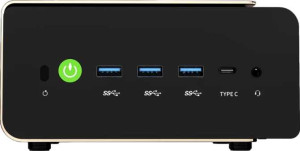
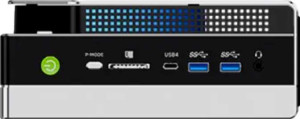
GMKtec Evo-T1
GMKtec Evo-X2

GMKtec Evo-T1 GMKtec Evo-X2

Common Features

  • Both products are equipped with an NVMe SSD.
  • Both products have integrated graphics.
  • Both products support 64-bit architecture.
  • Both products have 4 supported displays.
  • Both products support Wi-Fi.
  • Both products have Bluetooth.
  • Both products have 2 USB 2.0 ports.
  • Both products have 3 USB 3.2 Gen 2 ports (USB-A).
  • Both products have DDR memory version 5.
  • Both products have MMX, F16C, FMA3, AES, AVX, AVX2, SSE 4.1, and SSE 4.2 instruction sets.
  • Both products have the NX bit.
  • Both products are laptops.
  • Both products support DirectX 12.
  • Both products support OpenGL version 4.6.
  • Both products support OpenCL version 3.
  • Both products have 64 shading units on the GPU.
  • Both products have 32 render output units (ROPs).
  • Both products have a thermal design power (TDP) rating.
  • Both products support PCIe version 5.

Main Differences

  • SSD storage capacity is 1000GB on GMKtec Evo-T1 and 2000GB on GMKtec Evo-X2.
  • Thickness is 151 mm on GMKtec Evo-T1 and 252 mm on GMKtec Evo-X2.
  • Height is 73.6 mm on GMKtec Evo-T1 and 94 mm on GMKtec Evo-X2.
  • Width is 154 mm on GMKtec Evo-T1 and 384 mm on GMKtec Evo-X2.
  • Volume is 1711.4944 cm³ on GMKtec Evo-T1 and 9096.192 cm³ on GMKtec Evo-X2.
  • Thermal Design Power (TDP) is 45W on GMKtec Evo-T1 and 55W on GMKtec Evo-X2.
  • CPU speed is 6 x 2.9 & 8 x 2.7 GHz on GMKtec Evo-T1 and 16 x 3 GHz on GMKtec Evo-X2.
  • Turbo clock speed is 5.4GHz on GMKtec Evo-T1 and 5.1GHz on GMKtec Evo-X2.
  • CPU threads are 16 on GMKtec Evo-T1 and 32 on GMKtec Evo-X2.
  • GMKtec Evo-T1 does not use multithreading, while GMKtec Evo-X2 does.
  • L3 cache is 24 MB on GMKtec Evo-T1 and 64 MB on GMKtec Evo-X2.
  • Clock multiplier is 29 on GMKtec Evo-T1 and 30 on GMKtec Evo-X2.
  • CPU temperature is 110 °C on GMKtec Evo-T1 and 100 °C on GMKtec Evo-X2.
  • GPU clock speed is 300 MHz on GMKtec Evo-T1 and 1295 MHz on GMKtec Evo-X2.
  • GPU turbo is 2350 MHz on GMKtec Evo-T1 and 2900 MHz on GMKtec Evo-X2.
  • PCI Express (PCIe) version is 5 on GMKtec Evo-T1 and 4 on GMKtec Evo-X2.
  • Texture mapping units (TMUs) are 64 on GMKtec Evo-T1 and 160 on GMKtec Evo-X2.
  • Shading units are 1024 on GMKtec Evo-T1 and 2560 on GMKtec Evo-X2.
  • Render output units (ROPs) are 32 on GMKtec Evo-T1 and 64 on GMKtec Evo-X2.
  • DirectX version is DirectX 12 Ultimate on GMKtec Evo-T1 and DirectX 12 on GMKtec Evo-X2.
  • Semiconductor size is 3 nm on GMKtec Evo-T1 and 4 nm on GMKtec Evo-X2.
  • RAM is 64GB on GMKtec Evo-T1 and 128GB on GMKtec Evo-X2.
  • RAM speed is 5600 MHz on GMKtec Evo-T1 and 8000 MHz on GMKtec Evo-X2.
  • Wi-Fi version is Wi-Fi 6 (802.11ax), Wi-Fi 5 (802.11ac), Wi-Fi 4 (802.11n) on GMKtec Evo-T1 and Wi-Fi 6E (802.11ax), Wi-Fi 6 (802.11ax), Wi-Fi 5 (802.11ac), Wi-Fi 4 (802.11n), Wi-Fi 7 (802.11be) on GMKtec Evo-X2.
  • Bluetooth version is 5.2 on GMKtec Evo-T1 and 5.4 on GMKtec Evo-X2.
  • USB 3.2 Gen 2 ports (USB-C) are 1 on GMKtec Evo-T1 and 0 on GMKtec Evo-X2.
  • USB 4 40Gbps ports are 0 on GMKtec Evo-T1 and 2 on GMKtec Evo-X2.
  • Thunderbolt 4 ports are 0 on GMKtec Evo-T1 and 2 on GMKtec Evo-X2.
  • PassMark result is 33969 on GMKtec Evo-T1 and 54021 on GMKtec Evo-X2.
  • PassMark result (single) is 4472 on GMKtec Evo-T1 and 4142 on GMKtec Evo-X2.
  • Geekbench 6 result (multi) is 17173 on GMKtec Evo-T1 and 17698 on GMKtec Evo-X2.
  • Geekbench 6 result (single) is 2897 on GMKtec Evo-T1 and 2774 on GMKtec Evo-X2.
  • PassMark result (overclocked) is 34411 on GMKtec Evo-T1 and 57021 on GMKtec Evo-X2.
  • Maximum memory amount is 64GB on GMKtec Evo-T1 and 128GB on GMKtec Evo-X2.
  • GPU name is Arc 140T on GMKtec Evo-T1 and Radeon 8060S on GMKtec Evo-X2.
  • GMKtec Evo-T1 does not support ECC memory, while GMKtec Evo-X2 does.
  • Memory channels are 0 on GMKtec Evo-T1 and 4 on GMKtec Evo-X2.
  • RAM speed (max) is 8400 MHz on GMKtec Evo-T1 and 8000 MHz on GMKtec Evo-X2.
  • GMKtec Evo-T1 uses big.LITTLE technology, while GMKtec Evo-X2 does not.
Specs Comparison
GMKtec Evo-T1

GMKtec Evo-T1

GMKtec Evo-X2

GMKtec Evo-X2

General info:
SSD storage capacity 1000GB 2000GB
release date July 2025 May 2025
Is an NVMe SSD
thickness 151 mm 252 mm
height 73.6 mm 94 mm
width 154 mm 384 mm
volume 1711.4944 cm³ 9096.192 cm³

The GMKtec Evo-T1 and GMKtec Evo-X2 differ in several key aspects of their general specifications. Starting with storage, the Evo-T1 comes with a 1000GB NVMe SSD, while the Evo-X2 offers a larger 2000GB NVMe SSD. Both products feature an NVMe SSD, ensuring fast data transfer speeds, but the Evo-X2 provides double the storage capacity of the Evo-T1.

In terms of physical dimensions, the Evo-T1 is more compact, with a thickness of 151 mm, a height of 73.6 mm, and a width of 154 mm, giving it a total volume of 1711.5 cm³. In contrast, the Evo-X2 is significantly larger, measuring 252 mm in thickness, 94 mm in height, and 384 mm in width, resulting in a volume of 9096.2 cm³. This makes the Evo-X2 much bulkier in comparison to the Evo-T1.

Overall, while both products share the same SSD type and have different storage capacities, the Evo-X2 is larger in both size and storage, while the Evo-T1 offers a more compact design with less storage.

CPU:
Thermal Design Power (TDP) 45W 55W
CPU speed 6 x 2.9 & 8 x 2.7 GHz 16 x 3 GHz
turbo clock speed 5.4GHz 5.1GHz
CPU threads 16 threads 32 threads
Has integrated graphics
uses multithreading
L3 cache 24 MB 64 MB
clock multiplier 29 30
Has an unlocked multiplier
Supports 64-bit
CPU temperature 110 °C 100 °C

The GMKtec Evo-T1 and GMKtec Evo-X2 feature different CPU specifications. The Evo-T1 has a Thermal Design Power (TDP) of 45W, while the Evo-X2 has a slightly higher TDP of 55W. Both products feature integrated graphics, but the Evo-T1 does not support multithreading, while the Evo-X2 does, which may impact performance in multi-core workloads.

Regarding CPU speed, the Evo-T1 has a combination of 6 cores running at 2.9 GHz and 8 cores at 2.7 GHz, with a turbo clock speed of 5.4 GHz. The Evo-X2, on the other hand, features 16 cores running at 3 GHz and a turbo clock speed of 5.1 GHz. While the Evo-T1 has a faster turbo clock speed, the Evo-X2 has more cores, which can be advantageous for parallel tasks.

Both models have 64-bit support, but the Evo-T1 has a 24 MB L3 cache, while the Evo-X2 comes with a larger 64 MB L3 cache. The Evo-T1’s CPU temperature is slightly higher at 110 °C, compared to the Evo-X2's 100 °C. Both products have a clock multiplier, with the Evo-T1 at 29 and the Evo-X2 at 30, but neither has an unlocked multiplier.

Graphics card:
GPU clock speed 300 MHz 1295 MHz
GPU turbo 2350 MHz 2900 MHz
PCI Express (PCIe) version 5 4
texture mapping units (TMUs) 64 160
shading units 1024 2560
render output units (ROPs) 32 64
DirectX version DirectX 12 Ultimate DirectX 12
OpenGL version 4.6 4.6
OpenCL version 3 3
semiconductor size 3 nm 4 nm
supported displays 4 4

The GMKtec Evo-T1 and GMKtec Evo-X2 differ in several key aspects of their graphics cards. The Evo-T1 has a GPU clock speed of 300 MHz and a turbo speed of 2350 MHz, whereas the Evo-X2 offers a significantly higher base clock speed of 1295 MHz and a turbo clock speed of 2900 MHz. This shows that the Evo-X2 provides faster GPU performance overall.

When it comes to texture mapping units (TMUs), the Evo-T1 has 64, while the Evo-X2 has 160, offering much greater capacity for handling textures. Similarly, the Evo-T1 has 1024 shading units, compared to the Evo-X2's 2560, which again reflects a higher potential for graphical computation in the Evo-X2. The Evo-X2 also has 64 render output units (ROPs), double the Evo-T1's 32 ROPs, indicating a more efficient rendering capability.

Both products support the same number of displays (4) and share the same versions of OpenGL (4.6) and OpenCL (3). However, the Evo-T1 supports DirectX 12 Ultimate, while the Evo-X2 supports the slightly earlier DirectX 12. Additionally, the Evo-T1 uses a more advanced 3 nm semiconductor size, while the Evo-X2 uses a 4 nm semiconductor size, indicating a slightly smaller manufacturing process in the Evo-T1.

Memory:
RAM 64GB 128GB
RAM speed 5600 MHz 8000 MHz
DDR memory version 5 5

The GMKtec Evo-T1 and GMKtec Evo-X2 both feature DDR5 memory, but they differ in capacity and speed. The Evo-T1 is equipped with 64GB of RAM running at 5600 MHz, while the Evo-X2 has a larger 128GB of RAM, operating at a faster 8000 MHz. This means the Evo-X2 has double the RAM capacity and a higher memory speed compared to the Evo-T1.

Both products utilize DDR5 memory, ensuring high-performance memory support, but the Evo-X2’s larger and faster RAM could provide a notable performance advantage in memory-intensive tasks.

In summary, while both models feature DDR5 memory, the Evo-X2 offers a significant boost in both RAM size and speed over the Evo-T1.

Connectivity:
Wi-Fi version Wi-Fi 6 (802.11ax), Wi-Fi 5 (802.11ac), Wi-Fi 4 (802.11n) Wi-Fi 6E (802.11ax), Wi-Fi 6 (802.11ax), Wi-Fi 5 (802.11ac), Wi-Fi 4 (802.11n), Wi-Fi 7 (802.11be)
supports Wi-Fi
Has Bluetooth
Bluetooth version 5.2 5.4
USB 2.0 ports 2 2
USB 3.2 Gen 2 ports (USB-A) 3 3
USB 3.2 Gen 1 ports (USB-A) 0 0
USB 3.2 Gen 2 ports (USB-C) 1 0
USB 4 40Gbps ports 0 2
USB 4 20Gbps ports 0 0
USB 3.2 Gen 2x2 ports 0 0
USB 3.2 Gen 1 ports (USB-C) 0 0
Thunderbolt 4 ports 0 2
Thunderbolt 3 ports 0 0
DisplayPort outputs 1 1
HDMI version HDMI 2.1 HDMI 2.1
HDMI ports 1 1
RJ45 ports 1 1
has a socket for a 3.5 mm audio jack
has a VGA connector
Has S/PDIF Out port

The GMKtec Evo-T1 and GMKtec Evo-X2 both support Wi-Fi and Bluetooth, but they differ in several aspects of their connectivity options. The Evo-T1 supports Wi-Fi 6 (802.11ax), Wi-Fi 5 (802.11ac), and Wi-Fi 4 (802.11n), while the Evo-X2 offers the more advanced Wi-Fi 6E (802.11ax) and Wi-Fi 7 (802.11be) in addition to Wi-Fi 6 and Wi-Fi 5. Both devices support Bluetooth, but the Evo-T1 has Bluetooth 5.2, whereas the Evo-X2 has the newer Bluetooth 5.4.

In terms of USB ports, both products feature 2 USB 2.0 ports and 3 USB 3.2 Gen 2 ports (USB-A), but the Evo-X2 also includes 2 USB 4 40Gbps ports, while the Evo-T1 does not. Additionally, the Evo-X2 has 2 Thunderbolt 4 ports, which are not available on the Evo-T1. The Evo-T1 has 1 USB 3.2 Gen 2 port (USB-C) and 1 DisplayPort output, while the Evo-X2 has no USB 3.2 Gen 2 ports (USB-C) but does have the same DisplayPort output.

Both products support HDMI 2.1 with 1 HDMI port and feature an RJ45 port for wired network connectivity. They both also include a 3.5 mm audio jack, but neither has a VGA connector or S/PDIF Out port.

Benchmarks:
PassMark result 33969 54021
PassMark result (single) 4472 4142
Geekbench 6 result (multi) 17173 17698
Geekbench 6 result (single) 2897 2774
PassMark result (overclocked) 34411 57021

The GMKtec Evo-T1 and GMKtec Evo-X2 show significant differences in benchmark results. The Evo-T1 achieves a PassMark result of 33,969, with a single-threaded score of 4,472. In comparison, the Evo-X2 scores higher with a PassMark result of 54,021 and a single-threaded score of 4,142. While the Evo-X2 outperforms the Evo-T1 in the multi-threaded PassMark test, the Evo-T1's single-threaded score is higher.

In Geekbench 6, the Evo-T1 achieves a multi-core score of 17,173 and a single-core score of 2,897. The Evo-X2, however, scores 17,698 in multi-core and 2,774 in single-core, showing a slight advantage in both categories, with the Evo-X2’s multi-core score being marginally higher while the Evo-T1 has a slightly better single-core performance.

Both models have overclocked PassMark scores, with the Evo-T1 reaching 34,411 and the Evo-X2 hitting 57,021, reflecting a noticeable gap in their overclocked performance. Overall, while both products perform well in benchmarks, the Evo-X2 demonstrates stronger results in multi-core performance and overclocked performance, while the Evo-T1 has a higher single-core score.

Miscellaneous:
maximum memory amount 64GB 128GB
GPU name Arc 140T Radeon 8060S
Type Laptop Laptop, Desktop
instruction sets MMX, F16C, FMA3, AES, AVX, AVX2, SSE 4.1, SSE 4.2 MMX, F16C, FMA3, AES, AVX, AVX2, SSE 4.1, SSE 4.2
Has NX bit
Supports ECC memory
memory channels 0 4
RAM speed (max) 8400 MHz 8000 MHz
Uses big.LITTLE technology

The GMKtec Evo-T1 and GMKtec Evo-X2 differ in several miscellaneous specifications. The Evo-T1 supports a maximum of 64GB of memory, while the Evo-X2 can support up to 128GB. The Evo-T1 uses the Arc 140T GPU, whereas the Evo-X2 features the Radeon 8060S GPU. The Evo-T1 is specifically designed as a laptop, while the Evo-X2 is designed for both laptops and desktops.

Both products support the same instruction sets, including MMX, F16C, FMA3, AES, AVX, AVX2, SSE 4.1, and SSE 4.2. The Evo-T1 also has the NX bit enabled, which is also supported by the Evo-X2. The Evo-T1 does not support ECC memory, while the Evo-X2 does. Additionally, the Evo-T1 has 0 memory channels, while the Evo-X2 has 4 memory channels, which may impact memory bandwidth and performance.

In terms of RAM speed, the Evo-T1 supports a maximum RAM speed of 8400 MHz, which is slightly faster than the Evo-X2’s maximum supported RAM speed of 8000 MHz. The Evo-T1 also uses big.LITTLE technology, whereas the Evo-X2 does not.

Comparison Summary

This is a specification comparison between GMKtec Evo-T1 and GMKtec Evo-X2. Both models feature integrated graphics and support for Wi-Fi and Bluetooth, as well as offering DDR memory version 5. The GMKtec Evo-T1 has a smaller SSD storage capacity of 1000GB compared to the 2000GB of the GMKtec Evo-X2, and it is also more compact, with smaller dimensions in terms of thickness, height, and width. Additionally, the GMKtec Evo-X2 is equipped with more advanced CPU performance, offering a higher number of threads and a faster clock speed. Differences in GPU specifications are also notable, with the Evo-X2 featuring a more powerful GPU with faster clock speeds and a larger number of shading units.