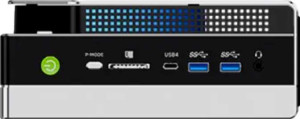
GMKtec Evo-X2
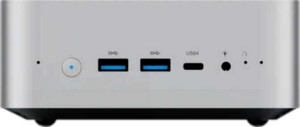
Minisforum M1 Pro

GMKtec Evo-X2 Minisforum M1 Pro

Overview

Welcome to our in-depth specification comparison between the GMKtec Evo-X2 and the Minisforum M1 Pro. These two compact computing devices take notably different approaches to performance and design, making the choice between them anything but straightforward. In this comparison, we examine the key battlegrounds: CPU and GPU horsepower, memory capacity, multi-core vs. single-core efficiency, connectivity options, and physical form factor — giving you everything you need to make a confident, informed decision.

Common Features

  • Both products have 2000GB of SSD storage capacity.
  • Both products use an NVMe SSD.
  • Both products feature integrated graphics.
  • Neither product has an unlocked CPU multiplier.
  • Both products support 64-bit processing.
  • Both products support OpenGL version 4.6.
  • Both products support OpenCL version 3.
  • Both products can drive up to 4 displays simultaneously.
  • Both products use DDR5 memory.
  • Both products include Wi-Fi connectivity.
  • Both products include Bluetooth, version 5.4.
  • Neither product has USB 3.2 Gen 1 Type-A ports.
  • Neither product has USB 3.2 Gen 2 Type-C ports.
  • Both products have 2 USB 4 40Gbps ports.
  • Neither product has USB 4 20Gbps ports.
  • Neither product has USB 3.2 Gen 2x2 ports.
  • Both products support a maximum memory amount of 128GB.
  • Both products share the same instruction sets: MMX, F16C, FMA3, AES, AVX, AVX2, SSE 4.1, and SSE 4.2.
  • Both products have an NX bit.
  • Both products use flash storage.

Main Differences

  • Thickness is 252 mm on GMKtec Evo-X2 and 128 mm on Minisforum M1 Pro.
  • Height is 94 mm on GMKtec Evo-X2 and 52.5 mm on Minisforum M1 Pro.
  • Width is 384 mm on GMKtec Evo-X2 and 126 mm on Minisforum M1 Pro.
  • Volume is 9096.192 cm³ on GMKtec Evo-X2 and 846.72 cm³ on Minisforum M1 Pro.
  • CPU TDP is 55W on GMKtec Evo-X2 and 45W on Minisforum M1 Pro.
  • CPU configuration is 16 cores at 3 GHz on GMKtec Evo-X2 and 6 cores at 2.9 GHz plus 8 cores at 2.7 GHz on Minisforum M1 Pro.
  • Turbo clock speed is 5.1 GHz on GMKtec Evo-X2 and 5.4 GHz on Minisforum M1 Pro.
  • CPU thread count is 32 on GMKtec Evo-X2 and 16 on Minisforum M1 Pro.
  • Multithreading is supported on GMKtec Evo-X2 but not on Minisforum M1 Pro.
  • L3 cache is 64 MB on GMKtec Evo-X2 and 24 MB on Minisforum M1 Pro.
  • Maximum CPU temperature is 100°C on GMKtec Evo-X2 and 110°C on Minisforum M1 Pro.
  • GPU base clock speed is 1295 MHz on GMKtec Evo-X2 and 300 MHz on Minisforum M1 Pro.
  • GPU turbo clock is 2900 MHz on GMKtec Evo-X2 and 2350 MHz on Minisforum M1 Pro.
  • PCIe version is 4 on GMKtec Evo-X2 and 5 on Minisforum M1 Pro.
  • Texture mapping units (TMUs) number 160 on GMKtec Evo-X2 and 64 on Minisforum M1 Pro.
  • Shading units number 2560 on GMKtec Evo-X2 and 1024 on Minisforum M1 Pro.
  • Render output units (ROPs) number 64 on GMKtec Evo-X2 and 32 on Minisforum M1 Pro.
  • DirectX version is DirectX 12 on GMKtec Evo-X2 and DirectX 12 Ultimate on Minisforum M1 Pro.
  • GPU semiconductor size is 4 nm on GMKtec Evo-X2 and 3 nm on Minisforum M1 Pro.
  • RAM capacity is 128GB on GMKtec Evo-X2 and 64GB on Minisforum M1 Pro.
  • RAM speed is 8000 MHz on GMKtec Evo-X2 and 6400 MHz on Minisforum M1 Pro.
  • Maximum supported RAM speed is 8000 MHz on GMKtec Evo-X2 and 8400 MHz on Minisforum M1 Pro.
  • Memory channels number 4 on GMKtec Evo-X2 and 2 on Minisforum M1 Pro.
  • USB 2.0 port count is 2 on GMKtec Evo-X2 and 1 on Minisforum M1 Pro.
  • USB 3.2 Gen 2 Type-A port count is 3 on GMKtec Evo-X2 and 2 on Minisforum M1 Pro.
  • HDMI version is 2.1 on GMKtec Evo-X2 and 1.1 on Minisforum M1 Pro.
  • PassMark multi-core result is 54021 on GMKtec Evo-X2 and 33969 on Minisforum M1 Pro.
  • PassMark single-core result is 4142 on GMKtec Evo-X2 and 4472 on Minisforum M1 Pro.
  • Geekbench 6 multi-core result is 17698 on GMKtec Evo-X2 and 17173 on Minisforum M1 Pro.
  • Geekbench 6 single-core result is 2774 on GMKtec Evo-X2 and 2897 on Minisforum M1 Pro.
  • Overclocked PassMark result is 57021 on GMKtec Evo-X2 and 34411 on Minisforum M1 Pro.
  • The GPU is the Radeon 8060S on GMKtec Evo-X2 and the Arc 140T on Minisforum M1 Pro.
  • ECC memory support is present on GMKtec Evo-X2 but not available on Minisforum M1 Pro.
  • big.LITTLE technology is used on Minisforum M1 Pro but not on GMKtec Evo-X2.
  • GMKtec Evo-X2 is classified as both a laptop and desktop form factor, while Minisforum M1 Pro is classified as a laptop only.
  • Warranty period is 1 year on GMKtec Evo-X2 and 2 years on Minisforum M1 Pro.
Specs Comparison
GMKtec Evo-X2

GMKtec Evo-X2

Minisforum M1 Pro

Minisforum M1 Pro

General info:
SSD storage capacity 2000GB 2000GB
release date May 2025 August 2025
Is an NVMe SSD
thickness 252 mm 128 mm
height 94 mm 52.5 mm
width 384 mm 126 mm
volume 9096.192 cm³ 846.72 cm³

Both the GMKtec Evo-X2 and the Minisforum M1 Pro ship with 2000GB NVMe SSD storage, so neither holds an advantage in capacity or storage technology — users of both systems get fast, ample local storage out of the box.

Where these two machines diverge dramatically is in their physical footprint. The M1 Pro is a genuinely compact mini PC, measuring 126 × 52.5 × 128 mm and occupying just 846.72 cm³ of space. The Evo-X2, by contrast, spans 384 × 94 × 252 mm and consumes roughly 9096 cm³ — making it more than ten times larger by volume. In practical terms, the M1 Pro can tuck behind a monitor, sit in a drawer, or fit in a bag with ease, while the Evo-X2 is a full-sized desktop tower that demands dedicated desk real estate.

For general form-factor considerations, the Minisforum M1 Pro has a decisive edge: it delivers the same storage capacity in a chassis that is an order of magnitude smaller. If space efficiency and portability are priorities, the M1 Pro wins outright in this category. The Evo-X2's larger chassis, however, may hint at greater internal expandability or cooling headroom — factors worth examining in other spec groups.

CPU:
Thermal Design Power (TDP) 55W 45W
CPU speed 16 x 3 GHz 6 x 2.9 & 8 x 2.7 GHz
turbo clock speed 5.1GHz 5.4GHz
CPU threads 32 threads 16 threads
Has integrated graphics
uses multithreading
L3 cache 64 MB 24 MB
clock multiplier 30 29
Has an unlocked multiplier
Supports 64-bit
CPU temperature 100 °C 110 °C

The core architecture gap here is significant. The GMKtec Evo-X2 fields a 16-core, 32-thread CPU with simultaneous multithreading enabled, paired with a generous 64 MB L3 cache. The Minisforum M1 Pro counters with a hybrid 14-core design (6 performance + 8 efficiency cores) producing only 16 threads and no multithreading support, backed by a much smaller 24 MB L3 cache. In practice, this means the Evo-X2 can handle heavily parallelized workloads — video encoding, 3D rendering, large compilation jobs — far more comfortably, while the M1 Pro's thread count limits its ceiling in those scenarios.

The M1 Pro does claw back some ground in two areas: a marginally higher turbo clock of 5.4 GHz versus 5.1 GHz on the Evo-X2, and a lower TDP of 45W compared to 55W. The turbo advantage is slim and unlikely to be felt in everyday tasks, but the power efficiency gap is more meaningful — the M1 Pro should run cooler and quieter under light-to-moderate loads, which aligns with its compact chassis. Notably, the M1 Pro is rated to a higher junction temperature of 110 °C versus the Evo-X2's 100 °C, suggesting its thermal management is tuned for a tighter thermal envelope.

For CPU performance, the GMKtec Evo-X2 holds a clear and substantial advantage: double the threads, a much larger cache, and higher sustained throughput make it the stronger processor for demanding or multi-tasked workloads. The M1 Pro's efficiency and slightly higher peak clock speed are real, but they do not offset the raw processing headroom the Evo-X2 brings to the table.

Graphics card:
GPU clock speed 1295 MHz 300 MHz
GPU turbo 2900 MHz 2350 MHz
PCI Express (PCIe) version 4 5
texture mapping units (TMUs) 160 64
shading units 2560 1024
render output units (ROPs) 64 32
DirectX version DirectX 12 DirectX 12 Ultimate
OpenGL version 4.6 4.6
OpenCL version 3 3
semiconductor size 4 nm 3 nm
supported displays 4 4

Raw graphics horsepower decisively favors the GMKtec Evo-X2. It carries 2560 shading units against the Minisforum M1 Pro's 1024 — a 2.5× advantage — while also doubling the M1 Pro's render output units (64 vs. 32 ROPs) and matching that ratio in texture mapping units (160 vs. 64 TMUs). Combine this with a significantly higher GPU turbo of 2900 MHz versus 2350 MHz, and the Evo-X2's integrated GPU is in a different league for graphics-intensive tasks: light gaming, GPU-accelerated creative applications, and multi-display rendering will all run noticeably smoother.

The M1 Pro counters with a couple of forward-looking advantages. Its PCIe 5 interface (versus PCIe 4 on the Evo-X2) offers greater theoretical bandwidth headroom for future peripherals, and its 3 nm fabrication node is a generation ahead of the Evo-X2's 4 nm — meaning the M1 Pro's GPU achieves its output more efficiently per transistor. It also supports DirectX 12 Ultimate, unlocking hardware ray tracing and mesh shader features that standard DirectX 12 does not guarantee. In practice, though, with far fewer shading units and lower peak clocks, the M1 Pro cannot take full advantage of those API features in any demanding scenario.

On graphics, the GMKtec Evo-X2 is the clear winner. The M1 Pro's process node and PCIe 5 support are meaningful on paper, but they cannot compensate for having less than half the GPU compute resources. Users who care about graphics performance — even at the integrated-GPU level — will find the Evo-X2 substantially more capable.

Memory:
RAM 128GB 64GB
RAM speed 8000 MHz 6400 MHz
DDR memory version 5 5

Both systems run DDR5 memory, which is the meaningful baseline they share — DDR5 brings higher bandwidth and improved power efficiency over the previous generation, benefiting both machines equally. The differences lie in capacity and speed. The GMKtec Evo-X2 ships with a substantial 128 GB of RAM running at 8000 MHz, while the Minisforum M1 Pro offers 64 GB at 6400 MHz — half the capacity and a notably lower clock rate.

In real-world terms, the capacity gap matters most for power users: virtual machine stacks, large in-memory datasets, professional video editing timelines, and heavy multi-application workloads all benefit directly from more RAM. At 64 GB, the M1 Pro is still generous for the vast majority of use cases, but it will hit a ceiling that the Evo-X2 simply does not face. The speed difference — 8000 MHz vs. 6400 MHz — is a secondary factor, but faster memory meaningfully feeds the integrated GPU and CPU with data more quickly, which compounds the Evo-X2's graphics and processing advantages noted in other categories.

The GMKtec Evo-X2 wins this category on both fronts. Double the RAM capacity and a 25% faster memory clock make it the stronger choice for memory-intensive workloads, with no offsetting advantage on the M1 Pro's side within this spec group.

Connectivity:
Wi-Fi version Wi-Fi 6E (802.11ax), Wi-Fi 6 (802.11ax), Wi-Fi 5 (802.11ac), Wi-Fi 4 (802.11n), Wi-Fi 7 (802.11be) Wi-Fi 6E (802.11ax), Wi-Fi 7 (802.11be), Wi-Fi 4 (802.11n), Wi-Fi 5 (802.11ac), Wi-Fi 6 (802.11ax)
supports Wi-Fi
Has Bluetooth
Bluetooth version 5.4 5.4
USB 2.0 ports 2 1
USB 3.2 Gen 2 ports (USB-A) 3 2
USB 3.2 Gen 1 ports (USB-A) 0 0
USB 3.2 Gen 2 ports (USB-C) 0 0
USB 4 40Gbps ports 2 2
USB 4 20Gbps ports 0 0
USB 3.2 Gen 2x2 ports 0 0
USB 3.2 Gen 1 ports (USB-C) 0 0
Thunderbolt 4 ports 2 2
Thunderbolt 3 ports 0 0
DisplayPort outputs 1 1
HDMI version HDMI 2.1 HDMI 1.1
HDMI ports 1 1
RJ45 ports 1 1
has a socket for a 3.5 mm audio jack
has a VGA connector
Has S/PDIF Out port

Wireless connectivity is a genuine tie: both machines support Wi-Fi 7 and Bluetooth 5.4, putting them on equal footing for cutting-edge wireless peripherals, low-latency audio, and future-ready networking. The wired high-speed story is similarly matched — each offers two Thunderbolt 4 ports, two USB4 40Gbps ports, a DisplayPort output, and a single RJ45 ethernet jack. For docking, external GPU enclosures, or fast storage, users of either system are equally well served.

The meaningful divergence emerges in two areas. First, port count: the GMKtec Evo-X2 provides three USB 3.2 Gen 2 Type-A ports versus the Minisforum M1 Pro's two, plus an extra USB 2.0 port, giving it more simultaneous peripheral capacity — a practical advantage on a desktop that tends to accumulate keyboards, mice, hubs, and drives. Second, and more significantly, the Evo-X2 ships with HDMI 2.1 while the M1 Pro is limited to HDMI 1.1. HDMI 2.1 supports up to 4K at 120Hz or 8K output, whereas HDMI 1.1 is a legacy standard capped at much lower resolutions and refresh rates — a stark gap for anyone connecting a modern display via HDMI.

The GMKtec Evo-X2 takes this category. The shared high-speed port parity is real, but the Evo-X2's additional USB-A ports and especially its HDMI 2.1 output make it notably more versatile for modern display setups and day-to-day peripheral management.

Benchmarks:
PassMark result 54021 33969
PassMark result (single) 4142 4472
Geekbench 6 result (multi) 17698 17173
Geekbench 6 result (single) 2774 2897
PassMark result (overclocked) 57021 34411

The benchmark results tell a nuanced story that cuts across two different performance dimensions. In multi-core throughput, the GMKtec Evo-X2 pulls ahead decisively: its PassMark multi-core score of 54021 is roughly 59% higher than the M1 Pro's 33969, and this gap is consistent with the thread-count advantage established in the CPU specs. For workloads that scale across cores — rendering, transcoding, data processing — the Evo-X2 is measurably faster in practice, not just on paper.

Single-core performance, however, flips the script. The Minisforum M1 Pro scores 4472 on PassMark single-core and 2897 on Geekbench 6 single-core, edging out the Evo-X2's 4142 and 2774 respectively. These margins are modest — roughly 8% in PassMark and 4% in Geekbench — but they are consistent across both test suites. Since many everyday applications, games, and latency-sensitive tasks rely heavily on single-thread speed, the M1 Pro's responsiveness in those scenarios is a legitimate counterpoint. The multi-core Geekbench 6 scores, at 17698 versus 17173, are essentially tied, suggesting the gap narrows when the workload is moderately rather than maximally parallelized.

A notable footnote: the Evo-X2's overclocked PassMark score climbs to 57021, while the M1 Pro's barely moves to 34411 — indicating the Evo-X2 has meaningful headroom under tuning while the M1 Pro does not. Overall, the GMKtec Evo-X2 wins on aggregate throughput and scalability, but users whose workflows are primarily single-threaded will find the Minisforum M1 Pro holds its own competitively.

Miscellaneous:
maximum memory amount 128GB 128GB
Type Laptop, Desktop Laptop
Uses big.LITTLE technology
instruction sets MMX, F16C, FMA3, AES, AVX, AVX2, SSE 4.1, SSE 4.2 MMX, F16C, FMA3, AES, AVX, AVX2, SSE 4.1, SSE 4.2
Has NX bit
GPU name Radeon 8060S Arc 140T
Supports ECC memory
memory channels 4 2
RAM speed (max) 8000 MHz 8400 MHz
warranty period 1 years 2 years
Uses flash storage

A few under-the-hood differences here carry real weight. The GMKtec Evo-X2 uses a 4-channel memory architecture versus the Minisforum M1 Pro's 2-channel setup — doubling the memory bandwidth available to the CPU and GPU. This directly amplifies the performance advantages already seen in benchmarks and graphics specs, as more data can flow simultaneously to the processor. Critically, the Evo-X2 also supports ECC memory, which automatically detects and corrects single-bit memory errors. For professional, scientific, or business-critical workloads where data integrity matters, this is a significant differentiator that the M1 Pro simply cannot offer.

The M1 Pro counters with two notable advantages. It employs big.LITTLE technology, pairing performance and efficiency cores to dynamically allocate workloads — a design that helps it balance responsiveness with power draw, which suits its compact, efficiency-oriented profile. Its warranty period is also 2 years versus the Evo-X2's 1 year, offering buyers twice the covered support window and a lower long-term ownership risk. The M1 Pro's maximum supported RAM speed of 8400 MHz also edges out the Evo-X2's 8000 MHz ceiling, though this is a marginal difference in practice.

This category splits depending on the buyer's priorities. For reliability-focused or professional deployments, the GMKtec Evo-X2 wins on ECC support and memory bandwidth. For everyday users who value long-term peace of mind and efficient core scheduling, the Minisforum M1 Pro's 2-year warranty and big.LITTLE architecture make it the more attractive proposition.

Comparison Summary & Verdict

After examining the full specification breakdown, two distinct profiles emerge. The GMKtec Evo-X2 is the clear choice for users who demand raw, sustained multi-core muscle: with 128GB of RAM, 32 CPU threads, a 64MB L3 cache, four memory channels, and a significantly stronger GPU featuring 2560 shading units and a 2900 MHz turbo clock, it dominates workstation-class and heavily parallel workloads. It also supports ECC memory, making it attractive for reliability-sensitive use cases. The Minisforum M1 Pro, on the other hand, wins on compactness and refinement — its dramatically smaller footprint, higher single-core benchmark scores, DirectX 12 Ultimate support, a newer 3nm GPU process, PCIe 5 connectivity, and a two-year warranty make it a polished everyday machine. Choose the Evo-X2 for power; choose the M1 Pro for efficiency and longevity.

GMKtec Evo-X2
Buy GMKtec Evo-X2 if...

Buy the GMKtec Evo-X2 if you need maximum multi-core performance, larger RAM capacity of 128GB, ECC memory support, and a more powerful GPU for demanding parallel workloads.

Minisforum M1 Pro
Buy Minisforum M1 Pro if...

Buy the Minisforum M1 Pro if you prioritize a much more compact form factor, stronger single-core performance, a longer two-year warranty, and a more refined GPU with DirectX 12 Ultimate support.